
Lee Chang-dong’s Possible Love is a masterful dissection of class privilege, socioeconomic disparity, and our ability to understand the fragility of others.
Director: Lee Chang-dong
Original Title: Ganeunghan sarang (가능한 사랑)
Genre: Drama, Romance
Run Time: 164′
Rated: R
Venice World Premiere: September 6, 2026
Theatrical Release: October 23, 2026 (limited)
Digital Release: November 6, 2026 globally on Netflix
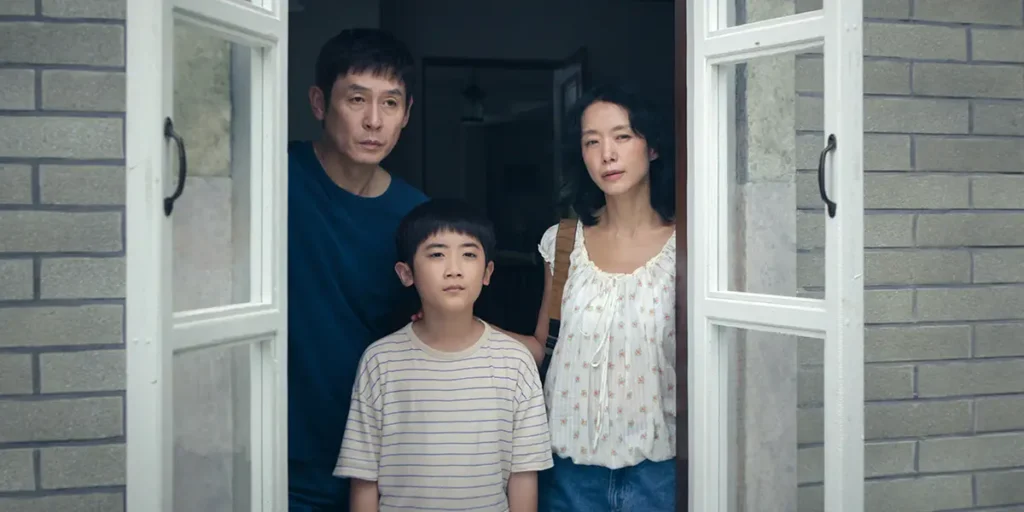
Possible Love follows two couples from very different social backgrounds. Ho-seok (Sul Kyung-gu, of Good News) and Mi-ok (Jeon Do-yeon) are struggling with the consequences of his dismissal from a local factory, while documentary filmmaker Ye-ji (Cho Yeo-jeong) and her husband Sang-woo (Zo In-sung, of Hope) live a considerably more affluent life. When Ye-ji begins working on a documentary about the workers affected by the factory’s mass layoffs and the violent repression of their strike, she becomes interested in the Choi family. Her encounters with Mi-ok and Ho-seok gradually bring the two couples into closer contact, exposing the tensions, desires and inequalities between their otherwise distant worlds.
Over the past few years, as Lee Chang-dong was working towards Possible Love, he kept asking himself several questions: who has the right to represent other people’s suffering without turning it into something to be consumed? And how can a director honor the trust placed in him by his subjects? He had long been interested in portraying the realities of working-class life, loosely inspired by a real-life strike that was violently repressed by the police, but the question of how to approach it proved just as important as the story itself.
It is telling, then, that Lee places another filmmaker inside the film. Ye-ji is a documentarian who wants to understand the lives of those she films while constantly risking exploiting the very people whose struggles she seeks to expose. In her, Lee seems to turn the camera back on himself, transforming his own ethical doubts into a character. Still, Ye-ji shouldn’t be read simply as Lee’s alter ego, but as someone who shares his doubts about representing other people’s pain without reducing them to their suffering.
Yet this concern is not immediately placed at the center of Possible Love. Instead, Lee stays with the Choi family, allowing the consequences of Ho-seok’s unemployment to emerge through their everyday lives. From the very first scene, as the family prepares to attend the funeral of one of Ho-seok’s former colleagues, the fracture within them is already visible. Mi-ok becomes upset because she can no longer afford to dress elegantly, to which her husband responds by placing a hand on her shoulder and telling her she can cry if she needs to, as if she were simply expected to accept her new reality. Their son Cheol watches silently, absorbing emotions he is too young to fully understand. At the funeral, a small argument breaks out between the couple under Ye-ji’s gaze and the increasingly intrusive lens of her camera.
What begins as a story about the workers’ collective experience therefore becomes increasingly personal. Ye-ji wants to document the mass layoffs that devastated the local community and the violent police intervention that followed the workers’ occupation of the factory. Ho-seok took part in the strike and, after it ended, was forced to spend months bedridden because of his injuries. But after her encounter with Mi-ok, Ye-ji’s focus gradually shifts. The broader story of the workers’ struggle gives way to Ho-seok himself, and to the private distress caused by the loss of his job.
For much of Possible Love, Lee Chang-dong constructs a masterful portrayal of how capitalism reshapes workers’ entire lives, with the effects extending far beyond the workplace itself. The loss of a job becomes a loss of identity and dignity, gradually affecting family relationships and the way people perceive themselves and their place in society. Lee shows how a system built around productivity and profit can leave lasting wounds on those no longer considered useful to it, or, as they call themselves, ‘the dead’. In this sense, the scenes in which Lee’s camera, embodied by Ye-ji’s own camera, lingers on workers’ faces as they recount their past are deeply significant. By simply allowing them to speak and lingering on their faces without rushing away, the film gives visibility to those whom society has effectively rendered invisible.
This political commentary also extends to the two social classes portrayed in the film: the working-class Choi family, and the more privileged, affluent world represented by Ye-ji and her husband Sang-woo. Though Sang-woo has relatively little screen time in the first part of the film, his every appearance further emphasizes the class divide between the two couples. Ye-ji’s position is more complex, as she genuinely wants to help the workers and do justice to their experiences, yet she cannot entirely conceal her privileged background, especially when she wears expensive branded clothes in front of Mi-ok. Sang-woo, on the other hand, makes no attempt to hide his position. He works for a multinational company and seems to observe the Choi family from a position of superiority, as if their lives belonged to a world that’s entirely removed from his own.
Once all the relationships are established and the full extent of Ho-seok’s situation becomes clear, Lee takes another step. Just as Ye-ji does with her documentary, he gradually moves away from a broader commentary on class disparity and the damage caused by capitalism, narrowing his focus to the four characters and the tensions between them. The final hour of Possible Love takes place in Sang-woo’s beach house, where Lee isolates them from the outside world and lets the relationships at the center of the film unfold without distraction. This place becomes a microcosm in which the two couples are forced to confront one another and themselves: the strange tension between Mi-ok and Sang-woo, Ye-ji’s final crossing of the boundary between observation and exploitation, and Ho-seok’s eventual confrontation with the desperate reality of his condition.
Lee’s ever-changing narrative scope reaches its apex in this final section. Possible Love first explores the universal despair caused by unemployment through a documentary lens, then expands into a study of class conflict, before finally becoming a deeply human and empathetic portrait of its four central characters. At each stage, Lee does not abandon what came before, but uses it to deepen what follows. This is where the film’s intricate writing becomes particularly impressive: rather than explaining its characters outright, Lee gradually reveals them through seemingly minor details, gestures and fragments of their past, which acquire new meanings as the story progresses, constantly reshaping our understanding of the characters and their relationships.
Possible Love is, in that sense, a deeply rewarding film, one in which Lee never wastes a shot or a moment. With a runtime approaching three hours, it is a dense narrative, filled with symbolism and universal themes of labour and class disparity, yet it is never exhausting and becomes increasingly engaging as it unfolds.
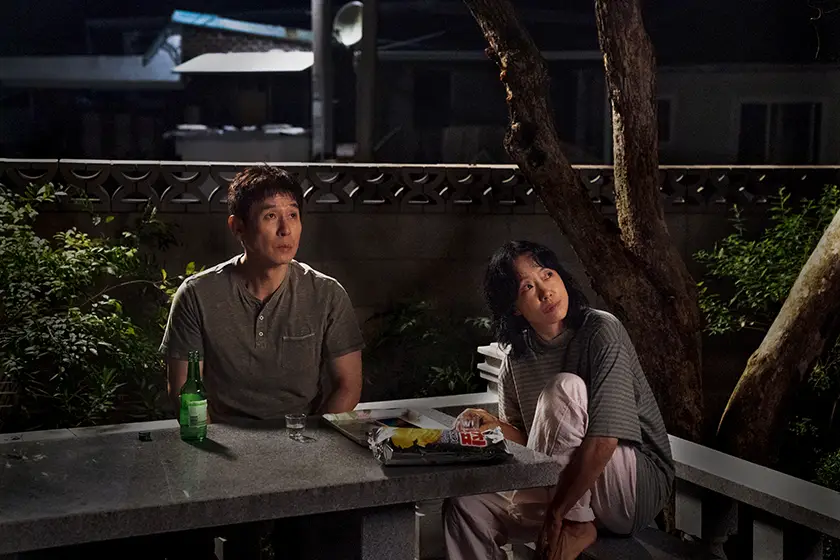
A great deal of the film’s power also comes from the brilliant cast Lee has assembled. Jeon Do-yeon is simply outstanding as she carries the burden of a miserable life while yearning for something better. Her character is shattered, but never without dignity: she keeps wearing a smile as if she were capable of enduring anything. Opposite her, Sul Kyung-gu delivers an excellent and remarkably subtle performance whose nuances gradually emerge as the reality of his character comes to light. Cho Yeo-jeong perfectly captures the contradictions at the heart of Ye-ji, while Zo In-sung’s charismatic yet detached performance feels like the missing piece that completes this quartet.
After filtering much of the film through Ye-ji’s gaze, Lee ultimately moves beyond it. By the time the characters leave the beach house, his focus is no longer simply showing us their suffering or the social conditions that produced it, but in what remains afterwards. The two couples return to their respective lives, changed by what has happened, but not entirely defined by it.
Much like in Secret Sunshine, as the film comes to an end, Lee takes a quietly optimistic approach, as if suggesting that his characters might still find a way out of their suffering. It may not be an easy path, but Lee refuses to dwell on their pain, choosing instead to focus on the possibility that something better might still emerge. It’s no coincidence that the film closes on the image of a full moon, the same sight that, in an earlier flashback, Mi-ok describes as what made her realize that Ho-seok was the person she wanted to spend her life with. It is a dignified and hopeful ending, but one that never feels naïve. This is ultimately where the meaning of Possible Love emerges: it is not a promise that everything will be resolved, but an acknowledgement that love and the possibility of a different future might still remain.
Possible Love (Netflix): Movie Plot & Recap
Synopsis:
After losing his job, Ho-seok struggles to support his family as the financial and emotional consequences of unemployment begin to tear their lives apart. When documentarian Lee Ye-ji meets his wife Mi-ok, she becomes increasingly drawn into the family’s troubled world, blurring the line between observing their lives and becoming part of their story.
Pros:
- A masterfully constructed narrative that gradually shifts from a broader examination of labor and class inequality to an intimate portrait of four deeply conflicted characters
- An outstanding ensemble cast, with Jeon Do-yeon and Sul Kyung-gu delivering particularly nuanced performances.
- A thoughtful exploration of the ethics of representation, questioning who has the right to tell another person’s story and where the line between empathy and exploitation lies.
- A quietly hopeful conclusion that gives the film’s themes of love, dignity and social inequality a surprisingly optimistic dimension.
Cons:
- None to name.
Possible Love had its World Premiere at the Venice Film Festival on September 6, 2026. The film will be released in select theaters on October 23, 2026 and globally on Netflix on November 6. It will also be screened at the New York Film Festival on September 27, and te the BFI London Film Festival on October 11.