
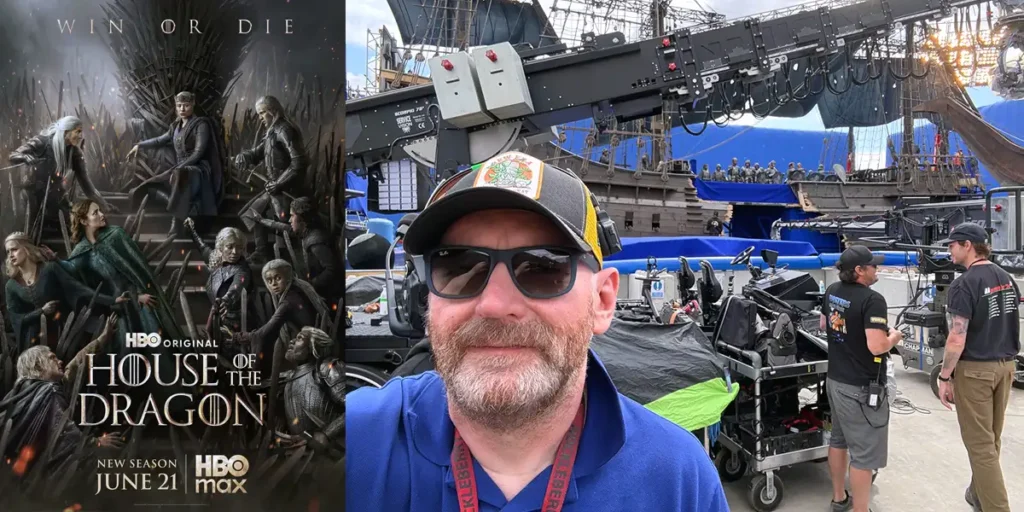
We interview cinematographer P.J. Dillon, ASC, ISC on his career so far and his work in House of the Dragon season 3.
House of the Dragon season 3 opens its first episode with the Battle of the Gullet, which sees the Blacks and the Greens fighting each other in a bloody and large-scale naval battle. Portraying such a pivotal moment in the Dance of the Dragons on screen is no small task, but Director of Photography P.J. Dillon, ASC, ISC did an excellent job.
Fans of House of the Dragons may recognise P.J. Dillon’s name, as on top of being the DOP for episodes 1 and 6 in season 3, he also worked on both season 2 of the show (episodes 1 and 4) and some episodes of Game of Thrones in the past. His other work includes other well-known shows such as Penny Dreadful, Vikings, and The Alienist, for which he won an Emmy in 2018. In our interview, P.J. Dillon talked about his career so far, the challenges of filming such a large scale naval battle, and what fans can expect from this new season.
Read the interview below!
P.J. Dillon on shooting episode 1’s naval battle in House of Dragon season 3
The biggest element of episode 1 is, of course, the big naval battle. How did you approach such an epic scene and how did it all come together?
P. J. Dillon: It was a long gestation, really, because initially the battle was meant to happen at the end of season 2, in episode 9. At a certain point, it was decided that season 2 would have 8 episodes rather than 10, so the battle was transferred to episode 1 of season 3. I was involved in season 2 in 2022 or 2023, and I was going to shoot the battle during that season as well. Instead, we shot season 2 and then came back for season 3, where the battle was going to be upfront and the main thing.
I started prep for the battle with the director, Loni Perister, in November 2024, and we shot on and off all the way through until September 2025. It was a long period of time – 10 months! – between prep and shooting. The actual shooting took place over 27 days in 5 different shooting blocks across 5 months.
We also had five months of intensive prep. Loni is the most well-prepped director I’ve ever worked with. He’s got a background in VFX; he understands that world really well. He was determined that, if we were amazingly well-prepped, we would go into shooting the sequence better, and we did. From our very earliest discussions, we were doing mood boards and storyboards, we were building models, and VFX were doing previews for us. So, going into every block of shooting of the battle, we knew exactly what we were trying to achieve and how we were going to achieve it.
We did extensive camera testing, going out on ships at sea to test how cameras and stabilized heads would react at sea. So, when we took it back into a blue screen environment, we could match that.
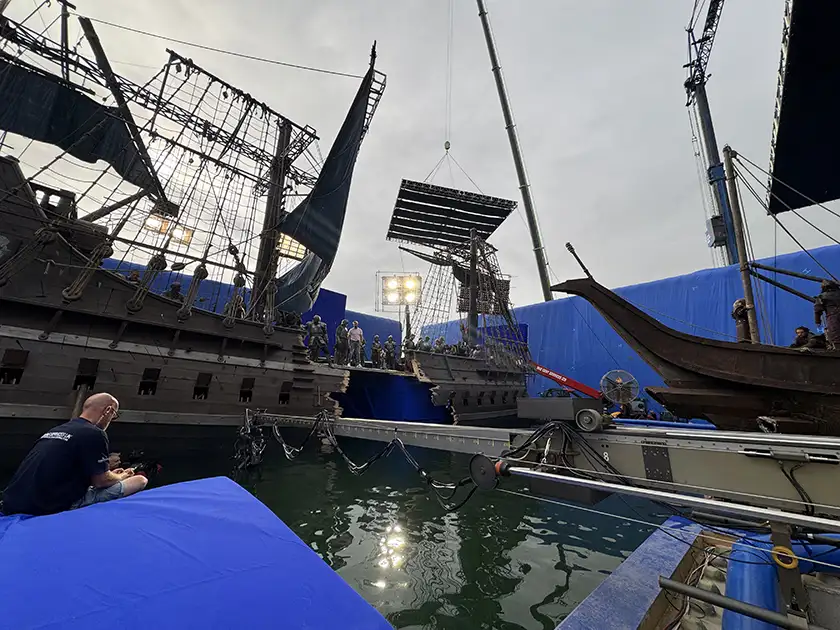
Something that I really liked in the battle is that it really feels like we understand the geography of the place really well and you know exactly where you are and what’s going on. How did you work on creating that?
P.J.D.: We worked very hard on it. The thing about any battle sequence is that it is chaotic, but it’s especially so when it’s at sea, and as big as this was. You have ships ploughing through the water; there are dragons sweeping, there’s fire, there are waves crashing decks. It is very chaotic, with a huge number of performers, so it could easily get quite confusing. At all times, we had to check that we were keeping sight of the story, so that the story and the geography and all of those elements would make what was happening understandable to the audience, who would not get lost in the chaos. It was about trying to find that balance between control and chaos, where the audience would feel on a visceral level what it was like to be in that situation without it becoming completely confusing.
This is the first naval battle we see in House of the Dragon. How did you work on portraying the elements of fighting at sea? Did you have any references that you looked at?
P.J.D.: In terms of films, the Godhead reference is Master and Commander, which is probably the best sailing ship movie ever made. We referenced that quite a lot; we actually went to see it in the cinema, and we watched it frequently as well. But then, more so than film or TV references, we worked with paintings. We wanted to feel like the battle would take place over the course of the day, and feel the progression of the day.
Oftentimes when you’re shooting a battle, you’re dealing with changing weather because you shoot it over a long period of time and the aim is to try and make everything look homogeneousWe very consciously set out to not do that, to try to feel the progression of the day. So at the start of the day, the light’s very cool, it warms up over the course of the day. And by the end, we wanted it to feel like you were almost in hell with the burning sails on deck and the low, fiery sun, and of course the dragon fire constantly strafing.
We worked on a road plan and mood boards of how that was going to progress, and our main references there were paintings. We referenced Whistler quite heavily and Turner was, of course, the main reference with the battle of Trafalgar painting and the slave ship painting, with lots of his other paintings as well. And then there are many other naval paintings from the 18th and 19th centuries, which we also referenced in terms of ships burning in the night.
Episode 1 of season 3 of House of the Dragon, and specifically the battle, was a highly anticipated moment for fans. Did you feel any pressure? What were the challenges of bringing this to the screen?
P.J.D.: You always have the pressure of that. You want the fans to like it, of course: you want people to like the show. But honestly, we go into it and we just try and do the best work possible creatively. Primarily driven by Ryan, the showrunner, and then Loni, the vision of what you’re trying to achieve is very clear. And then they encourage people like me, production designer and head of VFX to bring our creative vision to theirs and marry it all together. There’s more pressure from that than there is from the audience, really. You just really want to do good work. The material is fantastic, and you want to honor that. We have amazing resources on the show: the sets are incredible and so is the VFX work. The only pressure I feel is living up to that and doing my bit to contribute.
Working with the dragons and the challenges of shooting the naval battle in Episode 1 of House of the Dragon Season 3
Naturally, we have to talk about the dragons, they are such a big part of House of the Dragon and of the battle in episode 1. How did you work on that and were there any challenges?
P.J.Dillon: We get animated pre-visualizations of every shot that we attempt with the dragons. Even though we are not seeing them physically, we know where they live in space. And then we do the work with the riders on the dragons. . We have a partial dragon on a moving gimbal and we move the camera around that in a LED wall environment. And then we put the sky in on our screens, we put the sea, and the moon and [are able to] see all of that. After a while, you actually begin to kind of feel that they are there, even though they are not really and never will be. It’s a technical challenge, but actually, it is far from insurmountable.
And for the battle in episode 1 of House of the Dragon season 3 specifically, because that’s obviously impressive, what was the biggest challenge in filming that?
P.J.D.: Probably the period of time over which we had to do it. We shot it over five months and some days it was lashing rain, other days it was hard sunshine, and you’re maybe shooting the same part of the battle on those two days. Dealing with that and the changing conditions while trying to make the whole thing look like is happening in real time is probably the biggest challenge actually. You are doing that without the whole thing just becoming an exercise in problem solving and trying to bring creativity to that as well. So having your own voice while also putting on a farce.
How P.J. Dillon made House of the Dragon Season 3 his own and what we can expect from the rest of the season
There’s been quite a few episodes of House of the Dragon by now. How do you work on making it yours and having your creativity come through?
P.J. Dillon: Every script and every scene are different. You may be shooting a scene in a room you’ve shot in 15 times before, but it’s not the same scene, and the interpersonal relationships and the dynamics change. I very much see my job as trying to convey the mood, tone, and emotion of a scene visually. There’s always something new and a different way to approach it or think about it. If you shoot a room that many times, you learn what looks good and what doesn’t l. But there’s always the freedom and the room to find something new and challenging and to try to improve it.
I know you also worked on episode 6, which I am sure everybody is looking forward to. What are you most excited for fans to see in season 3, and specifically episode 6, once it comes out?
P.J.D.: It’s just that the scale of the season is bigger than previously: it’s enormous. But what grounds it is the characters, the performance,the intrigue and how that develops. The heart of the show is seeing those characters develop and the tangled lives they had to have to live. So that’s what people have to look forward to and some well-loved characters are gonna disappear from the show as always in this world. There’s plenty of shocks coming as well.
There’s definitely some characters that will be greatly missed when they go. But I’m excited about it. I’m a fan, before I ever even worked on season 2 of Game of Thrones and before I knew I was gonna work on the show, I’d seen season 1 and I was a huge fan. And I remained so for Game of Thrones and House of the Dragon, as well as working on them. I shoot 2 episodes in any given season, but there are 6 more that I don’t shoot so I’m just a fan of those.
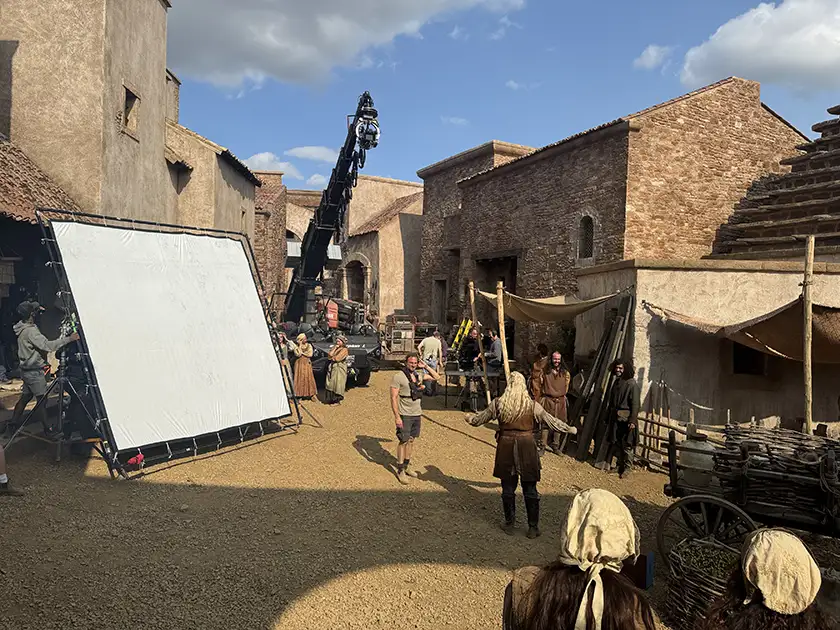
P.J. Dillon on his career and how his previous experiences influenced his work in House of the Dragon season 3
I know you also worked on Vikings. Do you think that experience influenced you specifically in this episode of House of the Dragon season 3?
P.J. Dillon: Hugely, of course. Vikings for me was a long time ago; the last time I worked on it was 10 years ago. But I shot 38 episodes so I did a lot of work on it and there was a lot of ship work of course. But usually, it was on a lake and we shot on boats. The technology now has changed quite a bit: you can get stabiliser heads on smaller frames. The Robin 4D, for example, is a very small, stabilised camera. Your ability to move the camera is far more sophisticated now than it was even 10 years ago when I was doing Vikings. But yes, the things you learn over the course of shooting that many episodes of a show in the water stay with you.
If it didn’t influence me, I’d definitely be doing something wrong, you know?
Speaking of your previous work, I know you also work on Game of Thrones as well as other seasons of House and the Dragon. How did that happen and how are the two different for you and influence each other?
P.J.D.: It is all the same ecosystem, but there are different showrunners, directors, and producers on House of the Dragon than on Game of Thrones. There are not that many crossovers: [Game of Thrones] was primarily shot in the North of Ireland. House of the Dragon films in Leeds or just outside of London. So it is different, but it is all the same world and we reference it all the time because it is such a high bar in TV terms. The look was created primarily by Jonathan Freeman for Game of Thrones and we have developed that and leaned into it, so there is definitely a through line. The use of the camera on House of the Dragon is very similar to Game of Thrones where they had quite a formal sensibility in the style of framing, and we have definitely inherited that.
What drew you to this fantastical – to a certain extent – world of Game of Thrones, House of the Dragon and Vikings to a certain extent?
P.J.D.: It is not necessarily that I went seeking that. Vikings is not a dissimilar world: it is sort of medieval. I actually shot an episode of Game of Thrones before I did any Vikings. Then I did a few seasons of that and went back to Game of Thrones. I have done other things in the meantime: contemporary things, some work for Marvel, I did a short film and various other projects. But when House of the Dragon came back and asked me if I’d come back to the Westeros world, it was kind of a no brainer. It suits my sensibility; I take quite a painter-like approach to my work and try and take inspiration from Rembrant, Joseph Wright Derby, and that style sits very well in this world, so I really enjoy it.
House of the Dragon is such a big scale TV show, which I’m sure you’re used to with Game of Thrones. Are there any challenges that come with that?
P.J.D.: Of course there are, there are enormous challenges. You have to learn how to work with scale, but I don’t think anybody gets dropped into a set like House of Dragon on their first day. You build and you learn, I worked on smaller shows and then I worked on bigger ones, so you learn as you go. And our team is incredible: we have two gaffers, Charlie Cox and Ben Purcell, and they’re both incredible. Our producer, Dan Gulliver, is amazing, and so is our executive producer, Kevin Delanoy. You’re working with the best people in the business and that makes it a lot easier.
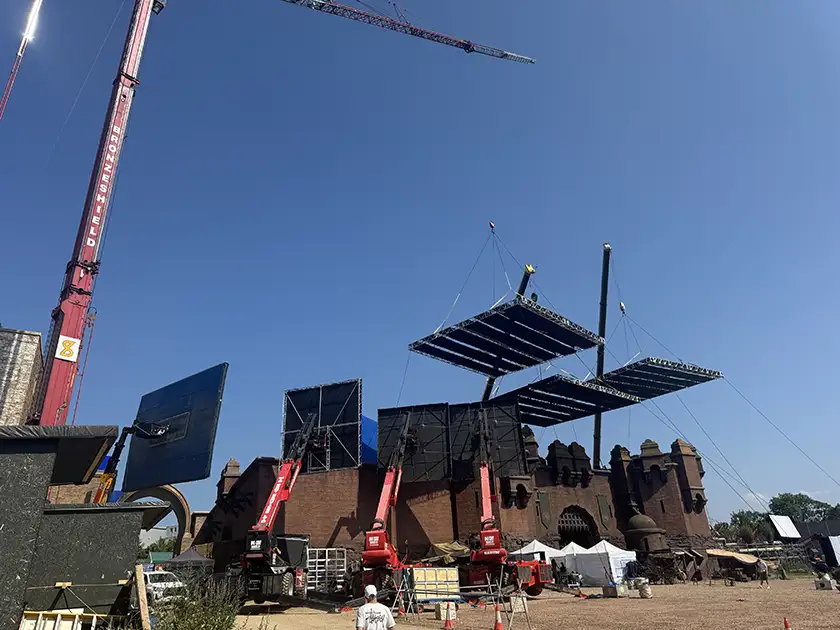
P.J. Dillon on cinematography and the future of the film industry
What is your general inspiration, in terms of cinematography in your work?
P.J. Dillon.: There are certain cinematographers like Vilmos Zsigmond and John Alcott, but too many too name! And current cinematographers like Emmanuel Lubezski, they’re all amazing inspirations for me, but actually paintings are my main inspiration. Trying to look at what all of those geniuses did and put my interpretation of that on film is what gets me up in the morning and inspires me.
What advice would you give to an aspiring cinematographer?
P.J.D.: My advice to any aspiring cinematographer is to shoot whatever you can, whenever you can. It doesn’t matter what it is, within reason, but take any opportunity you get to shoot. I just know for me personally, I learn by doing it. I learned by making mistakes and learning from them. I started my career as a camera assistant, but at the same time, I was shooting short films, working for free, doing music videos, helping people film , working as a grip, doing whatever I could. My advice to any aspiring cinematographer is just go and shoot because you’re constantly learning, you get better and the breaks come.
I think the future of the film industry feels uncertain at times, especially now with AI and some of its potential uses in filmmaking. Where do you see that going in your profession?
P.J.D.: I don’t know if anybody knows where it’s going, but I do strongly feel that AI is not going away. It’s a tool that can be very useful for us and that we can embrace and work with. But AI will strive to make everything perfect and I don’t think that is always the best. In terms of what we do as creatives, as artists, you’re in the job of conveying emotion primarily and if something is too perfect, like with AI, it feels like it is not quite there. [For example with] AI-generated images, the emotion isn’t there and I think that we have to be careful not to hand over the creative process to perfection.
Is there anything other than House of the Dragon that you’ve been working on that you can tell us a little bit about?
P.J.D.: I’m currently working on Wednesday with Tim Burton. This is the second season I’ve done with Tim, so that’s really great fun. It’s completely different to House of the Dragon, but equally amazing in its own way. Working with somebody like Tim is just career-defining for me. That’s what I’m doing at the moment and I am enjoying that. It also shoots in Ireland where I live, which means I can be at home while I work, which is not always the case. And Tim’s is so great. I’ve worked with a lot of directors over the years and he’s definitely, if not my absolute favorite, one of them, because he’s just such a good guy to work with.
Thank you for speaking with us!
This interview was edited for length and clarity.
.
Header credits: Poster for House of the Dragon Season 3 / P.J. Dillon on the set of the series (HBO / P.J. Dillon)