
Parallel Tales’ top-notch cast can’t elevate Ashgar Farhadi’s would-be meta drama above its inherent sordidness.
Director: Asghar Farhadi
Original Title: Histoires Parallèles
Genre: Crime Drama, Mystery, Thriller
Run Time: 140′
Cannes World Premiere: May 14, 2026 (In Competition)
U.S. Release Date: TBA
U.K. Release Date: TBA
Parallel Tales (Histoires Parallèles) is about a group of people who can’t stop staring at and thinking about Virginie Efira. It’s understandable; she’s an objectively beautiful woman, but she’s usually desired from afar and on a big screen. Try as it might to emphasize the danger in confusing fantasy for reality, Asghar Farhadi’s film can only take so much stalker behaviour and narrative flourishes before it threatens to collapse on itself. Much like an experience with a stalker, it’s never boring, but it feels needlessly cruel and ultimately pointless.
This isn’t Farhadi’s first foray into filmmaking outside his native Iran, but something’s gone awry since 2018’s Everybody Knows. That film was solid enough to support strong work from Penélope Cruz and Javier Bardem, but Parallel Tales is too thin and emotionally obtuse to support the surplus of Francophone talent on its roster. The likes of Efira, Isabelle Huppert and Vincent Cassel will entice a passing viewer to consider watching, but they can only do so much to elevate a needlessly complicated story that never clarifies what it’s trying to say. The emotional and filmmaking surety of A Separation is gone, replaced by convolution and commendable but broad attempts at commentary on the creative process.
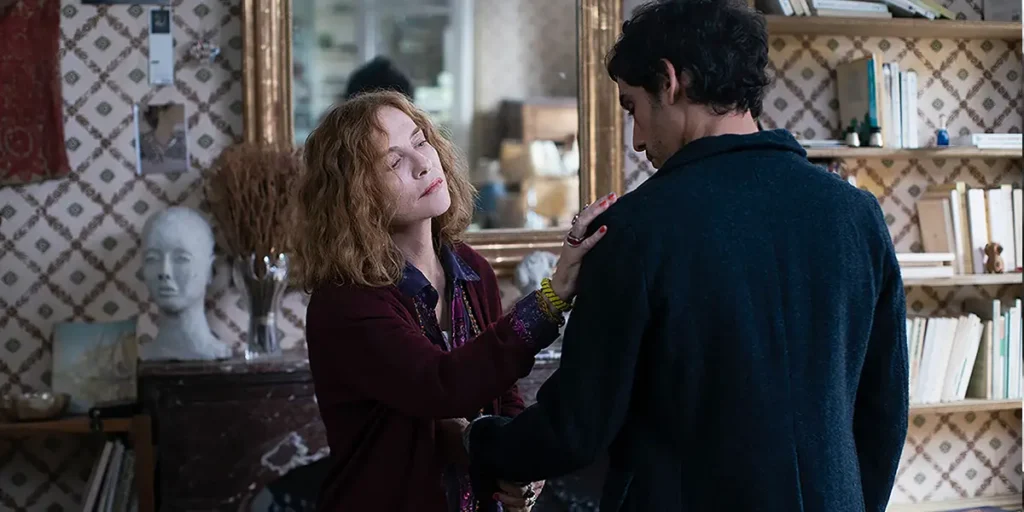
Everyone in the world of Parallel Tales is a creator, even if some of them haven’t worked out how to create. Adam (Adam Bessa, of Ghost Trail) is a young immigrant fresh in Paris, unsure of his next steps. When he saves a young woman (India Hair, of Jeanne du Barry) from being pickpocketed on the Metro, he finds his path when she hires him as a home help for her author aunt, the reclusive Sylvie (Isabelle Huppert, of The Blood Countess).
Meanwhile, Sylvie is writing a novel about a love triangle involving Anna (Virginie Efira with dyed brown hair) and her work colleagues Pierre (Vincent Cassel, of The Shrouds) and Christophe (Pierre Niney, of The Count of Monte Cristo). All this is inspired by the very real people that Sylvie spies on as they work in the building across the street, also played by Efira (in her natural blonde), Cassel and Niney. Farhadi does little to differentiate the different narrative strands, meaning this overlapping of these ‘parallel’ tales is just as confusing as it sounds. Even if you can click into its rhythms after a while, Farhadi and co-screenwriter Massoumeh Lahidji add on more layers of narrative to confound further.
At a basic structural level, Parallel Tales’ main problem is that its writers attempted to flesh out a short film that was already adapted into a feature, and the only thing they added is an hour of runtime. Krzysztof Kieślowski adapted the sixth episode of his Dekalog into A Short Film About Love, and both films’ relative brevity prevented the sordid behaviour of its characters from becoming sympathetic or relatable. Farhadi surrounds Efira’s characters with people that (want to) use her for any number of desires, from sexual gratification to artistic inspiration.
There’s a throughline to be found here on the selfish impulses that drive the creative process, best represented by Huppert’s Sylvie. She reluctantly accepts Adam’s help, but her independent drive and devil-may-care attitude makes her the most compelling element of Parallel Tales. Any time the plot cuts away from Huppert, the energy dips. As Adam attempts to befriend Efira’s Nita, it just invites more opportunities to behave poorly towards these women, whether real or fictional.
The first time around, Kieslowski kept proceedings relatively brief to prevent any sordidness from overwhelming his moral. Parallel Tales spends 140 minutes building obsessions past an uncomfortable point. The characters in Sylvie’s story turn to murder, while their real-life counterparts cross professional lines, and it all operates with an undeniably arresting soap-opera urgency. It’s only when you stop to think about it all that the unpleasantness comes through. Farhadi and Lahidji may intend this this as a metatextual commentary on blurring reality and fiction (The latter co-wrote Kiarostami’s Certified Copy, so this is not new ground for him), but neither the real nor fictional world of Parallel Tales is a place where anyone would want to spend much time. If it’s not being overly grim, it’s encouraging deja-vu; sequences and visuals are lifted wholesale from other Kieslowski projects like Three Colours: Blue and A Short Film About Killing.
When one of her neighbours confronts Sylvie about being used as inspiration without their knowledge, she responds, “If it’s not real, why are you so upset?” A fair point, but while Parallel Tales doesn’t try to pretend to be real, its dour register and mean streak feel too real for comfort.
Parallel Tales (Histoires Parallèles): Movie Plot & Recap
Synopsis:
The lives of an author, her hired help, and the small group of people they spy on for inspiration overlap with messy results.
Pros:
- A sturdy cast commit themselves to the material
- It has ideas about the chaos that the creative process can wreak
Cons:
- A confused screenplay and direction can’t control the various narrative strands
- Soapy plot developments undermine its attempts at sincerity and commentary
Parallel Tales (Histoires Parallèles) premiered at the Cannes Film Festival in Competition on May, 14 2026.