
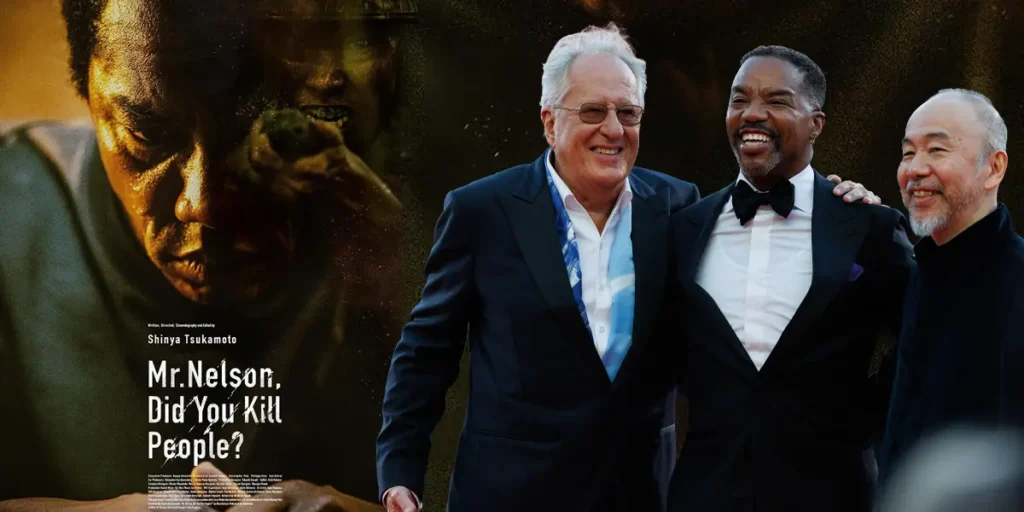
We interview Shinya Tsukamoto, Rodney Hicks and Geoffrey Rush about Mr. Nelson, Did You Kill People?, war, trauma, healing, and bringing Allen Nelson’s story to the screen.
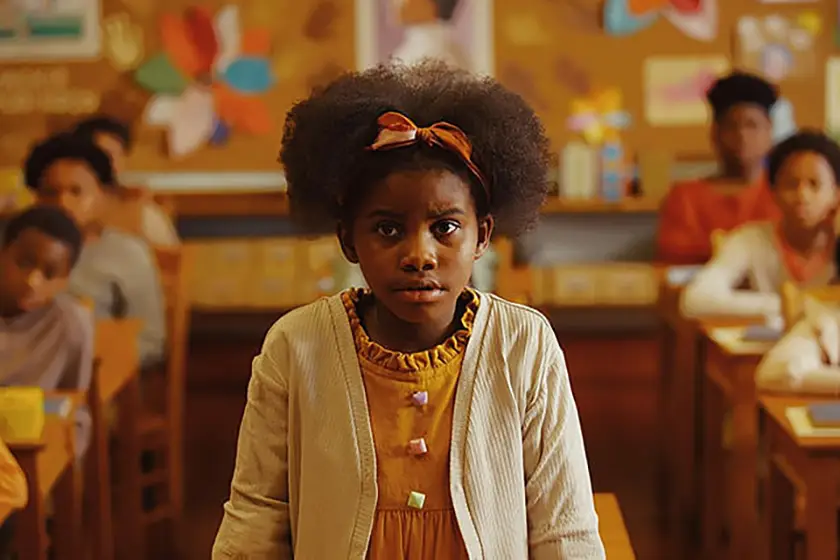
The titular question is at the core of Shinya Tsukamoto’s Mr. Nelson, Did You Kill People? (Nelson san, Anata wa Hito wo Koroshimashitaka?), adapted from Vietnam War veteran Allen Nelson‘s own account of his wartime experiences and struggles with PTSD after returning home. It’s first asked by a little girl at a school where Allen is invited to give a talk about his time in Vietnam, and our protagonist is taken aback, not quite knowing how to react. Years later, Allen’s therapist would ask him an even more important question, over and over again, hoping that one day he might figure out how to answer it: “Why did you kill people?”
Mr Nelson catapults us into Allen’s life by having multiple timelines unfold simultaneously. During the war, we watch a young Allen (Mark Merphy) join the U.S. Marines, undergo training, and be deployed to Okinawa, eventually playing a role in the brutal massacre of local residents suspected of supporting the Viet Cong. Many years later, Allen (Rodney Hicks) has returned home. He lives with his wife and stepson, but trauma and violence continue to dictate his life. As he thinks back on his time as a Marine, we watch his therapy sessions with Dr. Daniels (Geoffrey Rush), where he tries to make sense of the atrocities he witnessed and committed.
Tsukamoto doesn’t hold back, refusing to present us with yet another sanitized, romanticized portrayal of war, and Mr Nelson is so violent and gruesome that, several times, I found myself wanting to look away. But that’s the point of a movie that, like Fires of the Plain (2014) and Shadow of Fire (2023) before it, lets the director’s anti-war message come through in unmistakable, potent fashion. Why are we so quick to treat soldiers as heroes? Why do we often think of war in terms of victims and perpetrators, when the line between the two is so thin? These are some of the questions Mr. Nelson, Did You Kill People? raises, and thanks to superb performances from Rodney Hicks, Mark Merphy and the entire cast, and Tsukamoto’s control of pace and tone, this timely story will stay with you for a long time.
At the 2026 Venice Film Festival, where the film had its world premiere, we sat down for an interview with Shinya Tsukamoto, Rodney Hicks and Geoffrey Rush. Here’s what they told us about war and heroism, trauma and healing, bringing Allen Nelson’s story to the screen, and more.
Shinya Tsukamoto on Why It Was “Necessary for Mr. Nelson, Did You Kill People? to Exist in the World”
What made you feel that this was an important story to tell right now?
Shinya Tsukamoto: Japan hasn’t been at war for eighty years, but the country is rapidly moving toward a situation where it could go to war again. At the same time, the situation around the world is becoming increasingly volatile, and I’m concerned about wars breaking out in irrational ways. That’s why I felt it was necessary for this film to exist in the world, and why I made it.
When you’re making a film about a sensitive subject like war, how do you decide what violence to show on screen and what to leave unseen? Is that decision based on ethics, your own taste, or something else?
S.T.: First of all, since the original work is nonfiction, I wanted the audience to experience what happened as faithfully as possible. I depict those events, but within each scene, I’m very careful about deciding what to show and what not to show.
And then, as you mentioned, ethics are part of that decision, but so is my own taste. I think about it quite carefully, but ultimately, I trust my own instincts. If you show too much, people gradually become desensitized to the violence, so simply showing everything isn’t necessarily effective. If there’s no need to show something, I don’t show it. But if I feel that showing something will make a scene more frightening and visceral, then I show it. That’s how I make those choices.
Given Japan’s history, I imagine it could have been difficult to tell this story from the perspective of an American perpetrator. What was that process like for you? Was it difficult to empathize with Allen?
S.T.: I was deeply moved by Allen’s memoir. I had never encountered anyone else who spoke so honestly about their actions, and who dedicated the rest of their life to trying to reduce the suffering caused by PTSD. I felt a strong desire to bring Allen’s story back into the public eye and share his experiences and actions with everyone.
There were people in Japan who had experienced war as perpetrators, too, but unlike Allen Nelson, who spoke honestly about everything, they tended to keep silent, intending to take those memories to the grave. Many Japanese people certainly knew about these experiences, but those who had lived them weren’t talking about them. I believe that’s part of the problem.
“You’re Either Killed in a Horrific Way or you Kill Someone Else in a Horrific Way.” – Shinya Tsukamoto on War and Heroism
As I was watching the film, the thought that almost immediately came into my mind was that we need to stop treating war as something heroic, as if being a soldier automatically made you a hero. I think that’s how a lot of Hollywood productions portray war right now, sometimes even in movies that aren’t war films: if you’re killing people, you’re often presented as a hero. I really love how your film challenges that.
Shinya Tsukamoto: Yes, that was the biggest challenge, and also the most crucial aspect of this project. While it’s certainly fine for audiences to feel excited by films that portray war through the lens of heroism, I believe it’s extremely dangerous to depict war that way in our current climate, given the global situation and the fact that Japan is gradually moving closer to war.
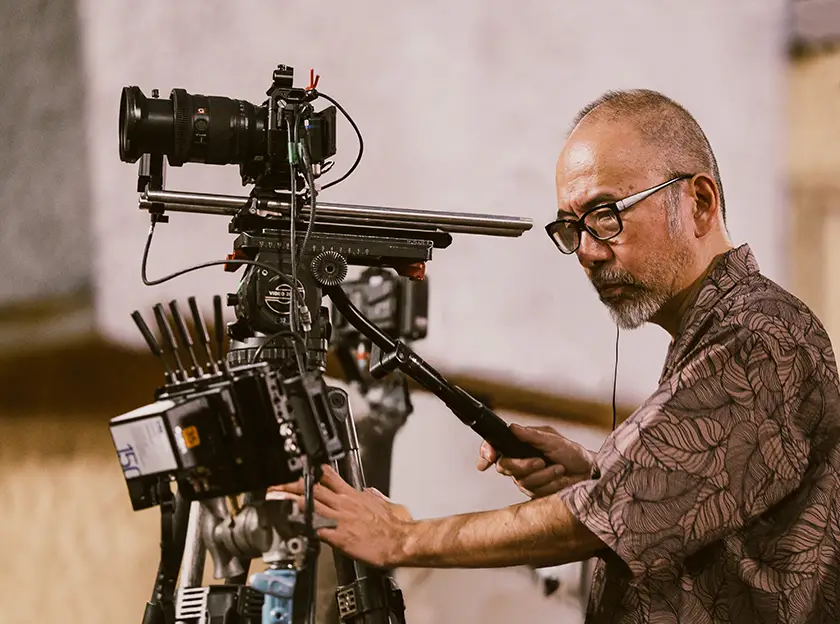
Young people might think that if they go to war, they’ll have the opportunity to do something heroic or serve a greater cause in some way. However, the reality is that you’re entering a world where you’re either killed in a horrific way or you kill someone else in a horrific way. I felt it was far more important to show that reality.
Yes, absolutely. What do you think of films like Top Gun, which present a very different image of the military and warfare? Are there any Hollywood movies whose depiction of war you think are more accurate?
S.T.: A lot of people really like Top Gun, so how do I put this… [laughs] Personally, I do find Top Gun a little difficult to embrace. But when it comes to American cinema, many masterpieces have been made about the Vietnam War. I think films that show how going to war can change a person and bring out the darker side of human nature, and that depict the horrors of war, are absolutely necessary—not just for me, but for everyone. I’m thinking of films like Full Metal Jacket and Apocalypse Now.
“By the End, People Will Be Conflicted That They Care About You.” – Rodney Hicks on Allen Nelson’s Journey, Masculinity, and “Inherited American Trauma”
Rodney, how did you become involved with the film, and how did you prepare to play Allen Nelson?
Rodney Hicks: I found out about the role three years ago, right before the strike, so thankfully, I had three years to prepare. My preparation began with getting to know Allen Nelson and researching him in depth. I’m also a twelve-year meditator, which helped me immensely in being able to compartmentalize and not lose myself in the role, while making sure I was open and available not only to my co-stars and our director, but also to myself as an actor.
It was very specific, and what I loved was that Tsukamoto-san knew exactly what he wanted to get out of my performance. It took a lot of skill and preparation to then let go of that preparation, to let go of the work, so that I could show up take after take organically.
They filmed the Vietnam flashbacks and war scenes first, and then Tsukamoto-san and I watched all of that footage together. That meant I knew exactly where Allen was emotionally during every therapy scene and every family scene, before we got into his full present-day story. That way, in my silences as Allen Nelson, all of that history is still there. It doesn’t feel like two different movies: I’m carrying young Allen’s entire journey with me, and you can feel that weight as the film continues and progresses.
Did you speak to any veterans as part of your preparation?
R.H.: Oh yes, many. I actually sat down with Theodore “Malik” Edwards, who does a lot of documentaries about Vietnam, and we spent a day together in Oakland, California. His journey was actually very similar to Allen’s in many ways. My neighbor happens to be a veteran as well, and I spoke to about three other veterans. I really wanted to immerse myself in that world.
The difference with this movie is that usually, these films are about active soldiers. It’s a soldier’s story, whereas this is a veteran’s story, which is unique.
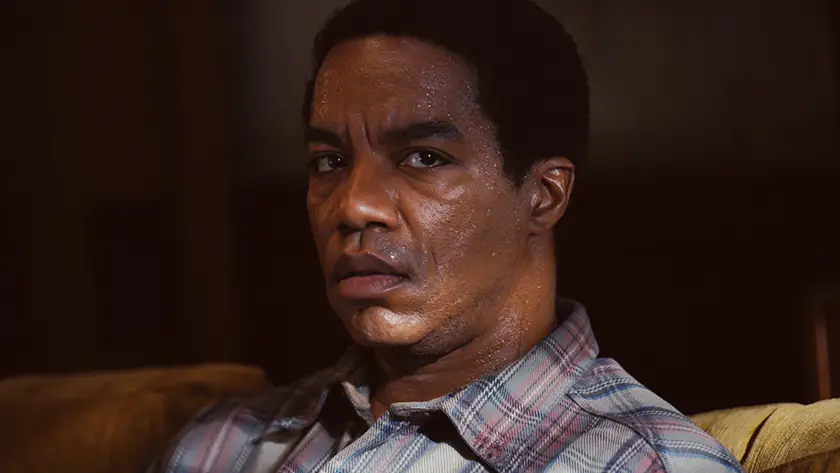
And I think you’ll notice that the first time I cry in the film is about forty-five minutes in, when Allen is playing the guitar. Allen played guitar, and what I loved was that he wasn’t really good. [laughs] He was okay. So I had to make sure that I wasn’t suddenly a great guitarist. Getting his voice right, too—everything had to come from a real place, as opposed to, “Okay, now he’s performing.” It needed to feel organic, like a release, because music really does that. And I think that scene was the beginning of his breakthrough.
I think the film tackles vulnerability, and the idea of what it takes to be a ‘tough’ man, very well.
There’s a scene in therapy when Allen talks about his father and he says he was “weak”. The first time he kills someone, a “switch turns on” in his brain telling him he had become tougher. A fellow soldier he meets cuts off his victims’ ears because “trophies show you what kind of man you are”, and the soldiers in general have a very strong idea of what makes a tough man.
R.H.: Yes, and I also believe it’s all part of inherited American trauma, and the circumstances we’re all born into. What I find fascinating about this film is that he’s not a victim, right? But he is. And he’s also a perpetrator: he’s all the things.
It’s just a matter of: do we want to go on the journey? And I realized that people do want to go on this journey because it’s a human journey, you know? It’s not Tom Cruise or Charlie Sheen we’re watching; we’re so used to that. We don’t know who this person is, as the character or as me, really. We’re all going in blind, and by the end of it, we’re like, “Wow, I’ve come to understand a little bit more about humanity.”
Was it difficult not to judge Allen for the things he’d done?
R.H.: Did I judge? No, because that’s another rule of thumb: you can never judge a character, even if they’re a monster. I did August Wilson’s “Gem of the Ocean,” and I played one of the coldest characters on stage, Caesar Wilkes. He comes in half an hour into the play, and for fifteen minutes he just talks, saying the most horrible things to everyone. And I thought, “I can’t judge him,” you know?
I’ve been fortunate to portray three Vietnam soldiers throughout my career, so I had all of that leading me into it as well, but I’d never portrayed a veteran. I read a lot of books and inundated myself in Vietnam [laughs], and just thought a lot about the moral ambiguity of it all. You just have to be who you are.
And I think that first therapy scene you mentioned, where Allen talks about his dad… When we did the first take, I had just come off filming a scene with Tatyana [Ali, who plays Allen’s wife, Linda], and then Geoffrey and I were [filming together], and I was [portraying Allen] in a very “woe is me” kind of way. And then Tsukamoto-san was like, “No, no. We have a whole way to go.” He goes, “I want you to be almost hardcore about it, staying true to the [character’s] truth [in that moment, when he hasn’t had the realization we see at the end yet]. At the start of the movie, you’re like, ‘I don’t like this guy. He’s an a*shole.'” And I said, “Okay, I understand the assignment.” He goes, “We’ll get there. You’ve got to earn it. We’re going to earn it.” And he added, “If we do our job right, we will have earned it, and by the end, people will be conflicted that they care about you.”
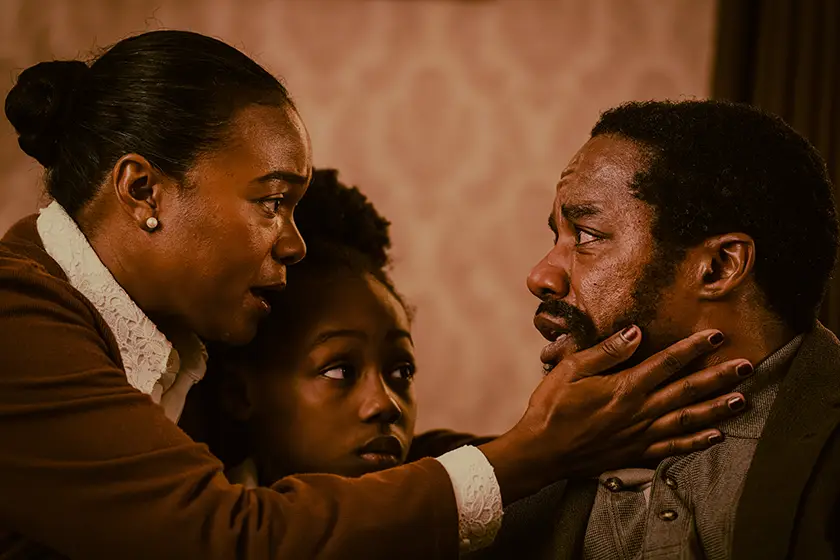
On Allen Nelson’s Answer to “Why Did You Kill People?”
By the end of the film, we absolutely care about Allen in a conflicted kind of way, just like Shinya Tsukamoto predicted.
Rodney Hicks: He made me mad, but I also felt for him, and it’s the way the world is now. What is really evil? What is really good? What is really bad? Are we selectively judging people? I just think, if you’re messing up in the present moment, then I’m going to go the other way. But I will stop and have empathy and listen if you’ve done work on your life.
***Spoilers from here***
We’re being forced to look at Allen in his present moment as it keeps going, because it’s such a mercurial journey, and I think that’s really something that I like. You think one moment he has it, and then he gets up and blows up at the therapist, because he’s asking a lot of him. All he’s asking is, “Why did you kill people?” And he finally says, “Because I wanted to.”
Because he wasn’t drafted. He signed up. He wasn’t—”Poor guy, he got drafted.” He wanted to be G.I. Joe until he realized, “Oh. Oh, this isn’t what I…” It was, again, the systemic, inherited trauma. He was becoming his stepfather, you know.
And so this film and this role are profound. I don’t know if I will ever have a role like this again, where I’m asked not to judge my character and to trust that the audience isn’t going to roll their eyes at it, you know, and just turn off completely. Some may, and I think that’s actually powerful too. It really is.
The scene when Allen finally answers Dr. Daniels’s question and admits, “Because I wanted to,” is such a cathartic moment for the film.
Shinya Tsukamoto: That scene was truly difficult [to include in the film]. There are actually two books, and that specific exchange between Allen and Dr. Daniels appears in the second one rather than the main source. At first, I thought it would be hard to include Allen’s conclusion—that he killed because he wanted to—in the film. I felt it might push the audience’s empathy too far, so I considered leaving it out.
But then I realized that this was an extremely important part of Allen’s story. I decided that I had to include it, difficult as it was, and from there, I worked backward to structure the story in a way that would still leave the audience just enough room to empathize with him, or at least reflect on the situation.
I deliberately chose not to provide a definitive answer in the film for why Allen says it: I wanted the audience to think about that for themselves. What’s been particularly interesting is that different viewers have given me completely different interpretations of what it means, but they’ve all told me that the moment was shocking and had a real impact on them, so I’m glad about that.
Personally, I think there are several possible ways to interpret it, but ultimately, it touches on how there is something deeply violent within human instinct. Allen finally becomes honest enough to acknowledge even that part of himself. The more honestly he speaks, the more his PTSD subsides. My interpretation of Allen’s memoir is that when he goes even deeper into his true, honest feelings, a significant part of his PTSD begins to disappear. That’s how I approached the scene.
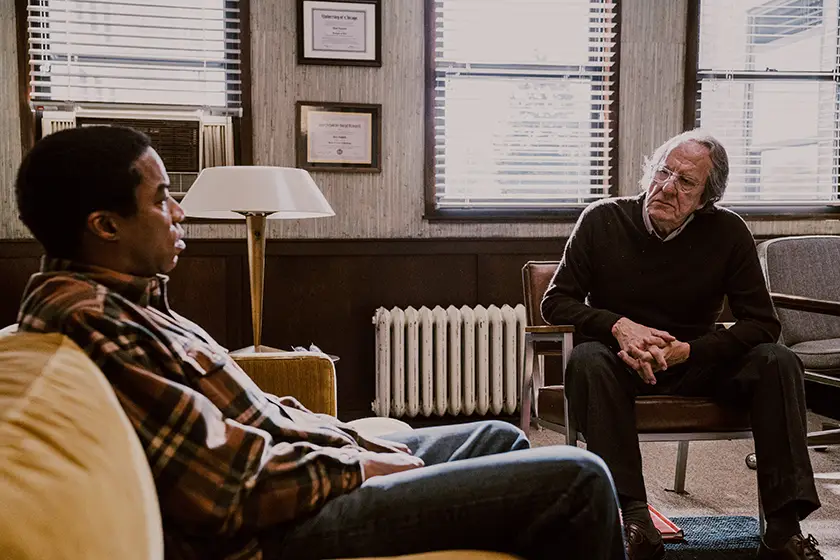
Geoffrey, before we get to that answer, Dr. Daniels keeps asking Allen the same question throughout the film: “Why did you kill people?”
Geoffrey Rush: A lot of people comment, “Why did he just keep saying, ‘Why did you kill people?'” And my thought, my connection with that line was—I didn’t want to read endless books about psychiatric theory or whatever. I’m a big classical music fan, and it reminded me of Shostakovich, who’s one of my musical heroes. If you hear Shostakovich’s Seventh Symphony—the Leningrad, which is about the siege—there’s this motif of music that just hammers over and over again. And you think, “Is this Stalinism at its worst? Or is this a cry of desperation about stopping Stalinism?” Because it is bulldozing the psyche of the country.
And I think Neil Daniels’s process was to go, “Until you acknowledge this one in your own way, you’re never [going to find a way through].” As Rodney’s been saying, he’s a very meditative man. He meditates every day, and that’s what got him through a lot of these scenes. One day he said to me, “I needed to deal with all of that and then throw it away and play the scene with you in the room.”
***No more spoilers from here***
“I Gave Him, You Know, a Background.” – Geoffrey Rush on Dr. Neil Daniels, the “Talking Cure,” and… Barbossa’s Origin Story
What did you draw on to play Dr. Daniels?
Geoffrey Rush: I think psychology and psychiatric medicine have kind of gone like that in the last ten or fifteen years. People are understanding with more complexity what happens with trauma victims. And I suppose, in Australia, I didn’t know anyone who went to see a shrink. You’d go to the pub and talk to people and get it off your chest. Americans seem to be always going to see their analyst. Woody Allen’s always in therapy, you know what I mean? I think it’s very, very common nowadays. Fundamentally, it still seems to be the “talking cure”: that goes way back. You don’t bottle it up; I think that’s still a big part of it, but maybe the techniques have shifted a lot.
I didn’t know Neil Daniels was real until after we’d made the film. I didn’t need to, because the script had so much detail about what my function was within that very loud and boisterous and aggressive, confrontational war scenario. There was this little oasis every so often where you saw Allen Nelson trying to come to terms with his experiences.
But I found one page online: some kind of legacy piece from a medical magazine where [American psychologist] Francine Shapiro basically wrote a hymn of praise about this coworker that she knew called Neil Daniels, and how his techniques were very rewarding and very radical at the time, based on a great strength of empathy. He’d always said, “I never want to be involved in the military. I want to work in hospitals.” So I wrote – just for myself – a fictional version of his past.
Oh I love this! Do you do this for all your characters?
G.R.: No. It was actually quite interesting because it became more about researching the history of psychiatric practice from the middle of the nineteenth century to the early twentieth century. You know, Freud visited Clark University in Worcester, Massachusetts, in 1909, and I thought, maybe Neil’s father was in the medical profession. Those were turbulent times of discovery, and he would have heard those conversations going on around the dinner table, you know.
I did it with Barbossa [from Pirates of the Caribbean] because I didn’t want him to just be a pirate with, you know, a monkey substitute for a parrot who went, “Arrr!” [gestures] So I built a story around him being a kid who grew up farming in the countryside near the port of Bristol, UK. He would have gone to sea and become a cabin boy or something, and then seen the captain’s quarters and thought, “I’ll never go through naval college, but I think there’s a way to get to the top really fast by killing people.” [laughs] So I gave him, you know, a background.
And my voice coach said, “Yeah, just watch your accent there; you’re drifting into Irish.” I said, “I think his mother grew up in Ireland.” [we both laugh]
“I Think Gratitude Also Kept Me Going.” – Rodney Hicks on Black Mental Health and His Own Journey of Healing
At the press conference in Venice, you talked about how this is a story about Black mental health, and you were right when you said that we don’t see it addressed on screen very often.
Rodney Hicks: …Ever! [laughs] I mean, when you think about it in the grand scheme of Vietnam stories, this is the very first one that centers a Black man’s journey, solo, that we’re going on. But also, it becomes universal.
And Black mental health, I believe, is important to talk about because we don’t talk about it even in the Black community. So therefore, how can any community really know? Because there’s a lot of shame behind it. My own journey through that, as well, in preparation, was talking with my own therapist about how not to get lost in it. From my own personal PTSD journey from a long time ago, I know that healing is possible: I actually did it. So now I get to step into someone else’s different trauma and find his way through. Because, as [Tibetan Buddhist] Pema Chödrön says, “The only way out is through.”
We never say “PTSD” in the film. We actually never say “race” in the film, funny enough, in a beautiful way, so that therefore, you become Allen Nelson. We all become this person. It’s complicated and it’s complex, and it’s inherently human. It’s a human story, and I think it defies race. It defies man or woman or everything in between.
And it’s also rare to see a movie with a Black man who is just completely vulnerable, you know? You’re mad at him at times, and then you’re also going, “Oh my God, he has a heart.” Because I believe two things can exist at the same time.
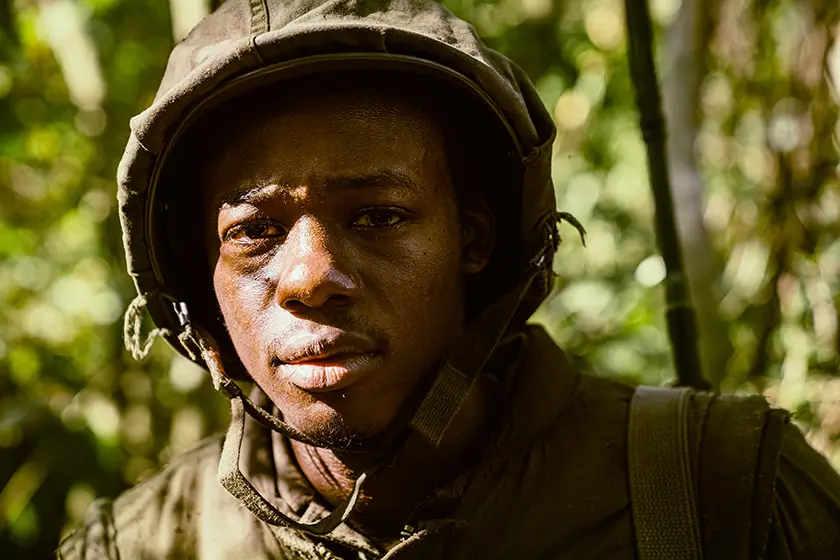
Did being a trained theater actor help you with this role?
R.H.: Yes, yes, yes. Thirty-two years of being a theater actor helped me immensely, but also twelve years of being a meditator helped [give me] the mental capacity of not losing myself.
I would meditate in the trailer before I’d come out and then open [myself up], you know. When I got on set, I made sure to greet everyone—every single person who walked onto the film set, crew, janitor, everyone—so they could see Rodney. And then I would visit my co-stars and say good morning, and then go in my trailer and do qigong, do yoga. I had The Art of Detachment mantra music playing so that I could really separate [myself from Allen]. Because, as you saw, it could potentially have been an easy role to lose yourself in.
Did you use any particular methods?
I used the Stanislavski method, the “magic if” [a technique that asks, “What would I do if I were in this character’s situation?”]. That just gets [you] here, and all you’re doing is being of service. That’s what I kept thinking: I am in service of this role. I am standing on the shoulders of veterans. I have a responsibility, as opposed to, “Look at me.” It’s not a vanity role at all. I look very unflattering as Allen, you know, until he looks well.
The very first image you see of him, the older Allen, it’s like, “Jesus, what happened to him?” And then by the time he gets older, in the diner scene at the end, he actually looks healthier than he ever did. He smiles for the first time. But again, healing isn’t linear.
And knowing that in my personal life helped me so much. Ten years ago, I was on Broadway with the show Come From Away, and it was to be the most profound moment of my career. I lost my voice—not through any throat thing. I developed a condition called spasmodic dysphonia, which is trauma-based. My brain stopped connecting to my voice, and everything I thought was going to happen in my career just went away overnight. I could barely talk.
Oh, wow.
R.H.: I couldn’t sing at all. [long pause] To even sing this quickly [in the musical], or even speak clearly throughout the whole thing, when I knew what it was like not to have that… I was under the bus with depression. And then, in 2023, I get this call out of the blue. They said, “We think you’re right for this role.” And at the time, I couldn’t get a job at all! So I said, “Okay.”
Knowing what it really meant to lose everything actually was my blessing for this film: to really know the devastation of not being needed to do anything. I felt that connection with Allen as well, and the hopelessness. And so I thought, “Okay, you got out of that, so now you have to step into someone else’s shoes.”
I worked with my therapist and a life coach for two years, and this was all in preparation for this, so that I could hold myself down. And I’m just grateful. I think gratitude also kept me going.
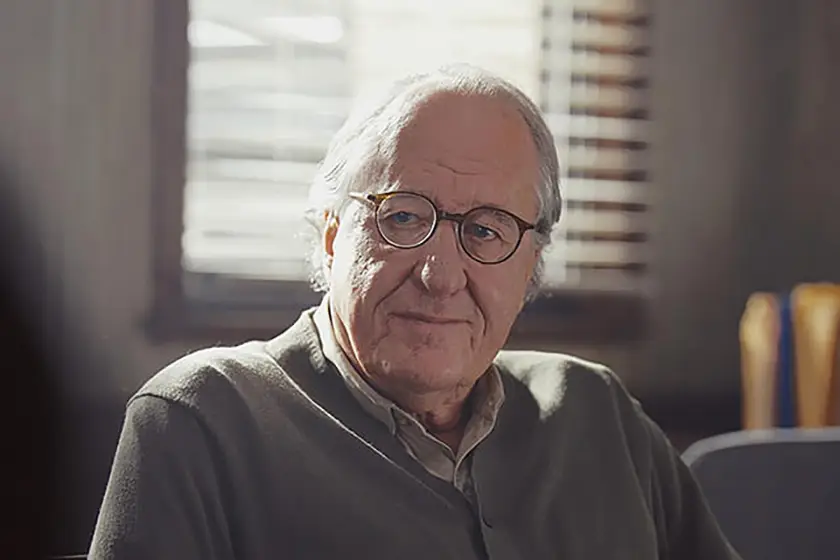
“You mean Shinya Tsukamoto, who did Tetsuo: The Iron Man?” – Geoffrey Rush on Being Cast in Mr. Nelson, and His Own Experiences With Therapy
What drew you to this role and to working with Shinya Tsukamoto?
Geoffrey Rush: I don’t know how Shinya-san knew about me. Suddenly, my agent said, “There’s this amazing Japanese director who wants you to read a script,” and I said, “Sure.” We did a Zoom, and everything was in Japanese and translated, so it was a very long, slow process. I got a feel for him instantly that he was non-pretentious but very lively with cinematic ideas.
I read about him, and I spoke to a friend of mine. I used to be the patron of the Melbourne International Film Festival, and at that time, the guy who was the head of the festival and curating—this is twenty years ago—I called him up and said, “What about Tsukamoto?” He said, “You mean Shinya Tsukamoto, who did Tetsuo: The Iron Man?” I said, “Yeah, that guy.” [laughs] He said, “Just sign! Do the film. It’ll be a very interesting job.”
And then I went and saw Tetsuo: The Iron Man at ACMI, which is like an arts museum of retro cinema. This was two or three years ago. I saw it on the big screen, and the cinema was packed with thirty-year-olds. They were born the year he made this film, but somehow, they knew he’s a filmmaker they should know about.
I found that very exciting because thirty-year-olds now—tricenarians now—they’re hovering between Gen Z and millennials. They’re very picky. [laughs] I mean, they have strong opinions and everything, and they were in awe of this film. It was talking to them, and it was thirty-something years old.
Why do you think Shinya Tsukamoto cast you as Dr. Daniels?
G.R.: I don’t know! I’ve not really played many American characters. Did he think, “He really helped that king with his stutter [in The King’s Speech]; can he help this guy with his Vietnam War trauma?” [laughs] He’s very good at being in a room by himself with somebody who’s…? [thinks] I don’t know. [shrugs and smiles]
Lionel Logue and Neil Daniels, to me, have nothing in common except I’m the vessel, you know.
Did you know which of the flashbacks we’d be seeing between the therapy sessions?
G.R.: Yes. I said, “I want to see all of those things.” Not for every scene, but I was very aware, because they’d been in Thailand for a couple of months, shooting the Vietnam scenes, so I knew that, in the rhythm and the pulse of the drama, we’d be cutting from the quiet of that room in the New Jersey hospital [where Allen and Dr. Daniels are having their therapy sessions] and going into absolute hell [with Allen’s flashbacks].
There were some sequences where I said, “Why don’t we, rather than shoot all these therapy scenes individually, do these four scenes today?” They were covering big events and the deepening of the experience that his troop was having, where they were becoming more ruthless, more anesthetized to what they were actually doing with their weapons.
I said, “Let’s reach that point and then just take a breath, and then pick up,” because we knew what the cut would do, going from us back to the cataclysm that was happening in the war zone. It was much better for us to get more material, more of a journey to share in the room together, you know.
Did anything surprise you when you finally saw the finished film, or was it what you expected it to be?
G.R.: I only saw it at the Venice premiere for the first time. I’d seen the trailer, and Rodney said, “The trailer is nothing like the film.” The film takes you down into deeper depths all the time, you know what I mean? It’s a different journey to what you get in the trailer.
We did make the suggestion—I said, “You know, I think certainly for the American trailer, the little girl saying, ‘Mr. Nelson, did you kill people?’ You open with that, and you’re instantly into a zone of: this is the key question.” And the second one is the psychiatrist saying, “Why did you kill people?” And you go, “Wow.”
Did you draw on any of your own experiences with therapy when playing Dr. Daniels?
G.R.: In my late thirties, early forties, I had, I suppose, a crisis career moment where I started to have panic attacks on stage, which were very debilitating. And it was one of those things where the more you spoke about it to people, you realized it was, throughout the industry, more common than you ever thought. People would go, “I’ve been through that.”
You know, you read that Laurence Olivier went through, “Don’t look at me on stage, I can’t handle it,” that sort of thing. So I went to see therapists for that. Some of that involved medication, and some of it involved Transcendental Meditation. And investigating breathing, you know—whatever could help.
So there were personal elements of what happens when you go to a complete stranger professionally and you start to talk about things. I had one psychiatrist who was very much… We would talk, and by the end of the fifty minutes, I’d be talking about my grandmother or my grandparents. And I went, “Wow, how did we get onto that?” He was obviously trying to get a portrait of me somehow.
And I remember saying to him after about three months, “Look, I work as an actor and I’m used to doing interviews, and I can be quite skillful at an interview. I know how to hold court—like we’re doing here now. This is not therapy. This is one of my tools as an actor. You have to do press conferences.—But I just don’t feel as though you’re giving me any advice. You know what I mean? I want you to say something really great like they do on TV: ‘We’ll talk about this next week, and let’s think about relaxing,’ or something.” [laughs]
They never did! So I went, “No.” That’s when I started seeing somebody else. I looked into Transcendental Meditation and that was, in fact, quite useful for me.
Shinya Tsukamoto on Adapting His Usual Filmmaking Process for a Large-Scale Production and the Impact of Allen’s Message Today
This was your biggest production to date, having been filmed in so many different countries. Can you tell us about the production process and the challenges of working on such a large-scale project?
Shinya Tsukamoto: I felt that Allen’s story needed to be made into a film, but at the same time, I thought it might be too difficult, because I knew it would require such a large-scale production. Then the head of the Kinoshita Group told me, “This is an important film, so we should make it.” Once we’d made that decision, all we could do was try to remain as faithful as possible to Allen’s memoir.
At the same time, I didn’t want to change my usual filmmaking process too much. I wanted to work in a way that felt comfortable to me, so I surrounded myself with a core team of Japanese crew members as I normally would—assistant directors, lighting and camera crews, as well as the art, costume, and prop departments. Then, in each country, the heads of individual departments would work with their Japanese counterparts. For example, a local production designer would work closely with our main Japanese production designer.
We couldn’t actually shoot the parts set in Vietnam entirely in Vietnam, so we used Thailand instead, though the final scene was filmed in Vietnam. We also filmed in the United States and in Okinawa, Japan. In each location, we worked this way so that we wouldn’t get things wrong or create something that might look “off” to viewers because it was made by Japanese people.
The main department heads were still based in Japan, and my immediate team still worked just as we always do, so making the film felt much the same as usual. But the crew kept expanding outward from there, with a huge number of people involved, so ultimately it became a massive production. [laughs]
Allen died in 2009, before social media became what it is today. If he were giving his talks now, in an era when we’re constantly exposed to images of war and violence online, do you think his message would have the same impact?
S.T.: That’s an interesting question. [thinks] If Allen were still alive and doing this work today, I think he’d be able to reach even more people. Word would spread through social media: “There’s this person, and this is what he’s talking about.” I think that would lead to Allen giving more and more talks, and even more people would have the opportunity to learn about him. I find myself wishing that [Allen had been able to reach more people in this way].
This interview was edited for length and clarity.
Mr. Nelson, Did You Kill People? had its World Premiere at the Venice Film Festival on September 4, 2026.
Header Credits: Geoffrey Rush, Rodney Hicks and Shinya Tsukamoto on the red carpet for the Premiere of Mr. Nelson, Did You Kill People? (Jacopo Salvi – Archivio Storico La Biennale di Venezia) / Poster for the movie (Kinoshita Group, Kino Films)