
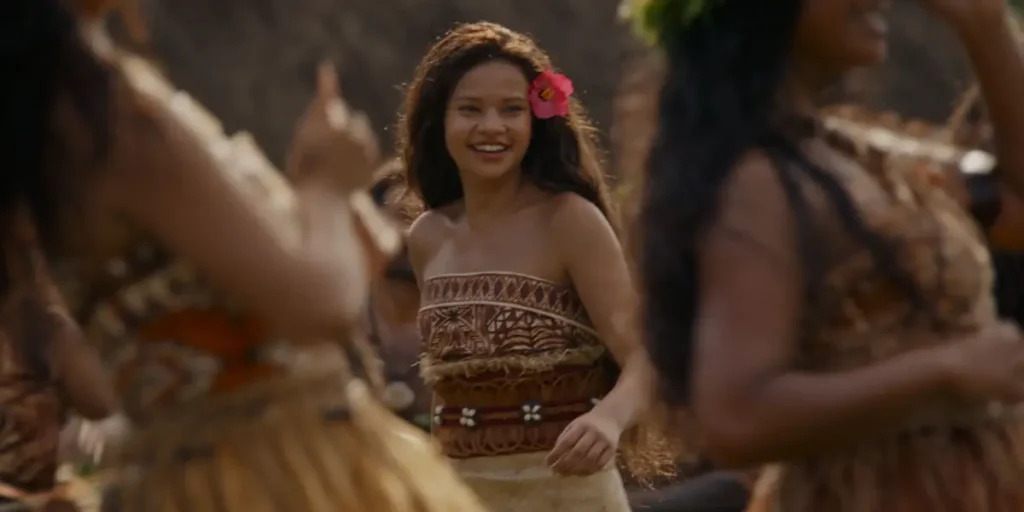
Every generation retells its stories. Moana (2026) asks whether that is worth doing again, and Catherine Lagaʻaia answers with a star-making yes.
Director: Thomas Kail
Genre: Adventure, Live Action, Comedy, Family, Fantasy
Run Time: 115′
Rated: PG
Release Date: July 10, 2026
Where to Watch: In U.S. theaters, in U.K. and Irish cinemas, and globally in theatres
Stories don’t survive because they’re preserved. They survive because somebody tells them again, usually a little differently than the last person did. The Brothers Grimm didn’t invent Cinderella. Bram Stoker wasn’t the last person to tell the story of Dracula. Sherlock Holmes has been played by so many actors he probably qualifies for his own SAG pension. Stories migrate, picking up new voices and new faces along the way, and we rarely object to that, because we understand that stories worth telling tend to outgrow the form they first arrived in.
Which is why the conversation around Disney’s live-action remakes has always struck me as a little strange. The moment one gets announced, the discussion stops being about the film itself and becomes an argument about whether it should exist at all. You either believe Disney is creatively bankrupt, or you’re part of the problem. Thomas Kail’s Moana doesn’t settle that argument. It’s almost too respectful of its source material to even try. But somewhere during its two-hour voyage, I stopped asking whether Disney needed to remake Moana and started wondering why I thought I was the person who got to answer that.
I’ve watched the animated original three times now, though never for reasons as poetic as inspiration. The first viewing left me admiring it more than loving it. The second happened because Moana 2 was arriving and I wanted the context fresh. The third happened a few weeks ago, because this live-action remake was on the horizon. It took that third pass to finally understand why she became one of Disney’s defining modern heroes.
Prompted by the Ocean itself, Moana (Catherine Lagaʻaia) leaves her island home of Motunui for the first time in search of the stolen heart of Te Fiti, hoping to save her people from a creeping blight that threatens everything they know. Standing between her and success is the boastful demigod Maui (Dwayne Johnson of Jungle Cruise), who would rather celebrate his own legend than confront the mistake that created the crisis in the first place.
If you’ve seen the 2016 film, none of this will surprise you. Jared Bush and Dana Ledoux Miller’s screenplay follows the original with almost forensic fidelity, recreating scenes, musical beats and even shot compositions with a precision that borders on translation rather than reinterpretation. It’s hard not to admire the craftsmanship while simultaneously wishing someone had occasionally looked at the blueprint and said, “What if we tried this instead?”
The movie comes alive whenever it forgets it’s chasing another version of itself, and that mostly means whenever Lagaʻaia is on screen. Disney sorted through more than 30,000 submissions before landing on her, and it’s hard to imagine that search ending anywhere else. Like Auliʻi Cravalho before her, she understands Moana’s courage grows out of uncertainty rather than fearlessness. She’s adventurous, impulsive and stubborn in equal measure, and never once slips into impersonation. This is an actor finding the emotional center of a role that already means something to millions, and discovering room left to make it hers, right down to a “How Far I’ll Go” that never competes with memory.
Johnson is trickier. Nobody could accuse him of a lack of affection for Maui, a role tied to his own Polynesian heritage, and that pride comes through in every frame. But affection isn’t discovery, and live action gives him surprisingly few chances to surprise us. Forty pounds of prosthetics, hair and tattoos sit on a genuinely playful performance, but the transformation occasionally becomes something you’re looking at rather than through. Jemaine Clement, once again voicing the treasure-mad crab Tamatoa, remains delightful, and “Shiny” is still a blast, but his return, like Johnson’s, suggests this Moana sometimes mistakes familiarity for affection.
The rest of the cast understands the assignment. Rena Owen gives Gramma Tala warmth without sanding off her eccentricity, building the relationship with Moana that supplies most of the film’s emotional core. John Tui and Frankie Adams make Moana’s parents feel like people rather than obstacles assembled for exposition. Heihei the chicken makes the leap into live action effortlessly, remaining every bit the gloriously confused rooster he always was.
Here is where I try to talk you out of dismissing this on principle. Write this film off for its real flaws if you want; I’ve listed a few. Just don’t write it off for existing in a shape you didn’t grow up with, because somewhere a kid is about to meet Moana for the first time this way. We revisit stories because every generation encounters them differently, and animation is no exception. Animation isn’t a neutral, universally accessible format. For plenty of viewers, particularly some neurodivergent audiences, the exaggerated movement and visual density of animation is genuinely difficult to sit with, not a stylistic preference but an actual barrier. Live action, built from human faces and real texture, can be the version that finally lets someone through the door. That isn’t nostalgia talking. That’s a different way of arriving at the same destination.
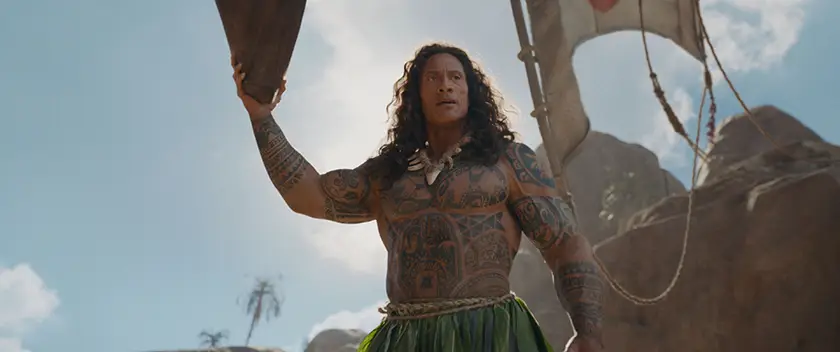
What keeps this Moana afloat isn’t nostalgia. It’s craft. Cinematographer Oscar Faura shifts effortlessly from dazzling turquoise to moonlit blues and ghostly teals that give the ocean an almost spiritual presence, and John Myhre’s production design feels built by people who cared where every carving and woven mat came from. Liz McGregor’s costumes, more than 2,000 handmade garments across cast and background, reward the camera every time it pauses on them. Lin-Manuel Miranda, Opetaia Foaʻi and Mark Mancina’s songs survive the transition beautifully, and the new closing number shared between Lagaʻaia, Johnson and Cravalho plays less like an attempt to top the originals than a passing of the torch.
Do I wish Kail had taken bigger swings? Absolutely, and there are stretches where the film feels reverential to the point of caution, as though deviating might diminish what already worked. But this isn’t Cinderella. Moana can’t relocate to Seattle and rediscover herself running a paddleboard rental company. The culture isn’t decoration here. It’s part and parcel of the whole story, and pulling too hard on those threads leaves you with nothing.
Moana didn’t convince me every Disney remake deserves to exist. It convinced me that existence might not be the first question worth asking. Stories don’t belong to the people who found them first. They belong to whoever finds them next.
Moana (2026): Movie Plot & Recap
Synopsis:
Answering the Ocean’s call, a chief’s daughter sails beyond her island’s reef with a Polynesian demigod to restore a stolen relic and save her people.
Pros:
- Catherine Lagaʻaia is a star-making Moana who never once impersonates her predecessor
- Miranda, Foaʻi, and Mancina’s songs survive the transition beautifully
- Costumes, production design, and cinematography reflect genuine Pacific collaboration
Cons:
- Follows the animated original with near-forensic fidelity, rarely taking creative swings
- Johnson’s and Clement’s returns favor familiarity over discovery
- Inconsistent CGI water and a distracting prosthetic transformation for Johnson
Moana (2026) will be released in U.S. theaters, in U.K. and Irish cinemas, and globally in theatres on July 10, 2026.