
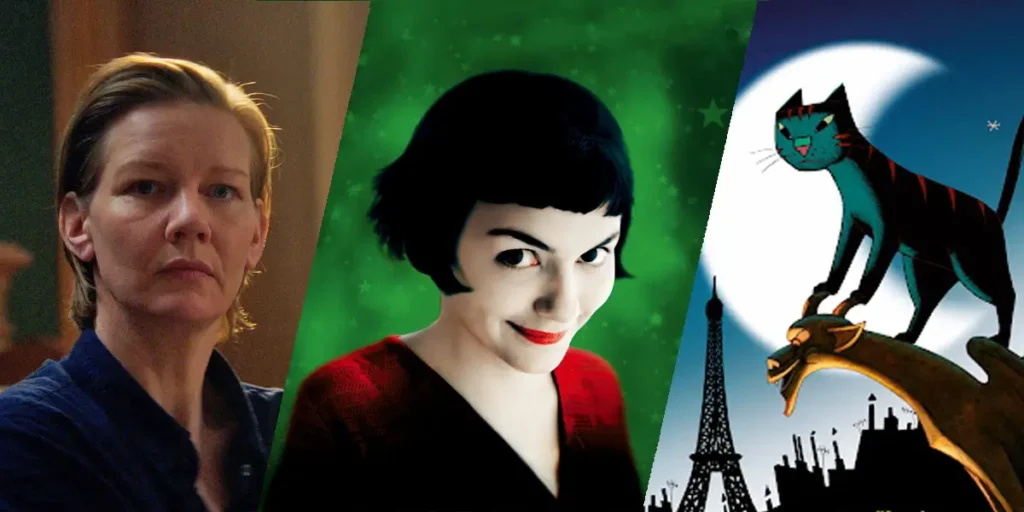
Learning a new language is no easy task, especially if that language is French. On top of the vocabulary to memorize, you’ll also have to familiarize yourself with verb conjugations, grammar rules, and sentence structure that are completely different to what you’re used to. If you’re in need of motivation, movies can help you truly understand a language, immersing yourself in the culture and the natural rhythm of everyday speech with memorable scenes and quotable lines. Hearing spoken language in movies can also help match words with visual contexts, get examples of diverse regional accents, and hear native speakers navigate different scenarios, from casual banter to intense courtroom battles.
Of course, it’s not always so easy, especially if you’re trying to learn French on your own, which is why many learners choose to take an online course like Promova, which provides real speaking practice, interactive exercises, and useful flashcards. Today, we recommend five movies to watch if you’re learning the language, whether you’re just beginning to decipher basic greetings or seeking to master more complex situations. Find the five French films below, carefully selected and ranked by difficulty level, and including a good selection of classics, hidden gems, and recent releases. Happy watching!
Le Petit Nicolas
Level: Beginners (A1-A2)
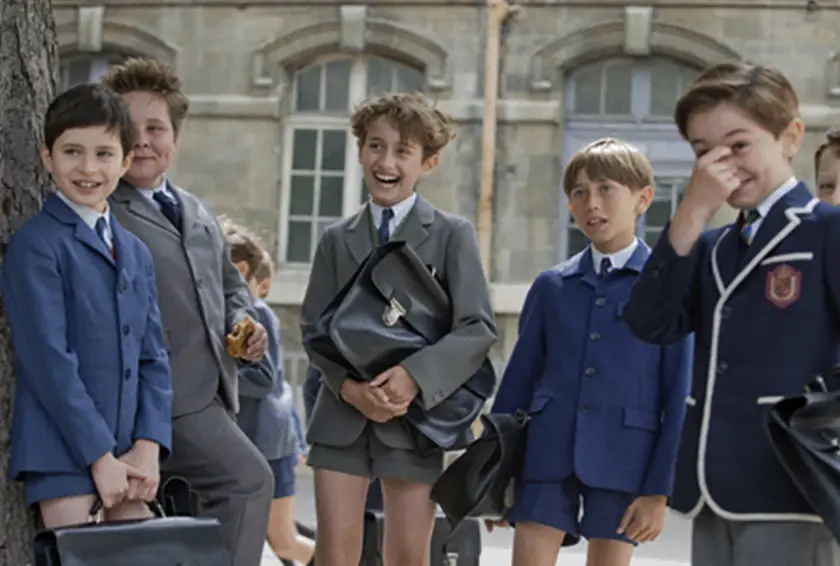
Based on René Goscinny and illustrator Jean-Jacques Sempé’s French children’s book series of the same name, Laurent Tirard’s Le Petit Nicolas (2009) is a great film to begin with if you’ve only just started to learn the language. This modern classic tells the story of a child named Nicolas (Maxime Godart), who leads a peaceful and carefree life, spending time with his friends at school and with his loving family at home. One day, his world is turned upside down when he misunderstands a conversation and becomes convinced that his mother is pregnant. Which, to Nicolas, means the worst possible scenario: his parents will abandon him in the woods to make room for the new baby. And so, our protagonist finds the only logical solution – at least, to his 9-year-old brain: asking his classmates for help, and hatching a series of hilarious, chaotic plans to secure his spot in the family.
The language in Le Petit Nicolas is very accessible, which makes it perfect for Beginner (A1-A2) French learners. Since the story is told from a child’s perspective, the dialogue is very straightforward, with clear pronunciation and many everyday expressions you’re probably familiar with. The visual storytelling is also very expressive, so even if you miss a word or two, you’ll still be able to follow the plot. Vocabulary-wise, you’ll hear a lot of common French idioms, school-related vocabulary, and casual conversations. Le Petit Nicolas is a heartwarming, wonderfully nostalgic gem that will make learning French fun and rewarding.
Une Vie de Chat (A Cat in Paris)
Level: Advanced Beginners (A2)
This charming French gem is the animated comfort film you didn’t know you needed. Une Vie de Chat (2009) takes place on the rooftops of Paris, where a clever cat named Dino eads a double life: by day, he is the beloved pet of a young mute girl called Zoé (Oriane Zani), who’s still mourning the loss of her detective father, and by night, he is (wait for it) a thief. Dino’s nighttime adventures involve devising daring thefts with a friendly, big-hearted burglar named Nico (Bruno Salomone), and when we meet him, our resourceful cat is great at balancing both lives. But things change when a ruthless gangster kidnaps Zoé, and Dino, Nico, and Zoé’s mother need to join forces and rescue her.
Ideal for Advanced Beginners (A2) level French speakers, Une Vie de Chat combines a truly original premise with gorgeous animation and an irresistible jazz soundtrack that gives it such emotion and personality. It will make for an effortless watch, and after a while, you won’t even notice our characters are speaking French. This is a family movie, so while the vocabulary is a little more complex than Le Petit Nicolas‘s, it’s still conversational, and well-enunciated enough for you to understand new terms. And since Zoé doesn’t speak, the film relies heavily on visual storytelling, which will help you focus on the French dialogue from other characters.
Le Fabuleux destin d’Amélie
Level: Beginner to Intermediate (A2-B1)

Jean-Pierre Jeunet’s Le Fabuleux Destin d’Amélie Poulain defined a generation back in 2001, revolutionizing filmmaking by creating a genre where a warm, saturated color palette helped introduce a quirky lonely protagonist who knows exactly what she wants – at least, that’s what she believes. Said protagonist is Amélie Poulain (Audrey Tautou), an introverted waitress with a fervid imagination who decides to secretly orchestrate little miracles to bring happiness to the eccentric people around her. One day, her mission is sidetracked when she falls in love with a stranger named Nino Quincampoix (Mathieu Kassovitz), who’s just as quirky as she is. If you like magical realism and Wes Anderson’s filmmaking style, you’re guaranteed to love Amélie.
Amélie is an excellent bridge for Beginner to Intermediate (A2-B1) learners aiming to transition to authentic French cinema. The film features a beautifully articulated voiceover narrator who explains quirks using repetitive, descriptive language patterns that will help you build vocabulary. It’s also in standard Parisian French, which will make for more authenticity, with some fast-paced dialogue and Parisian slang presenting a fun challenge for intermediate speakers. But even if you’re a beginner, the stylized visuals and expressive acting will still help you follow along.
Bienvenue Chez les Ch’tis
Level: Intermediate (B1-B2)
“Ouais, ch’est mi. Ouh, vingt de diousses!”. If you’re struggling to understand what this means, you’re not alone; Bienvenue chez les Ch’tis (2008) features many lines in the regional Ch’ti dialect spoken in Northern France, often intentionally rendered almost incomprehensible to non-locals for comedic purposes. The line above actually translates to “Oui, c’est moi. Oh, putain!” in standard French, and we guarantee you’ll find yourself laughing out loud when you hear it in the movie.
It all begins when a postal manager from the sunny South of France (Kad Merad’s Philippe) tries to cheat his way into a transfer to the French Riviera. His boss doesn’t fall for it, and as a results, he is transferred to Bergues, a small town in the far north of France, which Philippe and his wife Julie (Zoé Félix) believe to be devoid of fun and inhabited by barbarians. Of course, it’s a stereotype, and their meeting with many warm-hearted locals lead to an unexpected journey for our protagonist, and ultimately, to real friendships too. But before that happens, fantastic physical comedy and hysterically funny misunderstanding will make for a highly entertaining gem.
Bienvenue chez les Ch’tis brings a fun challenge for Intermediate (B1-B2) learners, as it provides very different examples of French, including one you’ll find very difficult to understand. But you won’t be alone, as so does Philippe, and sharing the journey with him is what will make learning so entertaining. As the story unfolds, your ear will learn to recognize phonetic shifts, like how “s” sounds are often softened into “ch” sounds in Ch’ti. This will boost your comprehension skills and even serve as preparation for language tests involving listening exams.
Anatomie d’une Chute (Anatomy of a Fall)
Level: Advanced (C1-C2)
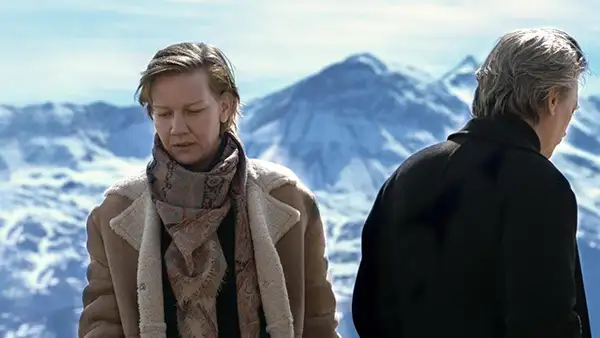
Anatomie d’une Chute (Anatomy of a Fall) is the most recent entry in our list, having been released in 2024 following a highly successful festival run in 2023, with universal acclaim and even an Oscar for Best Original Screenplay. This gripping, multi-layered courtroom drama starts with a simple family scene in a remote French chalet that soon turns into something else entirely when the husband falls to his death from the attic. With no witnesses other than their visually impaired son Daniel (Milo Machado-Graner) and their adorable dog (Messi the Border Collie, who got to attend the Oscars in 2024), and wife Sandra Voyter (Sandra Hüller) as the only other person in the house, there’s only one possible conclusion to be drawn. But is it really that simple?
The film mainly follows the grueling trial Sandra is subjected to after being indicted for murder, which slowly reveals pieces of their marriage that eventually lead to understanding the titular ‘anatomy of a fall’. And as a viewer, you’ll be second guessing yourself right till the end, which makes this tense gem an essential watch. For French learners, this will be a great resource for Advanced (C1-C2) learners looking to master sophisticated language. With dense legal arguments, psychological cross-examinations, and nuanced philosophical debates about truth and fiction, this is a complex film that will require your full concentration, eventually rewarding you with its ending.
If you’re worried Anatomy of a Fall might be too challenging language-wise, what might help is that, since Sandra is an expat, significant portions of the movie are spoken in English, such as when she communicates with her husband or struggles to express herself in court. This provides a welcome, strategic mental break for advanced learners, allowing you to reset your focus before diving back into the fast-paced French legal rhetoric.
The five movies listed above are all fantastic picks if you’re looking for a film that will help you learn French. From beginner to intermediate and advanced, there’s something for everyone here. Start with Le Petit Nicolas or Une Vie de Chat if you’re only just starting out, and don’t forget to turn off subtitles if you’re looking for a challenge. Enjoy!