
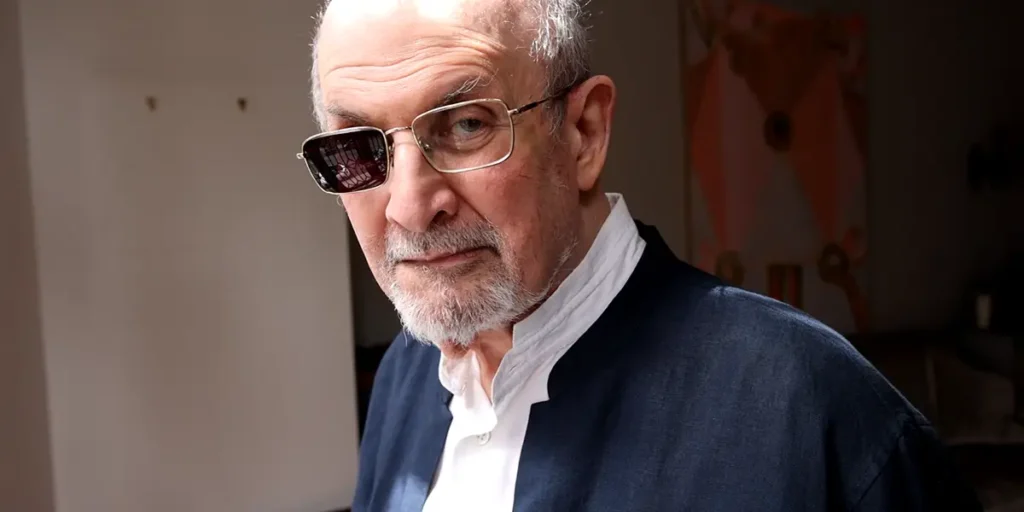
In Alex GIbney’s respectful and admiring documentary Knife: The Attempted Murder of Salman Rushdie, the dignity of its subject in the face of violence shines bright.
Director: Alex Gibney
Genre: Documentary
Run Time: 107′
U.K. & Ireland Release: October 2, 2026 in cinemas, with one night only previews on September 30
U.S. Release: September 25, 2026 in select theaters
“We need to document this.” These words are spoken by Rachel Eliza Griffiths, the poet and visual artist, and wife of Sir Salman Rushdie. Griffiths is referring to the damage inflicted on her husband by a would-be assassin in an auditorium in upstate New York in August 2022. The sight of Rushdie’s face, with his slashed jowls and badly swollen left eye, is almost enough on its own to justify the making of Knife: The Attempted Murder of Salman Rushdie.
The author went to a public speaking engagement, and barely emerged alive. Alex Gibney’s new documentary takes the journey of recovery with Rushdie, and infuses it with the same traits that define the author’s work, particularly his forthrightness and humility.
In response to the attack that almost claimed his life, Rushdie published “Knife: Meditations After an Attempted Murder” in 2024, which displayed his characteristic combination of warmth and strength. Gibney’s documentary is a handy summary of, and companion piece to, Rushdie’s memoir of the attack. The fact that Rushdie survived, and the book and this film exist, are a testament to his desire to keep living on.
Gibney captures that determination in a film that operates a little outside his usual remit of (in)famous public figures. From Julian Assange, to Steve Jobs, to Elizabeth Holmes, Gibney is usually drawn to searching for the shades of grey between the black-and-white public personas. In this case, more than any other of his subjects, Gibney lets Rushdie tell his story of survival, and it’s only fair; he’s earned the chance to tell it. Most of the narration in Knife is lifted from the book, infusing Gibney’s onscreen story with the wisdom, pain and triumph of Rushdie’s prose.
Rushdie has been as well known, if not better known, for the controversy around his novels than the novels themselves. In particular, 1988’s “The Satanic Verses” was accused of being anti-Muslim, resulting in worldwide protests and a fatwa being issued by the Iranian government against Rushdie. The author lived in hiding for many years, but as time passed and the threat of the fatwa faded into the background, he began to live life more publicly. By the turn of the millennium, he could be seen at public events and living an unguarded life.
The first act of Knife captures this period with news footage accompanied by Rushdie’s narration. It’s a Wikipedia-level summary of a series of events that benefits from Rushdie’s telling, and most resembles what people associate with a Gibney doc: slick presentation, but with little beyond the A-to-B structure. Gibney rarely escapes the gloss that defines his work, though his best films are usually the ones that transcend the glamour and/or notoriety of their subject.
Knife is closer in spirit to the likes of Mea Maxima Culpa and Taxi To The Dark Side because of its intimacy. The film’s trump card is the footage shot by Griffiths in the aftermath of the attack. As a filmmaker, she saw the value in documenting the damage, and her husband’s refusal to give in. Gibney is given access to this footage, and it’s as raw as the nerves slashed by the assassin’s blade. As his neck gets stapled, and his eye recedes back into his socket, the author retains his wit, albeit in a quieter and strained voice.
Rushdie’s observations from the memoir inform Gibney’s choices. While the director uses recreations and animations to fill in gaps, Rushdie cites various visual influences, from Alfred Hitchcock to Sebastião Salgado, clinging to them as it becomes clear he will lose the sight in his eye. The moment that news is relayed to Rushdie is accompanied by the eye-slicing scene from Buñuel’s Un Chien Andalou. Every artist takes inspiration from others.
Griffiths’ footage of Rushdie is both harrowing and hopeful. As the days pass and his condition improves, it is heartening to see time literally healing wounds. Until now, the wounds inflicted on Rushdie were metaphorical, but time healed the effects of the fatwa, and it has healed him again (This time with the assistance of various medical staff). In Knife, time and hope are the cures for a lot of ills, as shown when Rushdie finds the courage and strength to revisit the site of the attack one year on.
Rushdie may be too well known for Gibney to unveil much new about him, but for both men the aim is to display the resilience of body and soul. In “Meditations After an Attempted Murder”, Rushdie writes that a documentary must be made from this story, and it arrives in handsome and inspiring form. In “The Satanic Verses”, he notes that there are “too many demons inside people claiming to believe in bad”. Knife: The Attempted Murder of Salman Rushdie may help exorcise a few of those demons.
Knife: The Attempted Murder of Salman Rushdie – Movie Plot & Recap
Synopsis:
The harrowing attack on Salman Rushdie by an Islamist fanatic in August 2022 is told from the victim’s point of view, with home footage and narration from Rushdie and his wife.
Pros:
- Rushdie and the attack make for a compelling subject, with the footage from his hospital bed adding to the poignancy
- Gibney and Rushdie offer a hopeful point of view, encouraging resilience and strength in the face of vitriol and violence
Cons:
- Much of Rushdie’s life is already well-documented. As emotional as this all is, it offers little new information
Knife: The Attempted Murder of Salman Rushdie will be released in UK & Irish cinemas on October 2, 2026, with one night only previews on September 30. In the U.S., the film will be screened in select theaters from September 25, 2026.