
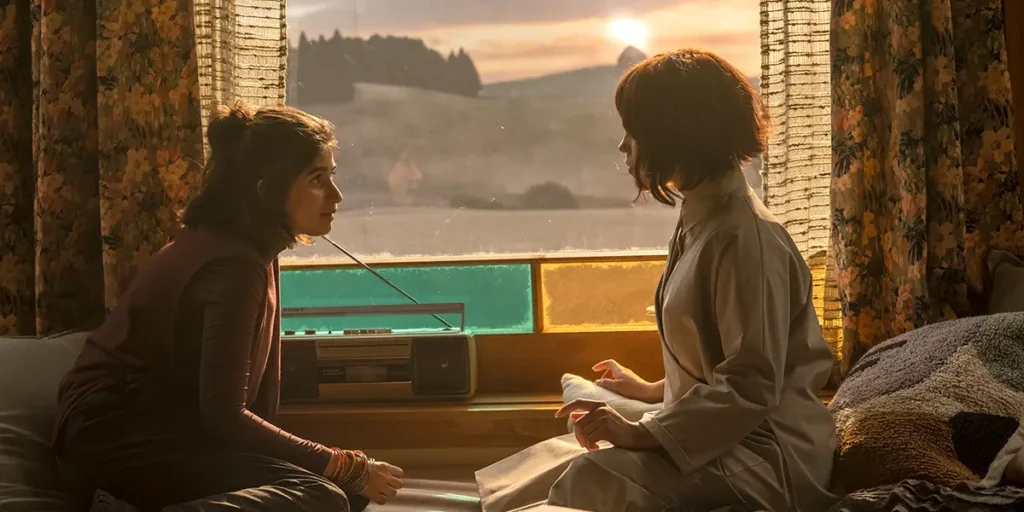
In a world with advanced technology, Klara and the Sun is a story of friendship, grief, and achieving one’s dreams.
Director: Taika Waititi
Genre: Dystopian, Sci-Fi
Run Time: 116′
Rated: PG-13
BFI London Film Festival Screening: October 15, 2026
Release Date: October 23, 2026
Where to Watch: Globally in theaters
Klara and the Sun is set in a dystopian future where technology has advanced to the point that genetic engineering and robot friends are possible. Klara (Jenna Ortega, of Death of a Unicorn) belongs to the latter category: she’s an Artificial Friend who struggles to get chosen because she belongs to a now obsolete model. But everything changes when Josie (Mia Tharia) sees her in the store window and convinces her mum Chrissie (Amy Adams, of Nightbitch) to purchase her as her companion.
Josie is a teenager who has been lifted, a genetic procedure for kids to become smarter, and has lost her sister when she was a kid.
The acting is really good in Klara and the Sun. Jenna Ortega does an excellent job at bringing Klara to life. She is especially great at embodying Klara with her wide eyes that hardly ever blink, robotic movements, and the walk of someone who is still learning how to move in this life. Amy Adams and Mia Tharia also stand out as their respective characters, Chrissie and Josie, but they are at their best when they are acting opposite each other, creating a believable and authentic mother and daughter relationship. Ortega fits into the dynamic really well by inadvertently bringing out new sides of both the mother and the daughter that they will have to come to terms with.
The setting of Klara and the Sun is also fascinating, taking us into an entirely different world where children go through medical procedures to become smarter and find companionship and friendship by purchasing artificial friends, essentially robots whose only job is to accompany them in their teenage years. What is even more interesting is that the audience sees all of this from Klara’s perspective and she is not a reliable narrator, given that she is seeing and learning everything from the first time. Not only do we gain an insight into how Klara sees and interprets the world, but we also learn how to decode that and understand how this dystopic world works for ourselves.
Unfortunately, the storytelling in Klara and the Sun does not work well at all. Due to its dystopian setting, the movie has a lot of information to share for the audience to understand the content and does so in a very heavy and flat way. From the opening scene, the film clearly struggles with the volume of information it has to convey to the audience and chooses to do so through lengthy speeches that function as exposition for the narrative and essentially just talk at the audience, rather than revealing information in conflict or in a more dynamic way.
The central themes of Klara and the Sun are also explored only briefly and with no depth at all. One of the main topics that the film sets out to examine is friendship: Klara and Josie seem to have an instant connection, but this is only ever shown in the scene where they first meet. There is a lot of talk in the film of how strong their friendship is and how beneficial it is to each of their character arcs but in reality, we see very little of it once Josie buys Klara other than one montage in the first half of the film. The other major theme of this film is grief and this, too, is not explored with enough depth. While grief is suggested to affect every character in this story, the only time this is actually addressed is in the second half of the movie, when Chrissie gives a very brief speech on her relationship with grief.
Overall, Klara and the Sun is an entertaining film in itself, with wonderful performances from all the main actors and a fascinating dystopian setting. However, as an adaptation it suffers from the lack of exploration of its central themes and a considerable struggle in its worldbuilding and set up. This is a shame because the film could have leaned into the elements of grief and friendship a lot more instead of simply hinting at them, as they are the two pillars on which this story is built and would have allowed for a much more emotional ending to the narrative.
Klara and the Sun: Movie Plot & Recap
Synopsis:
Klara is chosen as Josie’s Artificial Friend and will have to learn how to bond with her and support her in her everyday life and struggles as a teenager in a dystopian futuristic world.
Pros:
- The actors embody their characters really well, especially Jenna Ortega, and their dynamic is excellent on screen.
- The dystopian setting is fascinating and new.
Cons:
- The narrative and world building are not very well delivered.
- The themes of friendship and grief are only mentioned but never fully explored.
Klara and the Sun was screened at the BFI London Film Festival on October 15, 2026. The film will be released globally in theaters on October 23, 2026.