
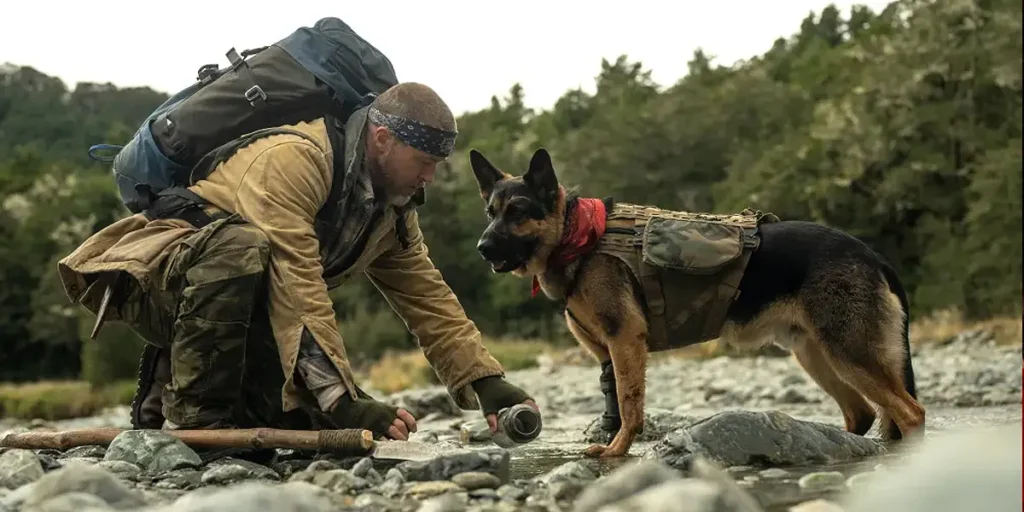
Despite reliable canine performances, David Ayer’s Heart of the Beast never develops the core relationship at the center of this survival thriller.
Director: David Ayer
Genre: Action, Adventure, Drama, Survival Thriller
Run Time: 101′
Rated: PG-13
Release Date: September 25, 2026
Where to Watch: Globally in theaters.
As soon as David Ayer’s Heart of the Beast opens with “Somewhere in Alaska,” you can leave the cinema, because it spoils exactly where the story will end up, without missing a beat. The harrowing journey of U.S. Army Veteran James Belmont (Brad Pitt) and his combat dog, Odin (played by a quartet of canines – Uber, Seeka, Ryder, and Hondo), will result in tragedy.
Maybe it’s just my averse eye that immediately clocked how the film would end, because a cacophony of tears filled the cinema when we eventually returned to the film’s opening scene. Either way, Heart of the Beast barely functions as either a survival drama or a pure adventure because it forgets what matters most in a movie like this.
The opening scene dampens any connection one might feel between James and Odin, because anyone who can put two and two together knows how we will get to that scene. Yet, Ayer never gives us any reason to care about the two when he flashes back to a week earlier, when James is stranded deep in the Alaskan wilderness after suffering a heart attack while flying a plane. The army veteran and a trauma-stricken dog must now brave the wild as they look for a safe path out of the woods and encounter various physical (or animal) obstacles that repeat what we already know about the characters but never actively deepen their bond.
Because the emotional core of a “man’s best friend” film is the audience falling in love with the “best friend.” In fact, James isn’t Heart of the Beast’s main character – it’s Odin. You could theoretically tell this by how cinematographer Mauro Fiore frames some of the film’s key sequences through the dog’s perspective, but the images are so often murky and underlit that we end up grasping very little of the movie’s treacherous adventure. The key sequence – where James and Odin cross a makeshift bridge formed out of a fallen tree trunk – is probably the most Ayer comes to palm-sweating thrills.
But it pales in comparison to the same type of scene found in Padraic McKinley’s The Weight, especially when (predictably) something bad happens, and James is thwarted in a body of water, where the camera purposefully disorients without making the action feel legible – or urgent. We barely feel the physical toll the character endures as he’s repeatedly hit in the head by the rocks he encounters, nor do we feel an ounce of emotional heft as Odin comes to his rescue.
Not once does Ayer take time to tell us why this bond between James and Odin matters, save for vague flashbacks of the protagonist’s time in Iraq and Afghanistan that essentially glorify the military without saying anything meaningful beyond “it gave them Post-Traumatic Stress Disorder.” Ayer implies this near the film’s opening, as the dog suffers from extreme, vivid nightmares, but it never factors into how the animal perceives danger in the wild. Once it’s mentioned, it comes up again only near the end that Odin can sometimes get aggressive if he remembers some of the more terrifying events he’s encountered, without explaining why it mattered for James to keep his best friend, despite one leg lost and titanium teeth in his mouth.
It’s almost as if Ayer wanted to criticize the United States’ involvement in the Iraq War, to question how so many veterans came home shell-shocked and are still reeling from its effects. However, he never goes further than surface-level depictions of a vague point in time, because if he engaged with the politics of Cameron Alexander’s screenplay, he wouldn’t find a story that celebrates American exceptionalism in a war that has been heavily scrutinized and criticized. But Ayer isn’t one to criticize the military (or the police, as seen in 2017’s Bright), so Heart of the Beast will never be able to examine the impacts of the Iraq War on its protagonists and on the senseless carnage that occurred in the flashbacks. Its politics remain vague until the American flag appears in the background of an image where James bonds with Odin abroad, then cuts to him walking in slow motion behind a decimated compound, with his dog by his side.
Many critics seem to have brushed off these images entirely and focused on the Call of the Wild-esque aspects of the picture, which would have been valid if the film didn’t feel like we were watching insidious state-approved propaganda near the end. Why does Ayer feel it necessary to highlight his service without talking about the fallout from the Iraq War and the larger political context that is entirely ignored, as James and Odin still reel from the trauma and experience nightmares so intense that James has to alleviate his constantly failing heart by guzzling down a bottle of Aspirin? That feels significant, but we never get the chance to spend meaningful time with characters who end up as surface-level depictions of “heroic” soldiers who have done great service to the United States and still help each other out.
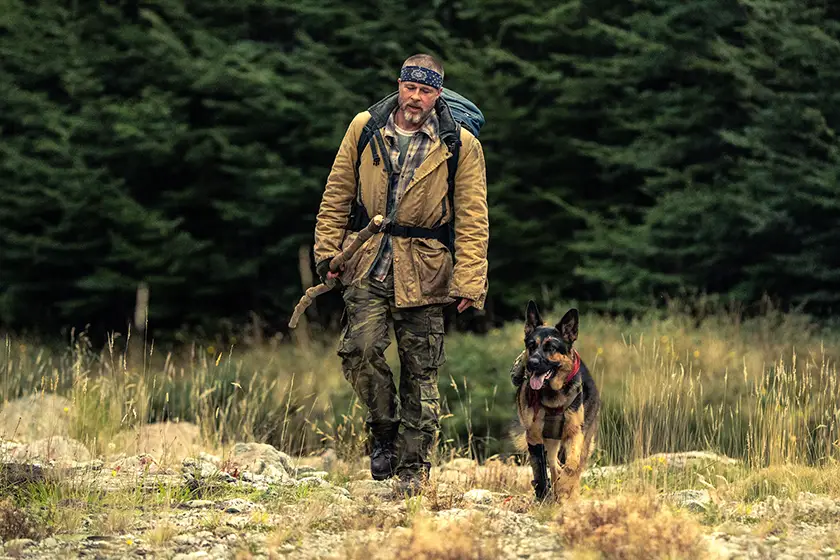
Not even Pitt churns out an interesting performance. His “late-stage” career has seen him reckon with his age and dwindling star power in Hollywood, through Jon Watts’ Wolfs and Joseph Kosinski’s F1. In Heart of the Beast, his turn as James Belmont is as silent as Robert Redford in J.C. Chandor’s All Is Lost, but with little introspection or contemplative micro-expressions to unlock the character’s pain. It’s as ordinary as the rest of the film, shot and staged with little imagination and a refusal to take a stance on the militaristic images it depicts. The only performance of note is the one its canine quartet gives as Odin, but even then, it’s only because of the dog’s physical prowess, not necessarily because the characters and the audience feel an emotional bond.
When J.K. Simmons eventually shows up as a retired gold digger with so much history to parse to James, Heart of the Beast wakes up from its slumber. But he disappears from the picture as soon as he dumps a bunch of exposition to the protagonist and extracts critical information from him. The movie never quite lives up to that soulful exchange between the two humans, because it never stops to ask what the images shown on screen actively mean. It’s heartwarming until it isn’t, especially when it’s clear none of the characters will feel tangible and complex. At some point, Ayer toys with spiritual fulfillment, but that scene says nothing about the character or salvages the film, especially when Jared Michael Fry’s musical score goes from evocative to shamelessly manipulative as it reaches what we all know is coming.
In the hands of a more cinematically (and politically) literate director, Heart of the Beast could’ve been one of the year’s best films. In Ayer’s hands, it’s one of the year’s dullest and most irresponsible.
Heart of the Beast (2026): Movie Plot & Recap
Synopsis:
After crashing his plane in the Alaskan wilderness, U.S. Army veteran James Belmont and his dog Odin must find safety and escape the woods before it consumes them whole.
Pros:
- The dog performances are impassioned.
- J.K. Simmons is always a welcome screen presence.
Cons:
- Brad Pitt’s performance is unimpressively dull, even if it’s mostly silent and attempts to be introspective.
- David Ayer’s cinematic language is unimpressive, and stages a bevy of nauseating and underlit peril sequences that never makes us gel with the characters.
- The movie never gives us a compelling reason to care about James or Odin, as the opening scene spoils what will ultimately happen.
- The film’s political commentary is vague until it glorifies the military and never interrogates the cost of the war and the fallout from James and Odin’s PTSD.
- The score turns from evocative to manipulative very fast, especially during a distasteful final montage.
Heart of the Beast is now available to watch globally in theaters.