

In Days and Nights in the Forest, Satyajit Ray offers a humorous yet philosophical examination of how people’s conduct shifts when stripped of social structures.
Director: Satyajit Ray
Original title: Aranyer Din Ratri
Genre:
Run Time:
Rated: Not rated
Original Release: March 14, 1973
4K Restoration Release: February 27, 2026 (limited); September 29, 2026 (Criterion)
Where to Watch:
Satyajit Ray found meaning in the ordinary. He utilized the contradictions of Indian society, the routines we utilized to make each day more comfortable, the disappointments people have when something is not going the way they would like it to be, and the fleeting moments of hope that help us see that there is a guiding light of prosperity ahead, to capture the beauty in the places others might look away from. And he does so with great honesty, observing the people from his country with their imperfections and constant striving for something better.
Before Ray became a filmmaker, Indian cinema leaned toward escapism and melodrama. Many films drew on mythology and history to create dazzling dramas or daydream musicals, like Bharat Milap (1942) and Anmol Ghadi (1946). Although they served primarily as entertainment, Ray argued that most filmmakers avoided the era’s many problems. Sure, the occasional popcorn entertainment does quench a certain cinematic thirst, distracting you from some of life’s hardships and personal grievances. However, Ray understood that cinema did not have to look away from reality to offer hope. That single aspect set him apart from his peers. The brilliance of his work, and what makes him one of the most important figures in Indian cinema, is that he lets his characters live through their struggles without resorting to despair or misery, even in the most dire situations.
Ray acknowledges the class divisions, poverty, and social inequality happening in the country, yet he does not suggest that these circumstances are the entirety of the human experience. By confronting reality, Ray paves the way for his characters’ search for hope and the humanity that gives life to his beautiful, meticulously crafted stories. One film that best presents this element is his 1970 picture Days and Nights in the Forest (অরণ্যের দিনরাত্রি), an unsung yet masterfully crafted piece from the second half of his career. In this film, Ray constructs a quietly observant portrait of human behavior through what people might call a “hangout film” today. But a kick-back this is not, although dashes of comedy are interlaced into the philosophical notions of the story.
What may seem at first like a simple escapist road trip to the other side of the country later becomes an intimate examination of how people’s conduct shifts when stripped of the social structures and daily routines that keep them, and their impulses, attuned to the privilege they have. Adapted from the novel of the same name by Sunil Gangopadhyay, Ray tells the story of four middle-class men from Kolkata–Asim (Soumitra Chatterjee), Sanjoy (Subhendu Chatterjee), Harinath (Samit Bhanja), and Shekhar (Rabi Ghosh)–who travel to the Palamu countryside as a means to find an escape from their rudimentary and pressure-filled lives. They have been friends for many years, know every little secret (or so it initially seems), and stand by each other through thick and thin.
During the initial passage of the film, the quartet’s “leading voice”, and owner of the car in which they travel, Ashim quotes: “People behave like kids when they leave the city.” From the get-go, Satyajit Ray presents the film’s thesis, letting the audience know that the childishness and carefree actions his characters display during their holiday are not innocent. Instead, Ray criticizes their male ineptitude and highlights their irresponsibility and arrogance when stripped of their status. Ashim and company drive toward Palamu while reading a guidebook that tells them about the district’s must-see places and, more importantly, key considerations, like how they should treat the local tribal women who live nearby, filled with both truths and stereotypes.
Immediately after arriving, they place their belongings in a state-owned bungalow without a permit, and they respond in a free-wheeling manner by trying to bribe the caretaker and get drunk, as expected when people are on holiday. They don’t seem to care about any potential repercussions or what might happen to the workers there, who might get in trouble for their ignorance. In these opening scenes, Ray establishes the four men as products of a privileged urban class, not tourists venturing elsewhere for an escape. Their casual disregard for the people around them is played with some hints of humor, but Ray does not let those comedic flashes obscure the ugliness beneath their behavior.
In the newly forged yet inevitably fractured relationship between Asim and Aparna, a local woman, Ray dismantles the illusion of control Asim vows to maintain. Aparna’s curiosity and Asim’s attraction to her reveal the insecurities and assumptions both carry beneath their composure. As the brilliant, crafty filmmaker he is, Ray doesn’t present this relationship as a conventional romantic side story; instead, he uses it to tie into his thesis on social conditioning. Adopting that approach would fracture the entire picture. The key scene in Days and Nights in the Forest, and the one most people highlight, is a memory game. Players name a celebrity of their choosing, building a list until someone forgets the order. It seems simple enough, but when more than ten names are thrown into the list, the confusion starts to take over.
The game begins smoothly, with each character naming a celebrity with a specific intent, and everyone remembering the list easily. However, as the names pile up, the tension rises, making the viewer want to play along and feel uneasy. This happens because your focus wanders to Asim and Aparna rather than the game itself. Ray reveals the difference between their behaviors and mentalities. The Indian filmmaker uses the game as a subtle window into their respective social conditioning–examining how people reveal themselves without realizing it. In the hands of another filmmaker, this would be an insignificant moment. In the hands of Satyajit Ray, however, it exposes the deeper contradictions of the characters and the society that surrounds them.
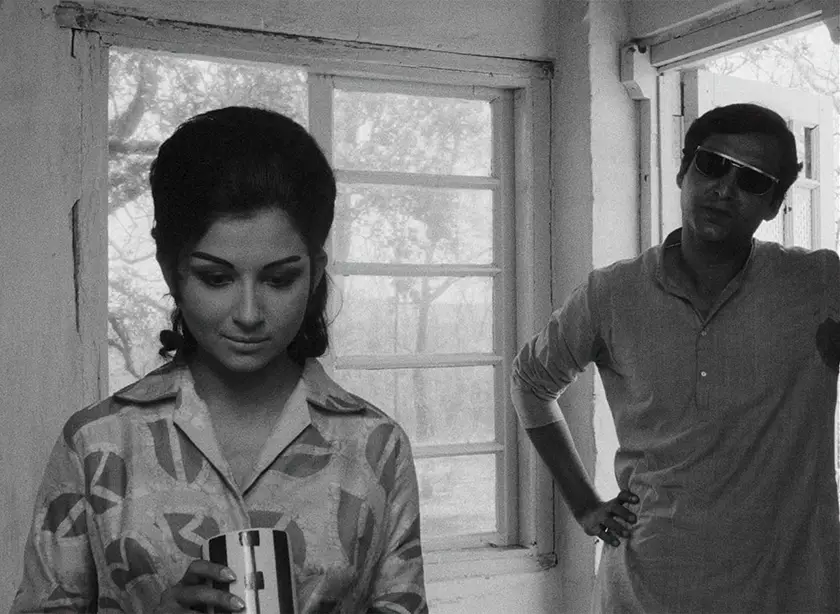
Days and Nights in the Forest ends with little resolution, offering only a brief hint at what these characters’ lives will be like after the film’s events. The audience must imagine whether their behavior would change, yet deep down, one knows it won’t. As society was back then, and as we look at the present, countless stories echo similar scenarios, and very few people have left their “escapist” holidays with a change in behavior or a crack in their privilege. This contemporary lens on what Ray examined makes the film even more heartbreaking and important.
Days and Nights in the Forest: Movie Plot & Recap
Synopsis:
A group of friends from Kolkata head to Palamu to escape their rudimentary lives, but their ignorance and arrogance are confronted as days and nights pass in the Indian district.
Pros:
- Satyajit Ray’s balance of humor and philosophical examination offers a truthful portrayal of people colliding with privilege, class, and social status.
- Soumendu Roy’s beautiful cinematography complements Ray’s portrait, as each use of natural light and shadow reinforces the film’s thesis.
- The entire cast’s performances feel naturalistic and honest.
Cons:
- None
Days and Nights in the Forest was released in a Criterion Collection 4K UHD and BLU-RAY Special Edition on September September 29, 2026.