
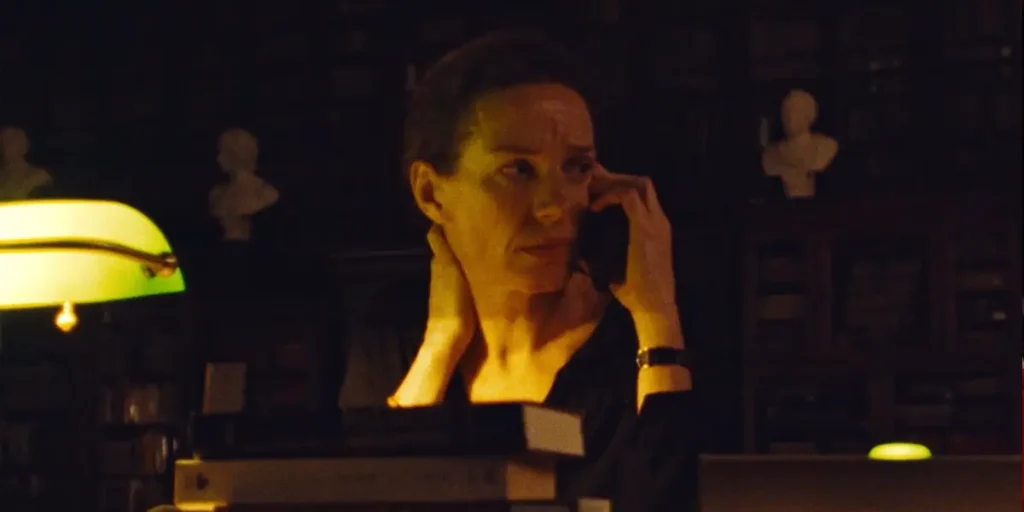
The premise, setting and inherent existential dread of Chronovisor combine to make it a truly unique psychological horror.
Directors: Kevin Walker & Jack Auen
Genre: Fantasy, Mystery, Sci-Fi, Thriller
Run Time: 99′
BFI London Film Festival Screenings: October 9, 2026
U.S. Release Date: TBA
U.K. Release Date: TBA
It is so easy to disappear down online rabbit holes. Whether Instagram doom-scrolling or YouTube binges, the draw of a distraction is undeniable. Work’s boring, people are annoying; why not seek solace in a dopamine hit? We are all susceptible to having our attention pulled away, no matter what work we do. The mesmerising and quietly disturbing Chronovisor is a welcome reassurance that not only can the most serious-minded people get sucked into full-blown paranoia, but they can be the ones most at peril from the consequences.
Jack Auen and Kevin Walker make their feature debut as writers and directors with Chronovisor, and it is a testament to their confidence that the film defies easy categorisation. To call it Lynchian would be too easy. The movie has also earned comparisons to the avant garde works of David Gatten or Michael Snow, but it’s far more accessible than that. Any tag would just be too constraining. Chronovisor is set in the cosy reading rooms and offices of New York academia, but Auen and Walker trust their audience to let the mood and the mystery bring them along.
Chronovisor opens with the inciting boredom that leads to distraction. Beatrice (Anne Laure Sellier) explains her academic research into brain loci to her dinner companions at a restaurant. She concludes, and takes a gulp of wine to wash the cerebral taste away. Sellier’s performance gives little away, but it’s evident Beatrice has had to explain her work many times before. Sellier maintains a necessary academic hauteur throughout the film, which makes it all the more compelling when someone who should know better ends up on a very dangerous tangent.
Beatrice gets a taxi home from dinner, but the streets of New York seen through the windshield have rarely looked darker than they do in Chronovisor. As viewed through the 16mm camera of DoP Leo Zhang, the city morphs into a blob of dark foreboding; anything not lit by banker’s lamps on research desks is a world operating in secret. The sight of NY cabs darting about the blackened streets recalls Eyes Wide Shut, another conspiracy thriller that confounds as much as it compels. The taxi will bring Beatrice home, but she will take a particularly mysterious detour all on her own.
There is a sad trend of acclaimed academics immersing themselves in conspiracy theories in later life, but Chronovisor is a brilliant evocation of the thought processes that can lead a person down such nefarious paths. Boredom, isolation and repetition combine to make even the most outlandish propositions seem plausible. While digging into Husserlian phenomenology one night, Beatrice finds a reference to the chronovisor, a device that allows the user to glimpse images of the past. The premise is just compelling and ludicrous enough for Beatrice to investigate further, and Chronovisor’s genius lies in taking it as seriously as she does. The idea of the chronovisor is nonsense but, by placing us next to Beatrice as she dives deeper into its lore, Auen and Walker make us want to believe.
The story of the chronovisor is based on the story of a real Italian Benedictine monk named Pellegrino Ernetti. He claimed to have used the device to glimpse Christ’s crucifixion and performances of lost Roman plays. As absurd as this is, Beatrice and Chronovisor approach the assertion with an academic openness. She reads contemporary articles, requests archival material from Ernetti’s estate, and bogs down in the minutiae of Ernetti’s work until something like a concrete theory emerges. Auen and Walker immerse us in the research, skimming pages of text and highlighting the important passages, just as a researcher would. Chronovisor is patient, but its pace immerses the viewer in Beatrice’s commitment to her new investigation.
Chronovisor speaks the language of horror, from its long shadows to its increasing paranoia, but it doesn’t resort to garish scares to make its point. The fear of the film lies in the possibility of upending our world with this technology. Auen and Walker tap into the fragility of social constructs by even daring to suggest that everything we know could be challenged. Beatrice is warned a number of times that using the chronovisor can have detrimental effects on its viewer, but watching an intelligent and rational person ignore such advice is a grave worry. Despite unfolding in a relative abstract, Chronovisor mirrors our lunatic moment of corrupted egos and wayward judgement. Even when ploughing headlong into a nightmare, we can’t seem to bring ourselves to stop, and that’s truly terrifying.
Chronovisor: Movie Plot & Recap
Synopsis:
An academic researcher begins investigating the possible existence of a device with unearthly powers.
Pros:
- The premise, and the directors’ approach to it, make this one of the most unique psychological horrors in years
- Full of atmosphere, aided by 16mm cinematography that darkens the shadows, and a compellingly still lead performance
Cons:
- The horror is slow-build, and won’t work for adrenaline-seeking fans of jump scares
Chronovisor was screened at the BFI London Film Festival on October 9-11, 2026.