
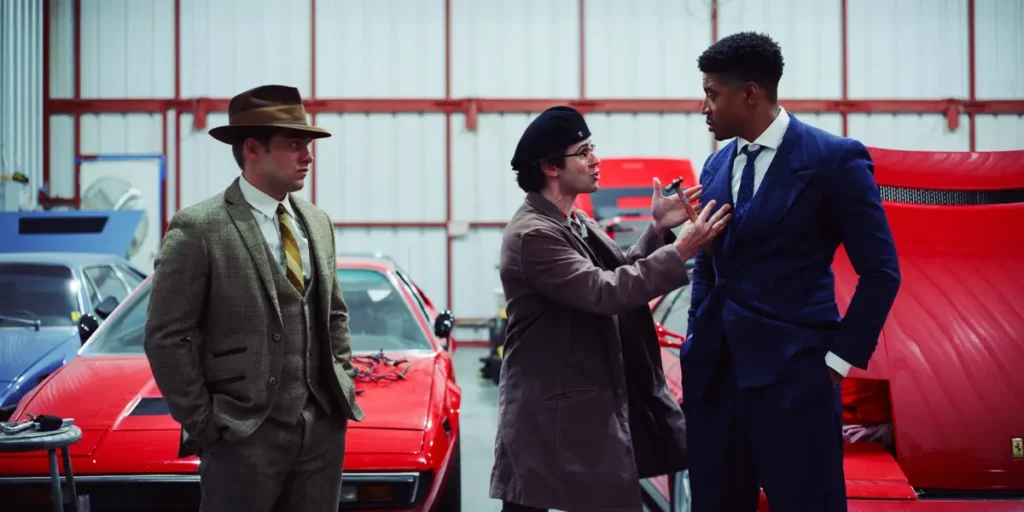
Tyler Shields’ Chapter 51 is an ambitious and admirable but ultimately flawed mockumentary about Hollywood culture and egos.
Director: Tyler Shields
Genre: Crime Thriller, Comedy, Mystery, Mockumentary
Run Time: 120′
U.S. Release: June 23, 2026
U.K. Release: TBA
Where to Watch: In select theaters and on digital platforms
Chapter 51 is more of an interesting experiment than a cohesive motion picture. Shot on a bunch of formats – 8mm, 16mm, 35mm and 70mm film, Vistavision, Panavision, IMAX, even mobile – and framed as a mockumentary centred around a series of murders, the movie doesn’t totally work either narratively or technically, despite all the kit at writer-director-cinematographer Tyler Shields’ disposal.
The end result is more of a curiosity than a satisfying film; something that’s much more ambitious than necessary, and that could have used its gimmick of “let’s use all the formats under the sun” in a more interesting fashion.
Chapter 51 is presented as a fake documentary in which ex-FBI investigator Thomas Scott (Shields) talks about and analyses the murder of three actresses (and the attempted murder of a fourth one) by a serial killer imaginatively called “The Hollywood Killer” during the production of a terribly ambitious movie named Dissident. The victims were all the leading ladies of said film: Ava Bergman (Abigail Breslin), who was supposed to be the muse of egomaniac and aggressive writer-director Christopher Pace (Connor Paolo); Greta Daniels (Charlotte Lawrence), who was hated by said filmmaker; Barbera Ball (Olivia Wachsberger), who was having an affair with her co-star, drug-addict thespian Dustin Scott (Dylan Sprayberry, looking like a mixture between Sebastian Stan and Chris O’Donnell), and the only survivor of the murders, the unpredictable Audrey Evans (Allie Marie Evans).
The main suspects in the killings are both Pace (who is as violent as any filmmaker could be) and Scott (who, as the filming progressed, became more erratic and suicidal), but also producer Tedd Makiewicz (Todd Mandel), one of the most powerful executives in Hollywood, and former action star Melvin Asher (Mo Abhat), who, as filming went on, became obsessed with winning a Oscar, and swore nothing (or no-one) would stop him from getting it. The idea, then, is that the mockumentary is telling the story of the film’s shoot, trying to find out who exactly could be the Hollywood Killer.
Now, the main gimmick of Chapter 51 is that it was shot in pretty much every camera format available. This could have been used imaginatively, either as a narrative tool or to differentiate different storylines or sensations within the movie. Unfortunately, as Chapter 51 is a mediocre documentary, the inclusion of all these formats doesn’t really do anything to make the end product better or more interesting. Yes, the movie includes images from the fake film Dissident, as well as supposed outtakes and interviews with the people involved. But despite all this variety, the different formats aren’t really used in interesting ways, or even coherently.
The fact that there’s a very particular conceit doesn’t help either. In short: in order for the audience to believe in Chapter 51, they also have to believe in the fact that the cameras in Dissident were rolling all the time, apparently, in an effort to capture something more natural and less restrictive. Not only that, but Dissident is described as one of the best motion pictures ever made; a true, transgressive masterpiece whose torturous filming process, like many other films in the past, is being justified due to its apparent quality. Thus, all the material the viewer is watching as part of Chapter 51 is supposed to be B-roll and the like from the shoot.
Now, there are two problems with this. The first is that the whole “they shot 90 million dollars of film for this project” idea is simply ridiculous and extremely hard to believe. Not only because it isn’t practical, it isn’t cheap, and it makes no sense, but also because after murder number one, any sane person would have stopped doing it. The second is that, due to the way Shields has directed Chapter 51, no part of the material feels like B-roll or outtakes. His camera rarely moves; most shots are composited like photographs, barely using depth of field or taking advantage of locations, and it all looks artificial and incredibly stiff.
Chapter 51 is supposed to be a mockumentary that uses “real” material from a fake movie, yet said material never manages to feel organic, but rather like stuff that was staged quite uncomfortably. This not only means that the film is an experience that’s very hard to swallow but also turns the usage of all those different camera formats into nothing more than a marketing ploy. There’s absolutely no benefit in having shot some scenes in IMAX, others in film and others digitally. The only moments that feel kind of realistic are the videos shot by the murderer with his phone, but even their inclusion doesn’t make sense, especially since this is supposed to be a documentary. Maybe if it had included some blurring or the pixelation of faces or something, it could have worked.
But even if the whole production feels haphazard, and even if the whole conceit doesn’t make a lot of sense, I can’t help admiring Chapter 51. Yes, most of its scenes feel like proofs of concept rather than bits and pieces of an actual movie (that’s supposed to be amazing, by the way). And yes, director Tyler Shields doesn’t make for a convincing detective. But the entire project is so ambitious, so ridiculous, and so big that at times it manages to feel like something worthwhile. At least when it’s satirising egomaniacal directors, problematic actresses, misogynistic actors and producers, nepo-babies (Emily Alyn Lind plays Tedd’s daughter, Effie, who is also a producer) and misguided auteur films. Not all of it lands, and some of it is questionably played for laughs (like Dustin Scott’s descent into madness), but at least it’s not boring and is quite weird.
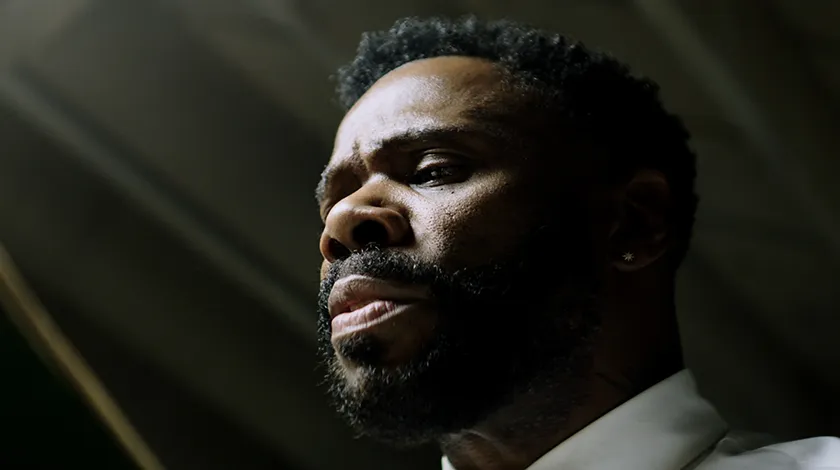
The performances are all fine, and vary from the mundane (Alyn Lind looks quite bored during most of her interviews, in fact) to the incredibly over-the-top and fun (like Connor Paolo playing Pace like a madman, or Sprayberry becoming crazier and crazier as the story advances). He wasn’t mentioned before, but Colman Domingo is also here, portraying the original director of Dissident, Christopher Demy. He’s obviously an amazing actor, but he doesn’t have a lot to do here, mainly appearing during the interviews and using his incredible voice to lend some gravitas to the character.
Chapter 51 is a rather intriguing curio: it’s got some sound ideas and a great cast, and it does manage to satirise some of the most ridiculous aspects of Hollywood culture. But at the same time, it clearly lacked the budget (or resources, or time) to become a credible mockumentary with an appropriately legendary (fake) movie at its centre. No amount of burning Ferraris or helicopters can compensate for the flat staging and stiff camerawork, unfortunately, nor can the multiple camera formats used. Chapter 51 is definitely not for everyone, but maybe the more forgiving audience members (like Yours Truly) will be able to find something of value in its admittedly original trappings.
Chapter 51: Movie Plot & Recap
Synopsis:
A mockumentary showing an ex-FBI investigator analysing the murder of three actresses and the attempted murder of a fourth one during the production of a misguided auteur film.
Pros:
- Admittedly ambitious.
- Some fine performances.
- Some interesting satirical elements.
- Yes, it uses all the camera formats under the sun…
Cons:
- …but the usage of said formats amounts to very little.
- Incredibly stiff camerawork.
- Isn’t believable as a mockumentary.
- Feels like a wasted opportunity.
Chapter 51 is now available to watch in select theaters and on digital platforms.