
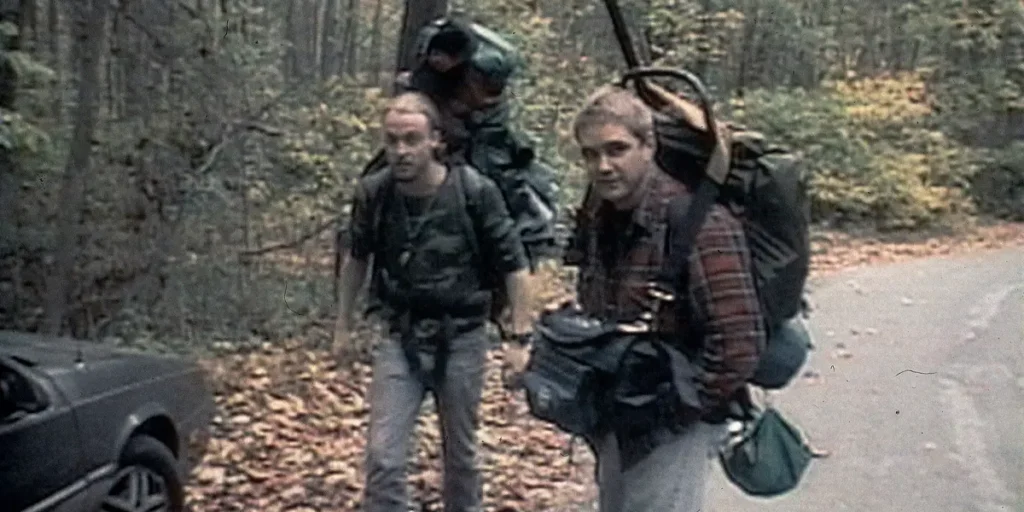
The Blair Witch Project is more than just a phenomenon of its time. It’s a found footage horror movie masterpiece that still holds up nearly 30 years later.
Putting all my cards on the table right away, The Blair Witch Project is one of my favorite horror films ever made. That may raise a ton of eyebrows even from people who simply enjoy the movie, let alone those who either see it as a mediocre product of its time or a downright lazy mess. The idea is very simple: Heather Donahue, Mike C. Williams, and Josh Leonard (played by actors of the same names at the time, though Donahue now goes by Rei Hance) are film students in 1994 making a documentary about the fabled Blair Witch in Burkittsville, Maryland.
The students head into the woods to find and study sites associated with the legend, but they wind up getting lost for days as unexplained sounds and sights drive them closer to madness and despair. And, of course, we see everything solely through the perspective of the trio’s camera footage that, according to the film’s intro card, was one year after their disappearance.
The Blair Witch Project spawned a massive surge of found footage horror in the 2000s, which could potentially lessen its novelty in retrospect. But on top of this being the mainstream pioneer of that style, the approach remains just as impactful now as it was in 1999 because it makes perfect use of every strength that found footage has, with none of the mistakes that other filmmakers have made in implementing it. The Blair Witch Project still holds up to this day. Why? Let’s find out. Spoilers will be present throughout, so be warned.
How The Blair Witch Project Nails Found Footage Filmmaking
The clear selling point of found footage horror is the sense of realism. Everyone knows what they’re seeing is fictional, but they’re invited to pretend and imagine that yes, this did really happen, and someone did really find this footage to prove it. The concept involves high risk and reward because the scares come much easier if the audience is able to play along, but the film is instantly killed if even a few major details are unconvincing. So, why does The Blair Witch Project still stand as the subgenre’s crowning achievement?
To start, there are absolutely zero flourishes to the actual footage. It’s abundantly clear that the film was shot with the kinds of low-quality camcorders that you’d expect these amateur film students to possess in the 1990s. Not only does it look cheap, but it sounds so jumbled and compressed that faraway dialogue cuts in and out. These kids are also recording on the fly, so almost nothing looks set up in advance, the frame is rarely aligned with where they are, and clearly improvised moments like an interviewee’s baby cutting off her words add to the documentary’s DIY quality.
You can obviously go too far with such imperfections to the point where even basic storytelling necessities are compromised. The pretense that these are just inexperienced amateurs runs the risk of becoming an excuse for the actual filmmakers – namely directors Daniel Myrick and Eduardo Sánchez – to not even try to be remotely competent. The timing of character dialogue and movements, their positioning within a scene, and the prearranged set pieces all still needed to be planned out or at least given discipline, after all.
Thankfully, The Blair Witch Project gives our characters some idea of what they’re doing, meaning we can still see and hear what we need to at least follow along. Early scenes, in which the documentary’s introduction is being filmed, contain decently shot, picturesque imagery within the realm of these cheap cameras since they’re more pre-planned by Heather and her friends for the movie they’re making. But even then, a rogue car will drive through a shot to remind you that this is still a mostly uncontrolled environment they’re filming in.
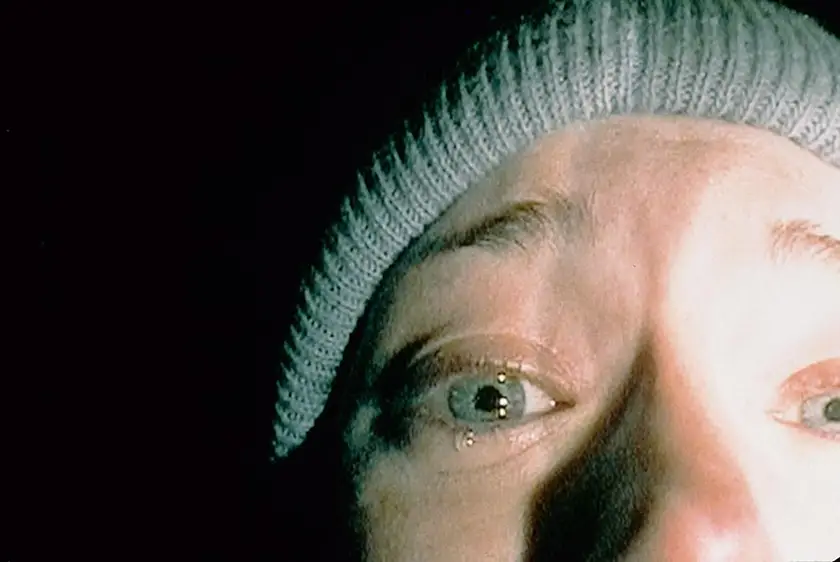
Or you’ll get the best of both worlds with an “accidentally” cinematic visual, like tree branches hovering over the students like omnipresent ghostly fingers closing in, or the now-iconic closeup on Heather’s face as she apologizes for her actions. The makers of The Blair Witch Project clearly wanted at least some cinematic quality without it appearing planned. Not to mention the setting of cold, colorful, possibly haunted Autumn woods makes for a perfectly cozy yet creepy watch around Halloween, especially if you live in a similar location like I do.
On a more minor note, a lot of found footage movies tend to implement musical scores, which only takes away from the illusion that we’re watching raw, unaltered recordings. The Blair Witch Project has no score at all aside from during the end credits. We’re seeing the footage exactly as it was originally “found.” It’s possible that Heather intended on putting music in her documentary in post-production, but that would make us viewing her unfinished, unscored work even eerier. We’re watching the ghost of what her final vision may have been.
It may sound crazy to call The Blair Witch Project a well-constructed film when it’s designed to not be well-constructed, but getting everything to look authentically homemade demands a very precise tightrope walk that few movies have achieved to the same degree as this one. It requires constantly resisting the urge to creatively go past your limitations, while still looking like capable human beings put it together and not a pack of literal monkeys. Because the film achieves that balance, I have no trouble putting myself in the headspace that everything onscreen really happened, which makes for a scarier experience.
The Blair Witch Project Tells A Good Story
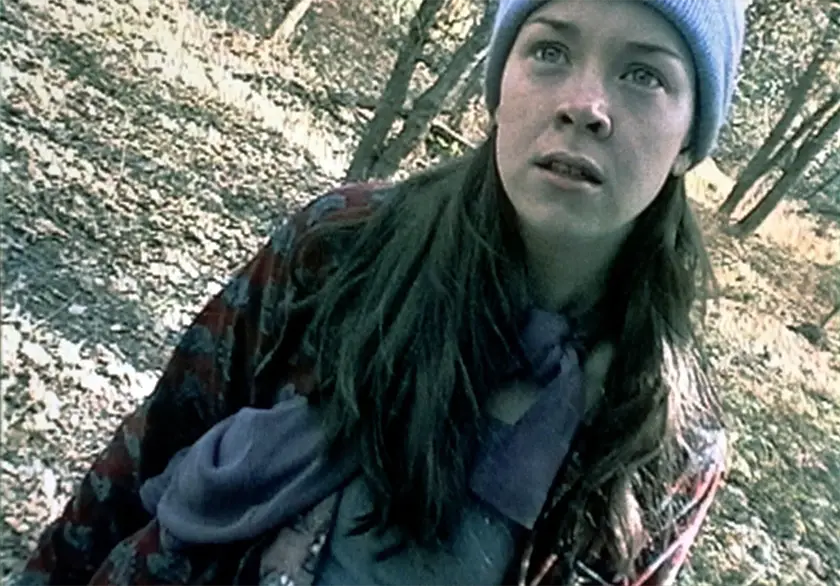
All this found footage trickery – or, usually, lack of trickery – doesn’t mean much if the actual events within the shaky frames can’t hold your interest. But The Blair Witch Project succeeds on that front as well through, again, fairly minimalistic means that take advantage of the format. We met our trio of would-be filmmakers as they, in charmingly lowkey campy fashion, introduce us to the lore – both from real tragedies and pure speculation – surrounding the Blair Witch in the tiny village of Burkittsville.
If you’ve ever had even a passing curiosity of local ghost stories or supposedly haunted historical landmarks, watching Heather passionately explore the town and talk with the locals about atrocities of decades’ past is as endearingly communal as it is unsettling, while also getting us invested in her love for the project very quickly. Still, there are hints that she doesn’t always vibe with Mike and Josh, who are shown to get rowdier and more liberally drunk than she is and are vocally more concerned about the practicality of their quest than the greater purpose of doing it.
Once our team begins their trek in the woods, The Blair Witch Project evokes a rugged feeling similar to that of when you’re a kid wandering past your backyard or through an open park, curious as to what’s beyond what you know. Or touching grass, as it’s now called. There’s a sense of fun in looking for something that may or may not exist, with a slight hint of danger knowing that some terrible things have happened in the areas Heather’s team plans to cover.
But as the film goes on and the students lose track of where they are, they grow more nervous and pricklier. Even if nothing evil was pursuing them, it’s still an unpleasant situation that leads to blaming and arguing between people we already know aren’t 100% compatible to begin with. Reckless and terrible decisions are made, the most notorious being Mike discarding their map out of frustration, and soon the anxiety and paranoia of not knowing how to get home or even trust one another becomes as upsetting as any supernatural forces at play.
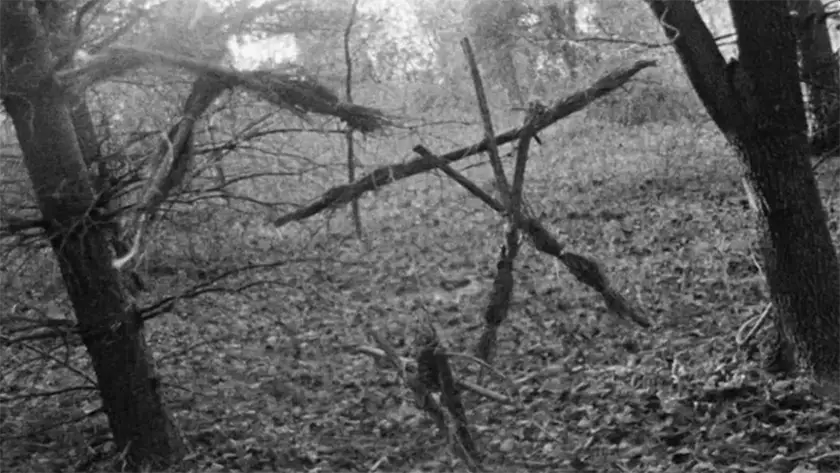
Oh right, we’ve got those to worry about on top of everything else. Whether they’re real or not, the mere suggestion is enough to add extra spookiness to the entire situation, mainly when unexplained events happen like a tent being shaken, hearing voices in the night, or finding very creepy stick figures resembling the symbol of the Blair Witch. With it being so easy to imagine yourself in this position, it’s understandable how these unprepared, inexperienced kids would come even more mentally undone by such strangeness when they’re already up sh*t’s creek.
But it’s not just our own self-inserting empathy carrying the story. The more Heather’s project falls apart, the more she desperately tries to assure Mike and Josh that she still has a handle on everything, and yet the more we can tell by her shaking voice that she does not. She just keeps on filming like it’s all still part of the documentary while her partners say enough is enough. Why? Because it’s the only way she can process the terrible reality. Seeing it through the lens of a camera is easier than seeing it through her own naked eyes.
In that way, the fact that we’re still seeing footage of the characters at all is a testament to Heather’s coping process, even more than it is an attempted documentary about an ancient evil. All three main performances are great and naturalistic, but Rei Hance is phenomenal especially in the second half when acceptance sinks in, culminating in her staring right at the camera, up close, and expressing regret for everything that she believes happened because of her. At this point, the camera is no longer filtering out her fear; it’s letting us see it as directly as possible.
The Blair Witch Project isn’t all style with no substance. It tells a simple, believable, and even thoughtful story about an earnest young person getting in way over her head, forced to accept a situation that’s spiraling out of control whether due to her own ambition, hostile forces, or just plain bad luck. It also shows how people who seem generally on the same page when all is calm can struggle to work together when that calm turns into uncertainty. You could pull the tale off with “conventional” Hollywood filmmaking and yield decent results, but the found footage medium lends itself much better to the arc and buildup at such a small, realistic scale.
The Blair Witch Project Scares With The Unknown
The Blair Witch Project is billed as a horror movie, so you’d want it to be… y’know, scary. For a lot of viewers, it isn’t. You never see any outright scary imagery until the very end, the Blair Witch itself never appears, and most of the movie is just teens walking through normal woods and screaming into the night. But when it comes to horror, tangibility plays a much bigger role than you might expect. The easier it is to envision a scene happening right in front of you, the easier it is to be scared by it.
Found footage horror obviously has the best odds in that regard, for reasons already discussed earlier. However, there’s another factor in The Blair Witch Project that takes the fear to another level: the unknown. We don’t know whether or not the Blair Witch was or is real. We don’t know whether or not anything that happens to Heather, Mike, and Josh has anything to do with the supernatural or even how much of it is caused by any kind of hostile force at all.
We clearly know that something out of the ordinary is going on. The tent must have been intentionally shaken by something, the stick figures directly relate to the legend of the Blair Witch, Josh’s voice audibly screams out well after he goes missing, and everything at the end of the movie is all kinds of messed up. But is everything connected to each other? If so, how? If not, what’s cause for genuine concern and what isn’t?
The tent shaking, for example, could’ve just been some passing punk looking to scare everyone inside. The voices we hear during the night could be anything from cultists to disembodied souls to more total innocents. It’s impossible to know because not only are we confined to strictly what the cameras pick up, but the idea of real witchcraft is literally the stuff of legends. You hear stories all the time about strange phenomena that some people attribute to spirits while others refuse to believe without proof, so why couldn’t this be any different?
Cults, religious zealots, and serial killers are not the stuff of legends, however. Those really exist. So, it’s much easier to imagine that the myth of the Blair Witch created delusional believers who want to commit evil in her name and proceed to stalk their next victims day and night. The most likely explanation is that these are the people who finally strike at the very end, forcing Mike to face the wall while Heather is taken down like in past stories. But does that mean everything beforehand was their doing? Does that mean the dark magic of the witch isn’t real? Maybe some spell caused the students to get lost, or maybe that happened entirely by chance.
Let’s go even more granular. Did these same people set up the small towers of stones that are found around Heather’s tent, or were those stones always there and nobody noticed them, which would also mean nobody caught them on camera? Hell, maybe the river crossing they think is the same as one from earlier is actually a different one that just looks really similar? I have paused and compared these two scenes, but because they’re shot at different angles in such low quality, I really can’t tell for sure.
At one point, Heather is running out into the night and screams, “WHAT THE F**K IS THAT!?!” only for the camera to pick up nothing… Why? Was she just seeing things in her frantic state, or was some entity or vision making itself visible to only her eyes and not to the objective camera? If the latter, how many times have spirits been lurking right in front of them without being visible to anyone?
Speaking of which, there is plenty that the camera doesn’t pick up simply because it’s not on. This already works great when cutting out the most intense parts of certain arguments, letting our imaginations run wild with how ugly they got. But it also means we can’t know what happens when the team is sleeping until they’re woken up by something. Nor can we concretely track their pathing to get a continuous idea of where they’ve been going.
Having the camera as an objective, technical tool is the most liberating way of confirming something is wrong, and also the most maddening way of having so little concrete information. It’s only at the final five minutes, at an abandoned house covered in children’s handprints where Heather and Mike are dispatched by unseen forces, that we know with 100% certainty that something actively evil is out there.
This, by the way, is one of the most frightening finales to any horror movie. After so much time spent entirely outside, we suddenly go through such a bleak, hellish indoor setting where the potential for mind games is higher than ever, screams grow more intense, and the final image of Mike standing in the corner lowers your stomach to the floor right as you know everyone is done for.
Going through every theory crafted over the years in detail would be a fool’s errand. But my personal favorite is that of Mike and Josh being in on the entire ordeal, having planned on ambushing Heather from the start. That’s why Mike throws away the map, how/why Josh disappears, and why we’d hear his screaming voice without hearing anything from those who are attacking him. It’s been pointed out that for them to do everything by themselves is pretty impossible, which I agree with. But they may not have been the only people involved.
Mike and Josh could be part of the Blair Witch cult, which works with them to systematically drive Heather to her demise. They could have targeted her specifically because she was making a documentary to uncover the mystery of the witch. Or they could’ve just had beef with her and teamed up with other thugs without caring about the witch at all, or they were possibly initially on her side only to be corrupted by the witch’s power at some point during the journey.
Even the hair on Mike’s chest vaguely resembles the symbol of the Blair Witch. Yes, I’m reaching that far to piece everything together, and I’m not the only one. Or maybe I just want the movie to justify making me stare at a dude’s gross hairy chest for seemingly no reason. All I know is that if I feel compelled to think this deeply about every possibility, it shows that the film is great enough to make me want to keep thinking and has enough subtleties and hints for me to get somewhere with these questions.
Like with the main story, if all these mind games were done with a conventional non-found footage setup, they wouldn’t work as well. The spookiness of the unknown is combined with a level of plausibility that can only be achieved through the straightforward, uncompromised conceit of real camera footage. It’s scary because not only is nothing explained, but something this unexplainable could actually happen. This footage could be real without stretching any facts of reality. If that’s not scary, it’s hard to know what is.
The Legacy Of The Blair Witch Project
The impact that The Blair Witch Project had on horror has been discussed so extensively that there’s very little for me to add. It’s not the very first found footage movie ever made, but the following influx of films like Paranormal Activity, Rec, Cloverfield, and V/H/S shows it might as well have been the first. As great as a lot of those movies are, though, they all make at least one or two little mistakes that go against what the subgenre is best at, whether it’s adding a score, not having the most convincing writing, or going so big that they resemble a typical film.
The Blair Witch Project may not have the most apparent complexity that other horror classics boast, but its commitment to the style, its nonstop restraint, and its solid, spooky campfire story play a huge part in why it was such a breakthrough and why it’s still beloved by many to this day, even if a nearly equal number of detractors have also made themselves heard. If you’ve never seen it or are willing to reevaluate it this Halloween, curl up on a chilly night and see how a film can achieve so much with so little.
.