
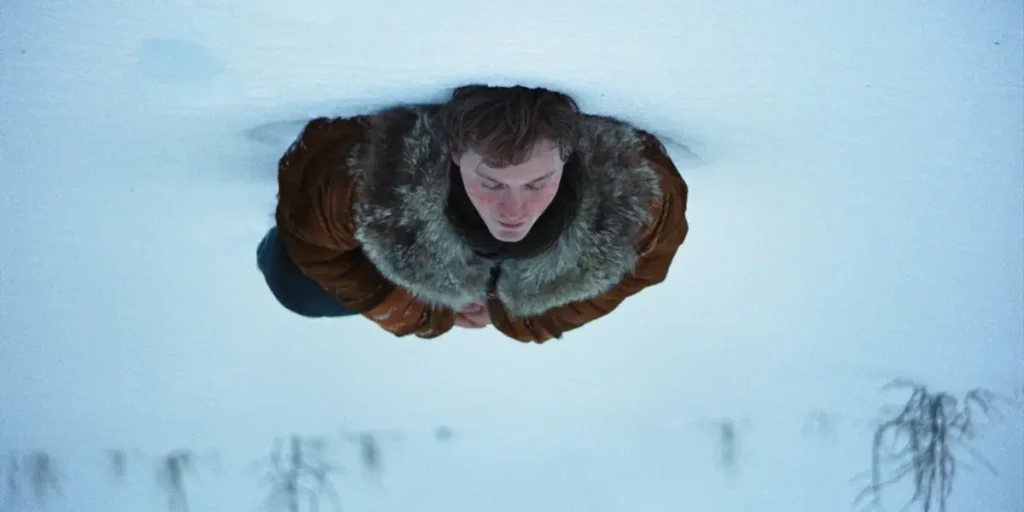
With empathy and compassion, Andrew Haigh’s A Long Winter explores the ways grief changes us, the damage we cause out of love, and the connections that help us heal.
Director: Andrew Haigh
Genre: Drama
Run Time: 117′
BFI London Film Festival Screening: October 14-17, 2026
U.S. Release: December 4, 2026 (NY); January 22, 2027 (wide)
U.K. Release Date: January 15, 2027 in cinemas
“It turns out that loving somebody isn’t always enough,”
Lester (Ebon Moss-Bachrach, of The Bear) tells his son Mike (Fred Hechinger, of Thelma) at the end of A Long Winter, giving a name to the feeling that has been haunting Mike, and us with him, throughout the film. Adapting Colm Tóibín’s 2006 novella, Andrew Haigh (All of Us Strangers) moves the story from the Spanish Pyrenees to Colorado’s Rocky Mountains, where we follow a family on the brink of collapse.
It all starts in 1951, when Mike returns home after spending time working on a farm in a neighboring state. But when his younger brother Tommy (Kit Connor, of Heartstopper) heads off to the Korean War, leaving him alone with his parents, it doesn’t take Mike long to realize that his mother, Louise (Caitríona Balfe, of Sense and Sensibility) isn’t doing well. First, he notices her drinking; then come arguments and broken glasses. Soon, Louise starts drowning in her sadness, incapable of doing anything but weep.
Eventually, a resigned Lester takes his wife to her room, explaining to his son what the doctor had said: “If it gets bad again, the only way [to deal with this] is to stop.” And so, father and son stop trying to communicate with Louise, hoping she’ll somehow heal on her own, their lack of communication as still as their isolated surroundings. For a while, life goes on for our central trio, but everything changes when Louise disappears into the wilderness right before a snowstorm blankets the landscape, and the titular ‘long winter’ moves in. “Call uncle Frank,” Lester urges his son, as the blizzard traps them both indoors, but not even the police’s search parties in the following days can uncover a single trace of her.
The days go on, and even though our protagonists haven’t lost all hope yet, the dynamics have changed within a family left broken by an all-enveloping, unbearable void. As father and son each try to go on with their lives, looking after the farm and clinging to a routine while retreating further into their own worlds, their relationship slowly begins to change as they start to communicate. But their lives are further upended by an inevitable turn, the arrival of a stranger, and unexpected realizations.
A Long Winter is a story about grief, but it’s also about love. It’s clear that the bond between Lester, Louise and Mike was fragile even before Louise’s disappearance, and that this family’s dynamics were shaped by pain they’ve been inflicting on each other for years. At the same time, Haigh doesn’t blame any of his characters, treating them with compassion and focusing on Mike and Lester’s journeys both individually and as a family.
For Lester, it all has to do with the guilt that comes from slowly realizing – or perhaps having known all along – that he played a role in his wife’s unhappiness, by prioritizing his own needs when he chose this secluded, suffocating life for them all. As the film unfolds and we watch the real Lester gradually emerge from under the stoic, ‘masculine’ facade he had built for himself, our perception of the character changes the more self-aware he becomes.
Mike‘s evolution is just as compelling, amplified by the arrival of an Indigenous young man named Jimmy (D’Pharaoh Woon-A-Tai, of Warfare) whom Lester hires as a live-in domestic worker and cook in Louise’s absence. Jimmy’s presence further complicates things for father and son, as Lester often belittles the young man by drawing attention to his more ‘feminine’ traits – qualities that are having an entirely different effect on Mike, who’s navigating a queer awakening of his own.
But Jimmy’s role is even more complex. Sleeping in Mike’s room, in his brother’s bed, Jimmy offers Mike something he’s never had: an empathetic, affectionate figure who not only understands him and is on his side, but who’s also capable of standing up for himself, refusing to take any abuse from Lester – the same kind of abuse that Mike himself might even have been subjected to growing up. There’s something unmistakably romantic between Mike and Jimmy, but the latter also becomes a protector in an almost motherly way, entering his life and offering him the kind of comfort he’s never known just when he needs it the most.
There are many themes in A Long Winter, from grief, trauma, and family dynamics to masculinity, mental health, and queer identity, and though not all of them are explored with the same depth, the film as a whole works, thanks to excellent characterization that really gets us invested in these characters’ lives.
Alternating between majestic views of the mountains, intimate shots of the characters, and disturbing close-ups of dead animals, André Turpin (Incendies) fully immerses us into an atmosphere that can be just as suffocating and haunting as it can be comforting and warm. The use of horizontal tracking shots, with the house often acting as a barrier between us and the characters, further highlights how trapped our protagonists feel, making us experience their isolation from the outside..
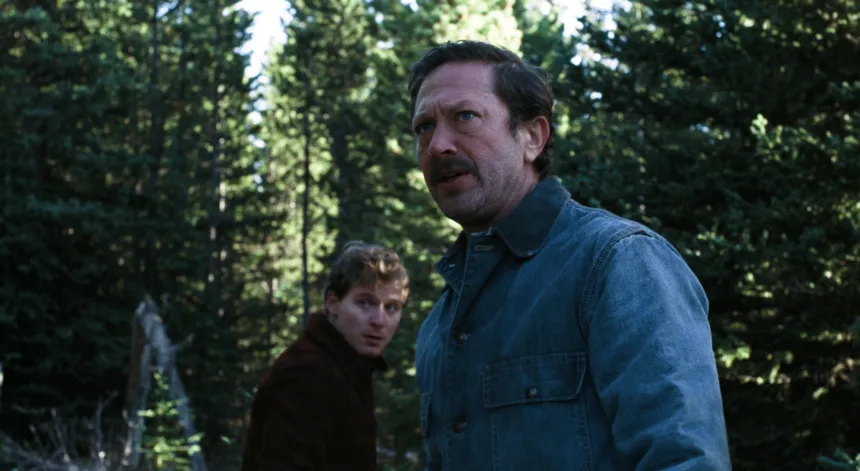
The acting is excellent from everyone involved. Ebon Moss-Bachrach demands our attention at all times, his restrained yet potent portrayal of Lester imbuing his character with a raw authenticity that makes him unforgettable. Fred Hechinger brilliantly captures a constantly evolving character, affected not only by grief but by emotions he can’t fully comprehend. The chemistry between Hechinger and D’Pharaoh Woon-A-Tai delivers a fascinating relationship that is so much more than just a romantic connection, and you won’t be able to stop smiling when Jimmy makes Mike a promise while he’s taking a bath. While Caitríona Balfe isn’t in the film for long, her grounded, heartbreaking turn as Louise makes us perceive her absence throughout.
“She didn’t want to wake up every morning like that all winter long,” Uncle Frank (a splendid Martin Freeman) tells Mike about his mother, halfway through A Long Winter, in a nod to the film’s title that leads Mike to have a conversation with his father later on. “I kept her safe. I built a dream for her up here, but it wasn’t enough,” Lester tells him, to which his son replies, “This was your dream, not hers, and not Tommy’s either”. There are other instances throughout A Long Winter in which the movie explains its themes to the audience, which can feel frustratingly on-the-nose when the film had already managed to convey these very concepts through observation alone.
Furthermore, while the film beautifully introduces its characters, allowing them time to evolve in authentic, surprising ways that make for highly affecting storytelling, the ending feels very abrupt. More frustratingly, while Tóibín’s novella ends in a similarly sudden way, it deliberately leaves the characters’ dynamics unresolved, in line with the tone established by the rest of the narrative. Here, there’s a more explicit sense of optimism to this resolution that doesn’t quite feel earned, particularly after everything we’ve witnessed, which ultimately undermines some of the complexity of the story.
Still, even with these flaws, A Long Winter is a haunting, poignant exploration of loss, masculinity, mental health, queer identity and family dynamics that you’ll find yourself thinking about long after the credits roll. By treating all characters with empathy and compassion, Haigh looks at the parts of ourselves that we keep hidden from the outside world, the damage we cause out of love when we try to force our loved ones into a role, and the people we meet along the way who end up healing us in unexpected ways, making it all worth it.
A Long Winter (2026): Movie Plot & Recap
Synopsis:
In 1951, a young man named Mike returns to his family’s isolated farm in Colorado’s Rocky Mountains, where he discovers his mother’s mental health is worsening. When she suddenly disappears during a snowstorm, Mike and his father are forced to confront their complicated relationship and face their grief, while the arrival of a stranger brings new dynamics.
Pros:
- Excellent characterization and emotionally compelling relationships.
- Superb performances, particularly from standout Ebon Moss-Bachrach, and from Fred Hechinger and D’Pharaoh Woon-A-Tai.
- Haunting cinematography that beautifully captures the characters’ isolation.
- Compassionate, nuanced exploration of grief, masculinity, queer identity, and family dynamics.
Cons:
- Occasionally heavy-handed exposition makes some themes too explicit.
- An abrupt ending whose more optimistic resolution feels unearned and undermines some of the story’s complexity.
A Long Winter was screened at the BFI London Film Festival on October 14, 2026. The film will be released in theaters in New York on December 4, 2026, nationwide on January 22, 2027, and in U.K. and Irish cinemas on January 15, 2027.