
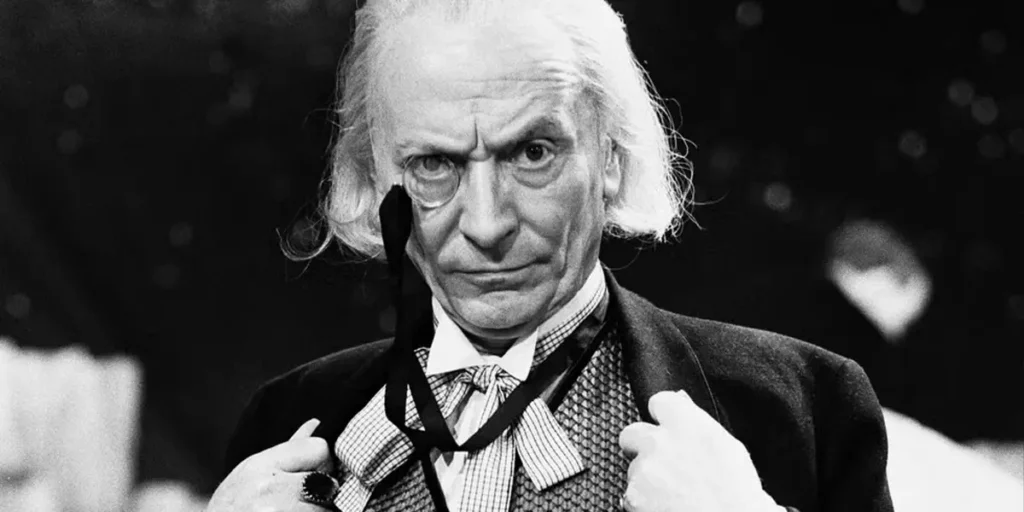
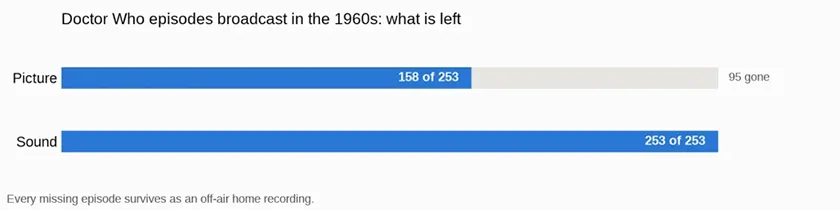
Ninety-five Doctor Who episodes were unaccounted for in the BBC archive as of March 2026, and the soundtrack of every one of them survives, taped at home by viewers who pointed recorders at their own television sets.
The reconstructions built around those soundtracks are distributed as video, with the picture reduced to a still that holds for half a minute, so there is nothing on the screen worth watching.
Getting at the sound means opening the container, and Convertio’s mp4 to mp3 converter strips the video stream out of the file, writing the audio back as a single MP3.
Doctor Who reached Australia on 16mm prints supplied by BBC Enterprises to the ABC, where the Australian Film Censorship Board ordered cuts, and the offending frames were removed before the print was spliced back together.
Every programme screened there carried a Certificate of Registration, and those certificates sat at the Australian Archives under folder series C-3057, in rough chronological order with no file for Doctor Who as such.
Damian Shanahan requested them in 1996, was told that nobody had ever asked to see them before, and spent his days off working through boxes that had been carted in from Villawood.
Some prints escaped the paperwork altogether. A collector named Stead held 16mm copies of three episodes that the BBC no longer had. They came to him around 1973 with his father’s film collection, and he could never say how his father had come by them. The Wheel in Space print changed hands for fifteen pounds. Handing it over was meant to be an occasion. Steve Bryant of the BBC Film and Videotape Library set the date for November 1983, the programme’s twentieth anniversary. The donor then went down with flu, and the film only reached the archive in April 1984. The BBC struck its own negative from it and gave the print back. By then Ian Levine had talked the owner into parting with a video copy, and pirate tapes of the episode were circulating among fans months before the BBC itself held it.
Not everything was lost to a wiping order. Going through the Film and Videotape Library’s index cards at Windmill Road in 1977, Ian Levine found one episode missing from the shelves, and the card explained where it had gone.
Episode four of The Daleks’ Master Plan had been loaned to Blue Peter in 1972, for a children’s programme item, and it was never sent back. The card was the last record of it. An episode that survived the junkings, the tape shortages and the clear-outs was finally lost because another BBC show borrowed it and forgot.
The corporation had already worked out why this kept happening. An internal committee, set up to look at how the BBC kept its own programmes, put the problem in a single sentence in its interim report.
Preservation and use are mutually incompatible; the greater the access given to any document, film or tape, the shorter its life is likely to be.
The committee’s answer was a master copy nobody was allowed to touch, from which working copies would be struck as needed. It also rejected, unanimously, the idea put to it that everything broadcast should be kept on the off-chance it might matter later.
What the BBC threw away
Between roughly 1967 and 1978 the BBC wiped or destroyed large quantities of videotape and film. The reasoning was that the recordings had no further practical value. Videotape cost about as much as a car and belonged to Engineering, who reused it once a programme had gone out.
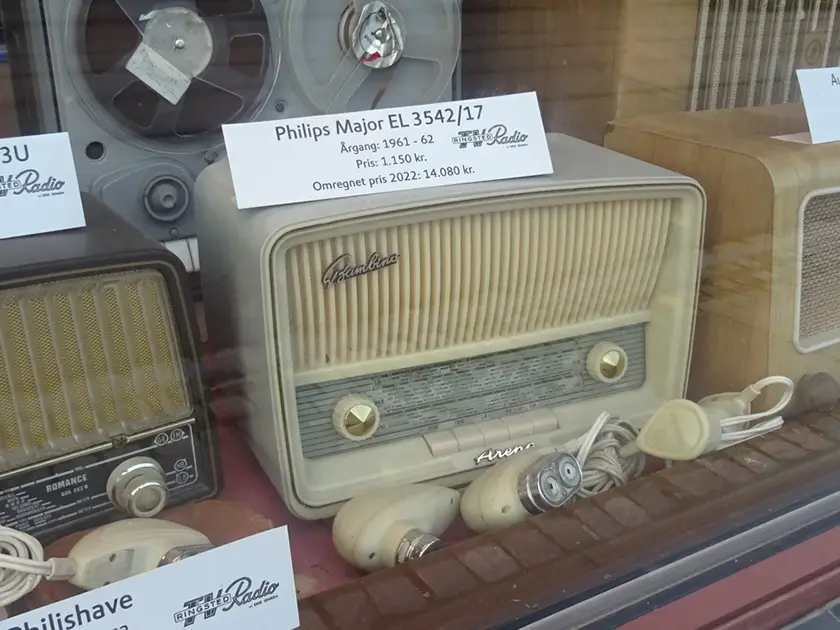
Two viewers of the show were Graham Strong and David Holman, Doctor Who fans who made off-air audio recordings of the programme at home. Using domestic reel-to-reel recorders, they captured episodes as they were broadcast, with Holman fitting four to six episodes onto each reel by cutting the titles as he recorded.
Neither man knew this was happening. They were taping a programme they liked.
The sampler tape
In the early 1990s BBC Audiobooks put some missing soundtracks out on cassette, and Strong wrote to the BBC offering his own recordings, and the response was lukewarm.
The problem was that the tapes fell between two stools. They were audio recordings, but of television programmes, so the sound archive, which handled radio, had little use for them. The Film and Videotape Library did not usually keep soundtracks for programmes with no pictures left. Nobody’s department owned the problem.
Friends talked Strong into cutting a sampler of excerpts, and that tape reached a BBC engineer named Paul Vanezis who heard the quality and made the argument that changed the answer, which was that a missing episode might one day surface dubbed into another language and an original English soundtrack would then be worth a great deal.
Four reels, one afternoon
In April 1994 Strong met Vanezis at Television Centre in London. He went. They showed him around the studios, and he left the tapes there. Four reels holding over 100 episodes of Doctor Who, which the BBC copied to digital.
Vanezis spent months copying them to DAT in his own time. Mark Ayres restored the copies, and the soundtrack range launched on CD in 1999. Strong’s audio was later used to put sound back onto mute 8mm footage shot off a television in Australia. The reels went home with him on a second visit.
| What survives | Where it came from |
| Complete audio for all 95 missing episodes | Domestic reel-to-reel machines, 1963 to 1973 |
| Four to six episodes per reel | Holman cutting the titles as he recorded |
Holman did his trimming with a finger on a button. Convertio takes several files at once and lands each audio track as its own MP3.
This article was produced in partnership with Convertio. At Loud and Clear Reviews, we only work with partners that provide relevant, valuable content for our readers.
Header Credits: Mirrorpix