
NBC’s Surviving Earth covers the most dramatic episodes in our Earth’s history with respect and intensity, serving as a cautionary tale for our own time.
Showrunner: Tim Haines
Director: Duncan Singh
Genre: Documentary Series
Number of Episodes: 8, released weekly
U.S. Release: June 11, 2026
U.K. Release: TBA
Where to Watch: NBC and Peacock
Prehistoric documentaries are officially back in vogue. After the success of Apple’s Prehistoric Planet and Netflix’s The Dinosaurs and Life on Our Planet, everyone wants to try their hand at making a new story to remind us of an Earth gone by. The dinosaurs get all the attention, but there is so much more deep time to examine and bizarre, otherworldly creatures to capture attention. Surviving Earth is NBC’s attempt at joining the trend.
Helming the show are showrunner and producer Tim Haines, whose Walking With Dinosaurs in 1999 set the standard for these types of shows, and director and co-executive producer Duncan Singh. Rather than focus on one period in Earth’s past, this show seeks to examine the ends of these points in history and why these spectacular animals are no longer with us. While only the first two episodes out of a planned eight have been delivered for review so far, these first two outings do show promise for the series to come. Going from the Ordovician extinction to the end of the last Ice Age, this is a show about when the Earth’s ecosystems shifted faster than most other animals could adapt. Could humans be next?
Much like Netflix’s other deep time show Life on Our Planet, Surviving Earth tells the whole story of Earth’s history from varying points in time. Unlike that series, this show details specific vignettes in time, capturing the moments when the Earth was most hostile. Geologists use five major mass extinctions (where at least half of all species disappear from the fossil record) as checkpoints when chronicling the lifespan of the Earth, with as many as twenty smaller extinction events also informing of when certain species died and new ones came to be.
While the asteroid that killed the dinosaurs gets the most attention, the largest extinction was actually the Permian extinction 185 million years before, where almost ninety-five percent of all species ceased to exist. This starts the first episode of the story, and the spectacle of seeing the mass extinction is appropriate. Massive volcanoes and elaborate CGI setpieces against live backgrounds captures the scale of the carnage, like a natural slow-motion carwreck.
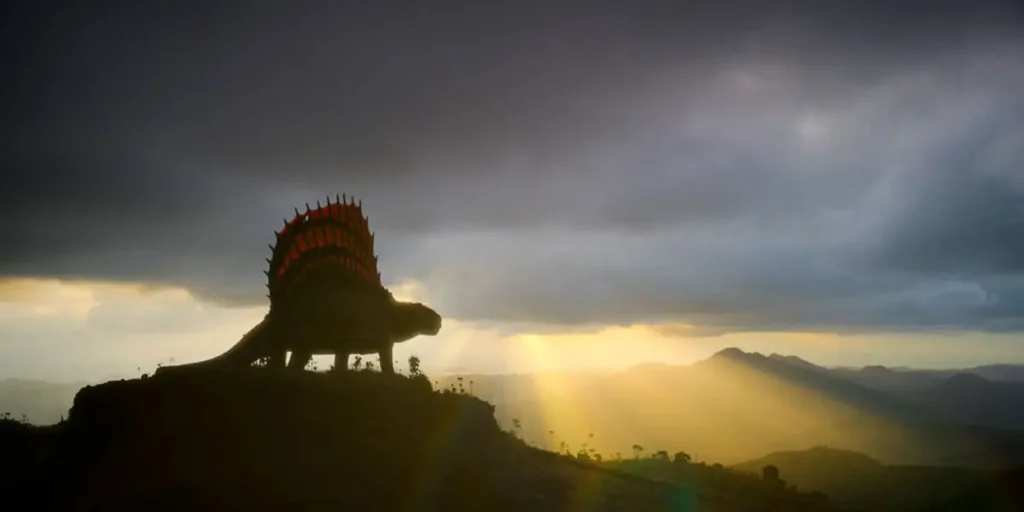
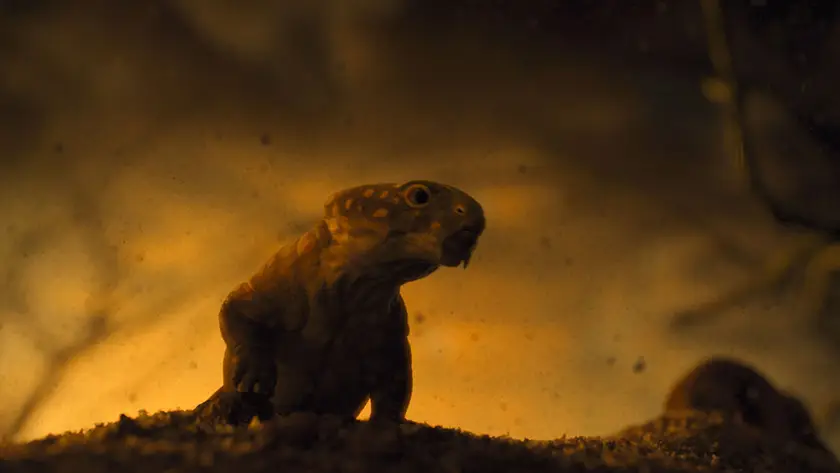
These kinds of shows live and die on storytelling. Haines knows well how to weave a narrative around creatures who perished eons ago, still building the right amounts of sympathy and compassion for all of them. These beings are at the borderline between reality and fantasy. They left behind remains and have defined forms, unlike dragons or unicorns, but none of them are alive. Surviving Earth paints these creatures not as monsters, but as animals inhabiting their ecosystems and struggling to survive, just as they would in any other time period. Obscure creatures like Inostrancevia, a massive pre-dinosaurian predator, and the rhinoceros-like Ischigualastia highlight just how strange life was like in those time periods. By spotlighting the lesser known beasts instead of the figureheads like Tyrannosaurus or Dimetrodon, the show can hook viewers with something new and encourage more research to learn more about what these creatures are.
The episodes follow a clear pattern of observing these animals in their lives and witnessing their deaths. The first episode is about the “Great Dying”, where a family of Inostrancevia goes on one last hunt before the volcanoes erupt. The second details the Carnian pluvial event, a time of massive flooding in the middle Triassic, from the point of view of a herd of Ischigualastia. While the show highlights the characters doomed to die, one final segment after the last commercial break chronicles the survivors. After the Carnian floods, for example, the show makes it clear this is the event which allows dinosaurs to inherit the Earth. With their primary competition gone, they expand and diversify in unique ways. Every extinction event has new creatures fill the void left by the old, and Surviving Earth showcases both life and death in dramatic fashion.
It can be nice to end on an optimistic note after witnessing something so depressing. Unfortunately, the structure of the first two episodes feeling this way could disorient the narrative and soften the drama of the extinction. Tonal dissonance is felt when viewers go from a massive flood wiping out the main characters to unrelated drama surrounding the earliest dinosaurs. Success does follow failure, but a bit more buildup would have made those scenes feel natural. The recovery scenes also take quite a while, putting some distance between the extinction and focusing on a new group of characters, which can be a bit confusing.
At the end of the show, a parallel is drawn to a real world issue affecting our Earth today. In a time when carbon emissions, energy consumption, and resource depletion are more pressing issues than ever, it can be easy to forget things were indeed worse before. We as humans have a duty to be stewards of the Earth, and the best way we can learn from it is to study the past and see how bad things were to prevent them from coming back again. Rather than moralizing about the climate crisis, Surviving Earth takes a hopeful tone, explaining what we have accomplished and providing the ideas for what humans will do to make the world a better place, preventing the current era from becoming the sixth major extinction.
Surviving Earth is an informative document and one of the most topical events on television right now. With humanity at a crossroads and contemplating its own extinction, this show offers both a plan to avoid a major crisis and a reminder that things have been worse. We are the only species with even a small chance of affecting the Earth, so learning from past extinctions will help us better prepare for what is to come. Other prehistoric documentaries have explained the history; this one tries to tie it to the present. It educates about Earth’s natural history as well as providing a stepping stone for us humans to build our own futures from.
Surviving Earth: Movie Plot & Recap
Synopsis:
Eight major extinction events in the Earth’s history are depicted and analyzed using the best knowledge of the fossil record and advanced animation techniques to draw parallels to the devastation of our own earth.
Pros:
- Breathtaking animation
- Spotlights more obscure creatures encouraging further analysis
- Informs of modern problems without being preachy
Cons:
- A bit formulaic
- Sometimes confusing with how it presents each end segment
Surviving Earth will premiere on June 11, 2026 at 8 p.m. ET/PT on NBC, with new episodes streaming the next day on Peacock. New episodes will air weekly.