
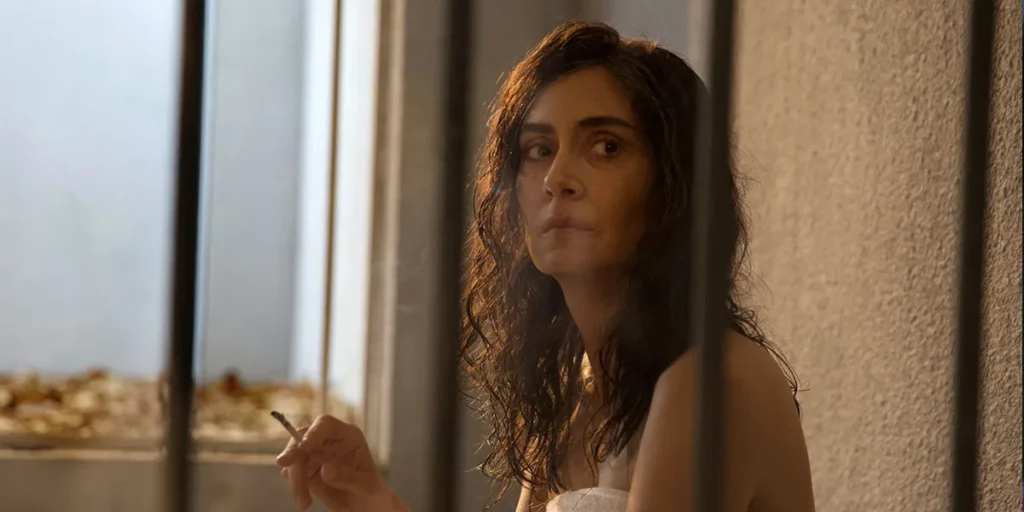
For Roya, Mahnaz Mohammadi draws on her own experiences of imprisonment to create a remarkable, unflinching film of great importance.
Director: Mahnaz Mohammadi
Genre: Drama
Run Time: 92′
Berlin Film Festival Screenings: February 18-22, 2026
U.S. Release Date: TBA
U.K. Release Date: TBA
For most of us, six months isn’t a long time. For the titular character of Roya, it is a lifetime, not only in how endless the experience feels, but also because of the indelible scars it leaves behind. An Iranian teacher, Roya is imprisoned for six months in the brutal Evin prison in Iran, just like the director/writer Mahnaz Mohammadi (Son-Mother) was herself.
Even without further insight into Roya’s production process or background, it is a striking cinematic achievement of impeccable sound design, bold directorial choices, and an unforgettable lead performance. The film becomes even more remarkable when considering what Mohammadi has been through and how a portion of this film was shot clandestinely in Iran.
The first 15-20 minutes of Roya are shot solely from a first-person point of view. The breathing of Roya, who is brought to life by a mesmeric performance from Melisa Sözen (Winter Sleep), is the first thing we experience before we see her hands touching the marked walls of her 3 square metres. It’s a dramatic, jolting start that at first feels jarring, albeit wholly immersive. After she is led to an interrogation room—her POV partially covered by blindfold, allowing her and us to only see the floor—she is granted a three day freedom pass from prison. Here, Roya shifts into a more conventional perspective, as we see Roya’s face and the world around her in a classic cinematic format.
This transition amplifies the destructive nature of solitary confinement, and enhances the freedom Roya feels, however fleeting, when she does temporarily head back into the wider world. Simple pleasures such as sunlight through trees or a man dancing in the street take on magical angles. Despite this, Roya’s three days are only marginally better than being in prison. Agents of the Iranian government trail her every move, whilst one man (identified only by his pointed shoes he wears during interrogations) hounds her to confess. If she does this, they’ll grant her permanent freedom.
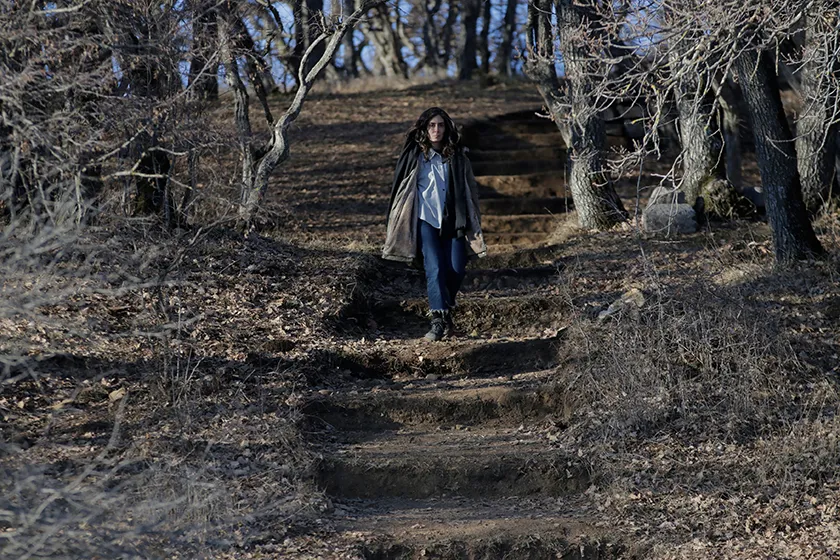
The structure of Roya begins to mirror the character’s mental health in increasingly dramatic ways. Roya starts to dissociate from herself and from reality; frequently, she watches herself in earlier scenes as if she is far removed from reality. By the film’s conclusion, linearity has, for the most part, been lost. Her existence is completely out-of-sync with what is real, hammering home the sheer cruelty of solitary confinement and the effects it permanently has on people. Roya has all the makings of a psychological horror film, but there are no ghosts, no ghouls, no vampires—only very real, very dangerous humans in power.
The titular character does not utter a word throughout the film’s 92-minute runtime, even when she sees her family again. Sözen shows that words aren’t needed to amplify tension or portray psychological torment. It’s a speechless performance of many levels, from small facial expressions, flickers of eye movement, and subtle mannerisms. Later on in Roya, she sits blindfolded at a table, and even a single footstep causes her to flinch uncontrollably. Much of the film’s power also comes from Ashkan Ashkani’s (There Is No Evil) cinematography and Esmaeel Monsef’s (The Charcoal) editing, but the star-of-the-show in the technical department is Ensieh Leyla Maleki’s (Kabul Between Prayers) sound design, which is backed up by a subtle drone-inflected original score by Andrius Arutiunian.
The sound design of Roya is exquisite, particularly in the film’s first-person segments. Whether it’s the constant crackle of a vinyl player or Roya’s breathing, the aural elements combine to enhance the overarching tone of horror. Visually, there are some overly stylised moments that, when they occur, lessen the movie’s impact, but at its core, this is an exceptionally effective experience that bravely shows viewers what atrocities the Iranian government are currently committing.
Roya (Berlinale 2026): Movie Plot & Recap
Synopsis:
Roya, an Iranian teacher, is imprisoned and pushed via torture to confess to crimes. She faces an impossible choice of permanent imprisonment and potential death or a televised confession, as she loses her grip on reality and her own identity.
Pros:
- Very effective portrayal of solitary confinement
- Immersive sound design
- A stunning central performance Melisa Sözen
Cons:
- Some artistic choices weaken those particular moments’ impact
Roya premiered at the Berlin Film Festival on February 18-22, 2026. Read our Berlin Film Festival reviews and our list of 20 films to watch at the 2026 Berlin Film Festival!