
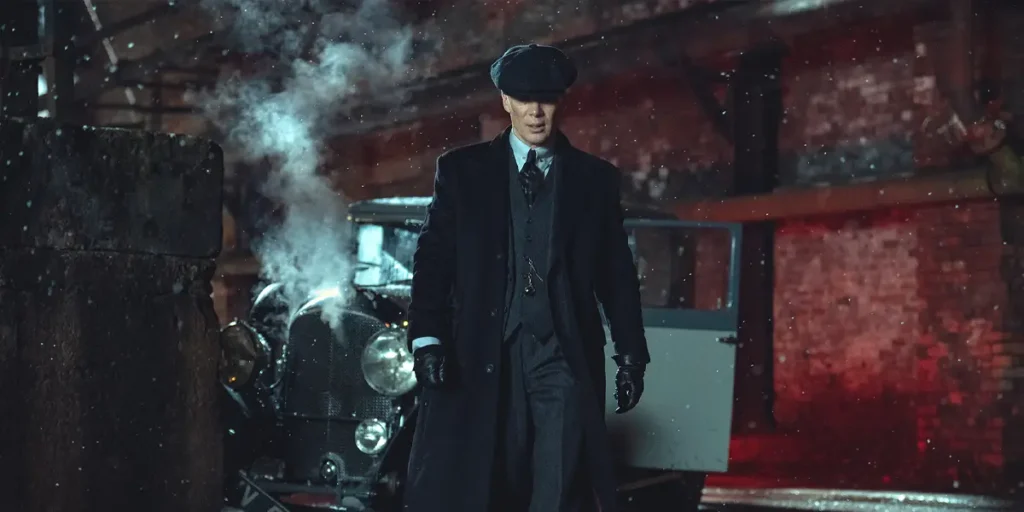
Cillian Murphy gives more layers to Tommy Shelby in Peaky Blinders: The Immortal Man, which overcomes a formulaic structure and one-note villain.
Director: Tom Harper
Genre: Crime, History, Period Drama
Run Time: 112′
Rated: R
Theatrical Release: March 6, 2026 in select U.S. theaters
Streaming Release: March 20, 2026 globally on Netflix
“In the bleak midwinter…”.
When Thomas Shelby (Cillian Murphy) eventually makes his appearance in Tom Harper’s Peaky Blinders: The Immortal Man, he has firmly resigned himself to solitude and patiently awaits joining his wife Grace (Annabelle Wallis) and daughter Ruby (Bonnie Stott), wherever they are, beyond the world of the living.
Nothing keeps his feet firmly on Earth. Most of his family members have died. The fascist movement he failed to stop in the show’s fifth and sixth seasons has grown considerably in support, not just in the United Kingdom, but around the world. War has broken out once again, but Tommy still hasn’t recovered from his time as a tunneler in World War I, and never will.
However, upon receiving word from his sister, Ada (Sophie Rundle), that Tommy’s eldest son, Erasmus “Duke” Shelby (Barry Keoghan, replacing Conrad Khan from the television series) is working hand-in-hand with the Nazis, the time has come for him to come out of isolation and return to the town of Small Heath, Birmingham, where it all began. The community is continually rattled by the effects of World War II, while Duke sees it as an opportunity to enrich himself. He partners with John Beckett (Tim Roth), a known sympathizer of National Socialism, to move counterfeit pound notes within the UK to collapse the economy and enable those responsible to make a considerable amount of money.
The gist of the story is fairly simple. It’s also the most uninteresting aspect of The Immortal Man. Whereas Steven Knight’s television series dug deep into a group of close-knit British gangsters that operate inside a world in perpetual movement, the movie barely scratches the surface of anything it introduces to the audience. Tim Roth, who plays the film’s antagonistic figure well, is painfully underdeveloped as the one-note Beckett. The character is doing all of this for the money, sure, but his personal vendetta against Tommy – and, by extension, the entire Shelby family tree – is left unclear by the time Harper reaches the movie’s (highly) explosive climax.
Similarly, the core relationship between Tommy and Duke is barely fleshed out, which is a damn shame, considering how Harper and Knight introduce Erasmus as the leader of a new generation of Peaky Blinders. Keoghan’s introductory scene is a real stunner, with the actor giving one of the most thrilling performances of his career…until Duke takes a backseat and barely registers a form of emotional complexity when his father returns to Birmingham. Rebecca Ferguson is also in this movie, as Kaulo. However, talking about her in detail would mean spoiling things Netflix does not want anyone to reveal, as stated by Murphy himself during a voiceover intro before the film started: “Spoilers are terrible. Keep it to yourself, by order of the Peaky Blinders.”
What you do need to know is that everything revolving around the film’s side characters isn’t nearly as intriguing as when one watches the television show and observes the emotional progression of each protagonist over the course of thirty-six episodes. That said, comparing a film to a television series is a bit of an apples-and-oranges situation, but it becomes increasingly clear that The Immortal Man would’ve undoubtedly benefited from being a limited series, because the film’s under two-hour runtime makes everything around Tommy feel terribly rushed and barely touched upon, even when it brings back some known characters from the series.
Whenever the movie focuses on Tommy, though, is where The Immortal Man begins to lock in and provides a satisfying, and often painful, coda to one of the most emotionally tormented protagonists in contemporary television. Employing the same perceptive and intimate visual style of the fifth and sixth seasons, Harper and cinematographer George Steel directly peer into Shelby’s mind and make the audience aware of the regrets he’s sadly carrying on his shoulders.
He recognizes that the only way out of this predicament won’t end well for anyone, which is why he’s resigned to living alone, with no one to care for but himself. Everything he touches dies. By that logic, the only way for him to keep this curse at bay is to live far away where he can’t hurt – or kill – anyone. He may hurt himself, but he’s ready to die anyway, and has been for a very long time.
In that regard, Murphy’s portrayal of Shelby is the most emotive he has been since the start of the series. Shelby used to cloud his emotions by numbing himself with opium (which frequently gave him distorted nightmares and hallucinations of his time in the Somme), or by tending to various activities he dubbed as “business.” Since he no longer has business to attend to and is spending the rest of his days writing a book, we finally have the privilege of examining who he is as a human being, deep inside his mind.
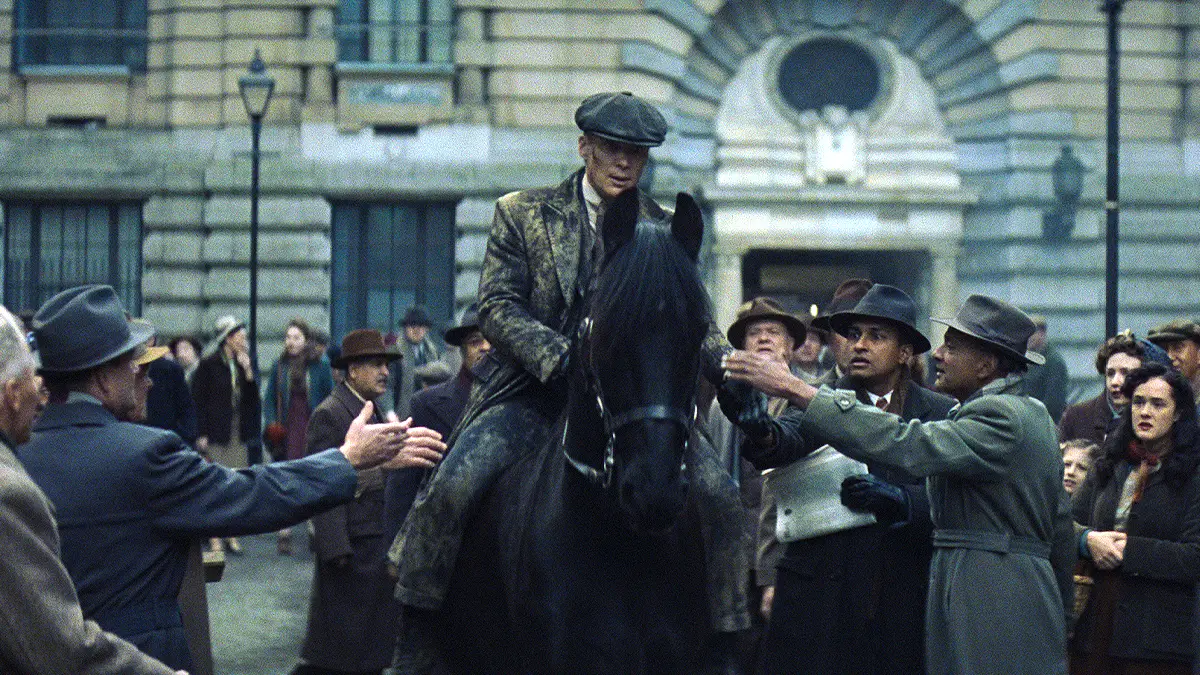
Moments of spiritual awakening, specifically when Harper and Knight play with Romani folklore, reveal Murphy exploring territories of his character we’ve rarely seen in the series, at least not in the way his psyche is represented here. It’s hard to discuss any specifics without revealing a thing, but the battle at the heart of The Immortal Man is both internal and external, with the former surprisingly allowing more texture to Shelby than I’d imagined, considering how every “loose end” was resolved by the time the series ended with its 82-minute-long finale.
Such a soulful (and, at times, mordantly funny) performance leads to a devastating final half-hour, in which Tommy understands what he must do to weaken the fascist forces at play and perhaps redeem himself in the eyes of his late wife and daughter. He’s done too much harm to fully repair the wounds he’s created across decades, and now finds solace in speaking to the dead and acknowledging that the ghosts of his family continually haunt him within the walls of his torn-down home. However, if he accomplishes this without innocent people getting hurt, perhaps he’ll be at peace with whatever comes next.
In this case, Peaky Blinders: The Immortal Man accomplishes a rare feat in the world of television: satisfyingly wrapping up the story of a beloved character many audience members thought they would never see again. But since Tommy Shelby will live forever, there are always more stories to tell inside a Birmingham which has seen more than its fair share of bloodshed and fire and is now looking for a way out of the horror, and (hopefully) into the light. Shelby knows he won’t bring them there, but he can at least try to do this “good thing” and see if it will bring about change for the better…
Peaky Blinders: The Immortal Man (Netflix) Movie Plot & Recap
Synopsis:
After several years in isolation, Tommy Shelby returns to Small Heath when he learns that his son, Erasmus, is collaborating hand-in-hand with the Nazis to enrich his pockets.
Pros:
- Cillian Murphy continues bringing immense texture and emotional depth to Tommy Shelby, who has now taken solace in speaking with the dead rather than trying to comprehend a living world in perpetual movement and decay.
- The film’s visual look responds to the more intimate (and cinematic) images of seasons 5 and 6, which dared to take the audience further inside Tommy’s tormented mind.
- The action is frequently exhilarating and emotionally powerful.
- The music, while a bit too omnipresent, gives a real edge to the changing times Tommy has refused to acknowledge.
Cons:
- Tim Roth’s villain is painfully undercooked and one-note, despite his giving a solid performance
- Most side characters, including Barry Keoghan’s Duke and Rebecca Ferguson’s Kaulo, fall by the wayside in favor of concluding Tommy’s story.
- The narrative frequently feels rushed and hollow when it pulls the focus away from its titular immortal man.
Peaky Blinders: The Immortal Man will be available to stream globally on Netflix from March 20, 2026.