
Our Hero, Balthazar aims to skewer online culture and gun violence through two lonely teens, but settles for shock over substance.
Director: Oscar Boyson
Genre: Comedy, Drama
Run Time: 91′
Rated: R
U.S. Release: March 27, 2026 (New York) – April 3, 2026 (LA)
U.K. Release: TBA
Where to Watch: In theaters
The freedom teens once had to stumble through identity formation has been swapped for a rigid set of steps designed to secure approval or be cast to the social fringe. Plenty of films have explored a kid on the cusp of fitting in, doing something reckless to cross that line. Our Hero, Balthazar takes it several notches further, using school violence as an entry point to examine how we interact with people online versus in reality.
The result is a movie that isn’t very pleasant to watch, and that may be the point. But the story’s willingness to use armed aggression as thematic fodder mirrors the same hollow provocation its lead character traffics in.
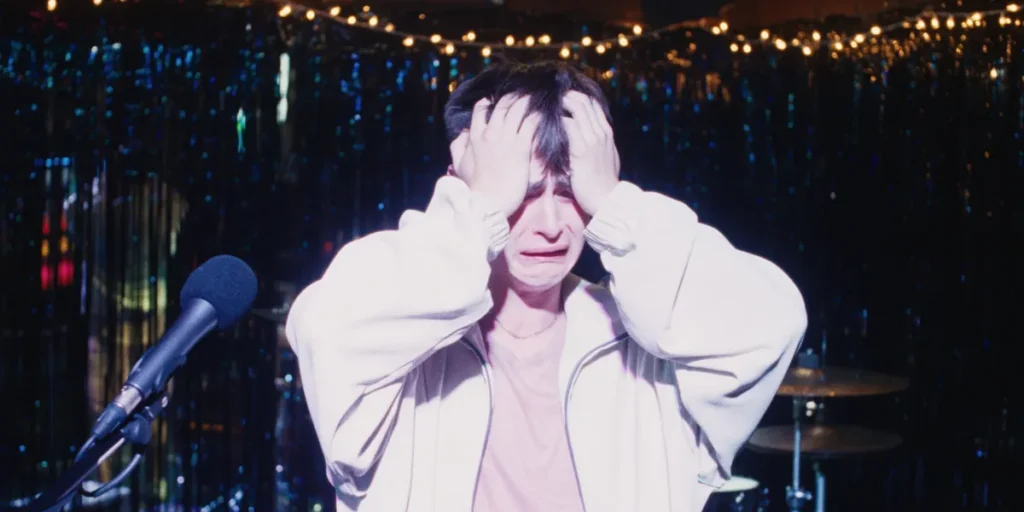
Balthazar Malone (Jaeden Martell, of It) is a wealthy Manhattan teenager with penthouse views and zero parental supervision. His mother Nicole (Jennifer Ehle, of Saint Maud) is too consumed by a new romance to notice her son is spiraling. His father exists as a checkbook upstate. Balthy posts teary-eyed grief videos to rack up sympathy clicks. When a classmate, Eleanor (Pippa Knowles), calls out the monetization of narcissism after an active-shooter drill, Balthy becomes fixated on impressing her by tracking down an anonymous online troll who’s been posting violent threats, hoping to stop a tragedy before it happens.
That troll turns out to be Solomon Jackson (Asa Butterfield, of Hugo), a lonely Texas teen living in a trailer park with his ailing grandmother Elaine (Becky Ann Baker, of Girls). Solomon works a dead-end convenience store job alongside Taylor (Anna Baryshnikov, of Love Lies Bleeding) and endures visits from his grifter father Beaver (Chris Bauer, of The Wire) and Beaver’s sleazy associate Supes (Avan Jogia). Balthy catfishes Solomon into meeting in person, and what follows is an increasingly volatile ride toward a finale the narrative seems to think is inevitable. Oh, and it’s supposed to be a quasi-comedy. I know, right?
Writer-director Oscar Boyson, a producer on the Safdie Brothers’ Good Time and Uncut Gems, clearly knows pace and timing. You can feel those films in the DNA here. The synth-heavy score by James William Blades and handheld camerawork from cinematographer Christopher Messina give the project propulsive, jittery energy. Messina does interesting work contrasting Balthy’s sleek upper-class world with Solomon’s cramped double-wide, and when the two collide in Texas, the camera finds a new urgency. The technical package is solid.
Martell continues to show promise as he ages into more complex roles, but there’s a calculated quality to his work here that keeps you at a distance. Butterfield is the dynamic center of the project. He looks completely different from anything he’s done recently, and every scene he’s in improves because of him. There’s also something simmering between the two leads that the picture never addresses directly. Solomon swings between craving Balthy’s attention and pushing him away violently; at times, there’s an unmistakable homoerotic charge to their interplay. Whether that’s intentional queer questioning or something the film simply doesn’t want to touch is anyone’s guess, but Butterfield commits to every beat regardless of what the script leaves unresolved.
Baker is excellent in her limited screen time. Ehle barely registers, and every time she appeared, I spent more time imagining a movie where she and Meryl Streep play sisters than paying attention to the moment. Noah Centineo (To All the Boys I’ve Loved Before) is so thinly sketched as Balthy’s life coach that a key moment early on creates more confusion than payoff. Bauer and Jogia, playing two genuine lowlifes, drain momentum from every scene they enter. With names like these in the ensemble, the imbalance is puzzling.
The larger issue is structural. Boyson can’t find a conclusion. There are roughly six endings, and they get progressively less satisfying. The climax veers into genuine bleakness, the kind that sits heavy in your chest, and then the film pivots to a wrap-up so smarmy and glib it feels like a different movie wrote the last five minutes. How much do we want to invest in someone so actively not great? Our Hero, Balthazar never answers that question. It just becomes redundant and reductive, never hitting the nerve it’s aiming for, settling instead for whacking away at a synapse that gave up caring long ago.
Our Hero, Balthazar: Movie Plot & Recap
Synopsis:
A privileged New York teenager follows an online troll to Texas in a misguided act of heroism, only to discover the real-world consequences of treating tragedy as content.
Pros:
- Asa Butterfield delivers a transformative, electric performance as Solomon
- Strong technical craft from Messina’s cinematography and Blades’ propulsive score
- Becky Ann Baker is excellent in limited screen time
Cons:
- The film struggles to land a satisfying ending among its many attempted conclusions
- Impressive supporting cast is significantly underused
- Never commits to a clear perspective on the violence it portrays
Our Hero, Balthazar will be released in theatres in New York on March 27, 2026 and in Los Angeles on April 3.