
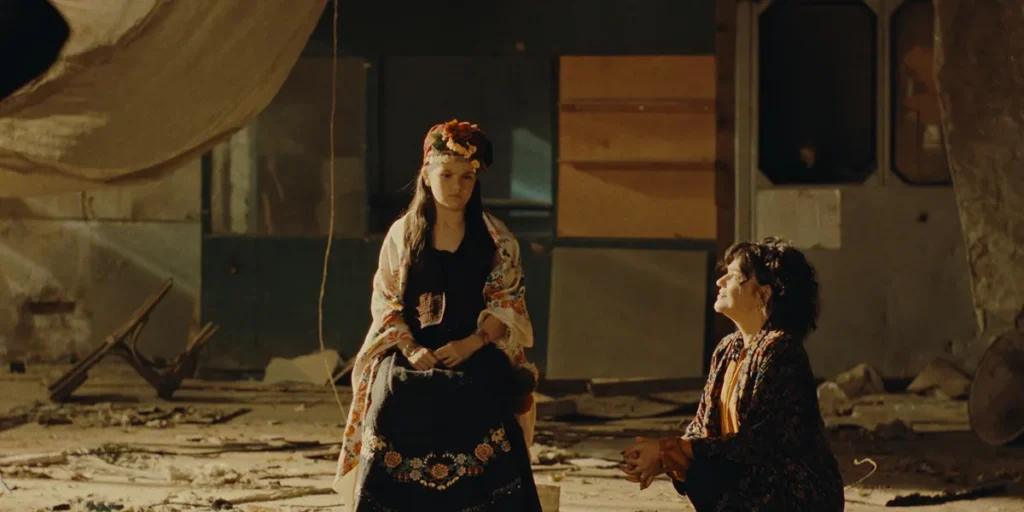
Nina Roza is a confident, understated drama from Geneviéve Dulude-de Calles that reflects on a variety of questions in increasingly interesting ways.
Director: Geneviève Dulude-de Celles
Genre: Drama
Run Time: 103′
Berlin Film Festival Screenings: February 16-22, 2026
Release Date: TBA
From the very beginning of Nina Roza, the sense of isolation is captured magnificently by director/writer Geneviève Dulude-de Celles (The Days), so much so that there are shades of the great Chantal Akerman (Jeanne Dielman) to the film’s opening. More specifically, Dulude-de Celles magnifies the loneliness one can feel even when surrounded by other people.
One of the central characters, Rosa (Michelle Tzontche, Nowhere), sits alone at a party, children and adults laughing and playing around her. She is disconnected, aloof—feelings that are instantly communicated by Dulude-de Cells. Nina Roza continues in this intelligent, artful, and evocative way for the rest of its runtime.
Rosa is a young adult living in Montreal, where she has resided for much of her life with her father, Mihail (an understated but effective Galin Stoev, Kurshum za raya), after the pair emigrated from Bulgaria in the 1990s. The death of her mother and Mihail’s wife still hurts the small family unit; both seem to turn away from unclosed wounds. There is a simmering of an argument, but this is left on the backburner after art collector Mihail is confronted with his past, travelling to his homeland to authenticate the work of an eight-year-old girl (Sofia Stanina). In its earlier stages, Nina Roza is slow but enthralling, slight but detailed, before stepping up to further levels upon Mihail’s return to Bulgaria.
Nina Roza is a film about many things: the beauty, mystery, and stories behind great art; being burdened by memories and regrets; what to do with children in difficult, life-altering situations. The movie’s depiction of art—Nina seems to be creating paintings beyond her tender age—is reflected in the way Dulude-de Celles and DOP Alexandra Nour Desjardins (The Hidden Woman) construct each shot. The camerawork is flowing and poetic, capturing both the intense isolation of foggy cityscapes alongside the more freeing surroundings of the Bulgarian countryside. There is a lot to glean from much of Nina Roza, but it never feels overwhelming or out-of-reach.

Furthermore, memories seep into everyday items and keepsakes, such as a character in the present being reflected as their younger self in the glass of a photo frame. Such thoughtful shots are given further impetus by editor Damien Keyeux (Papicha), who weaves everything together into a cohesive whole. As Nina Roza continues, Mihail’s past and present collide in interesting ways. He sees similarities between Nina and his own daughter, Rosa, not just in their mature ways, but also in how much influence he has or had on each of them as youngsters. With Rosa, it was his decision to move to Canada; with Nina, his decisions will affect her art career, and in turn her whole life. They are fascinating parallels, handled extremely well by Dulude-de Celles.
Mihail eventually faces his sister Elvira (Svetlana Yancheva, Strah) and her family, who he hasn’t seen in decades. It’s a cathartic moment, made even more so by Yancheva’s brief but fantastic performance, although it perhaps comes too late in the film and is tied up too neatly. Nevertheless, Nina Roza is impressive in how elegant and deliberate it is in telling its plot. There is a ripeness to how Dulude-de Celles crafts the story that feeds directly into how quietly but assuredly moving it is by its conclusion.
Nina Roza (Berlinale 2026): Movie Plot & Recap
Synopsis:
After emigrating from Bulgaria to Canada 28 years before with his young daughter, Mihail returns to his homeland to see the work of a talented young painter. His journey brings back many memories and suppressed emotions.
Pros:
- Elegant camerawork and original score
- Many levels to Geneviève Dulude-de Calles’ screenplay
- Impressive performances, particularly from Svetlana Yancheva
Cons:
- The conclusion feels slightly hurried and is reached too neatly
Nina Roza premiered at the Berlin Film Festival on February 16-22, 2026. Read our Berlin Film Festival reviews and our list of 20 films to watch at the 2026 Berlin Film Festival!