
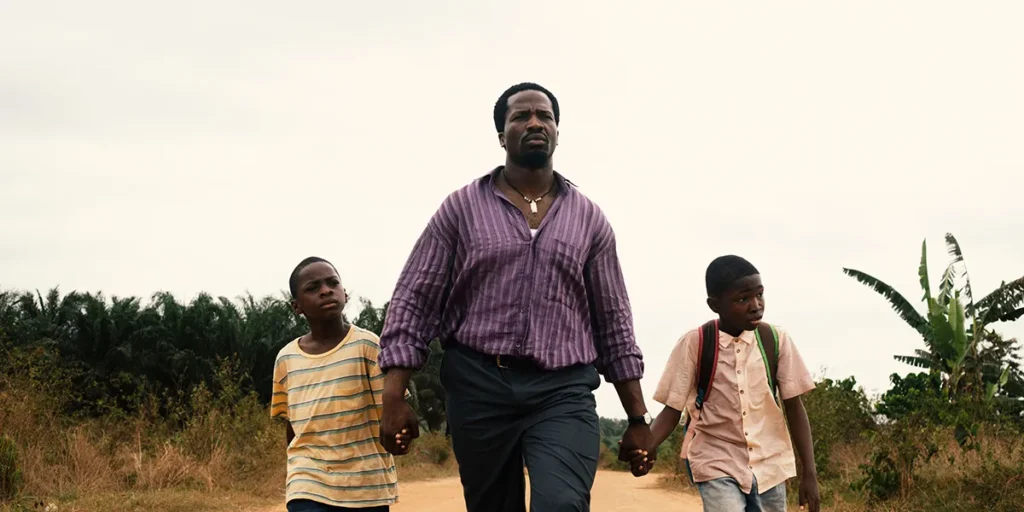
We sat down for an interview with cinematographer Jermaine Edwards to discuss his work on My Father’s Shadow.
My Father’s Shadow follows a family reunion set against the backdrop of the 1993 election in Nigeria. Director/co-writer Akinola Davies Jr., who wrote the personal script with his brother Wale, takes us on an incredible journey that is simultaneously grand in its scope and intensely personal in its emotions. Two young children Aki and Remi (debutants Godwin Chiemerie and Chibuike Marvelous Egbo, brothers in the film and in real life) get to spend a special day with their mysterious father, Folarin (an entrancing Sope Dírísú, His House). Appearing almost out of the thin air at the start of My Father’s Shadow, Folarin guides his two boys through places like Lagos and Ibadan, all whilst the tension of the election increases.
It is a deeply moving story that is brought to the screen in startling detail. Akinola and Wale lost their father at a young age, and this experience feeds into the film. After its British premiere at the BFI London Film Festival in 2025, we sat down with Jermaine Edwards, who as cinematographer played a large part in crafting My Father’s Shadow’s dense and detailed world. We talked about the film’s impressive worldbuilding, what it was like shooting it, and more. Read the interview below.
Worldbuilding: Jermaine Edwards on crafting the vivid setting and tone of My Father’s Shadow
Jermaine, congratulations on My Father’s Shadow! I saw it at the London Film Festival in October 2025 and loved it. It’s such a detailed, vivid film with very impressive worldbuilding. As the Director of Photography (DOP), how did you influence the on-screen environments?
Jermaine Edwards: A lot of it came from Jenna and Pablo Anti [Production Designers on My Father’s Shadow]. I was in Lagos from early January 2025; I’d never been there before, so I was acclimatising to the place. I met Jen, Pablo, Akinola [director and co-writer], and Wale [co-writer]. We went on a load of recces to find places; the Location Management team was amazing.
Then the worldbuilding came from sitting down with Akinola, Wale, Rachel, Pablo, and Ade Oshin [First Assistant Director] to talk about specific scenes and creating a language with the film. We wanted to find the emotional resonance of particular moments, so we looked at things like Akinola and Wale’s family albums. It all fed into the film.
A lot of My Father’s Shadow is just depicting what Lagos, Ibadan, and Nigeria as a whole, are really like. We’d just augment everything with lighting, production design, makeup, and so on.
The opening scene of My Father’s Shadow is so memorable and visually very interesting. What was the creative process like behind this beginning? It’s a mixture of realism with more magical elements.
J.E.: Basically, the camera got f*cked! Cristina Cretu [First Assistant Camera] was pulling her hair out! We shot all of that footage twice; we were doing wide and super close shots. At one point, Godwin hit his hand on one of the equipment boxes. At another moment, Godwin and Chibuike Marvelous ran into each other and tripped up. We left those parts in the film.
In this opening scene, the camera wasn’t working properly and the film wasn’t registering. It created a streaking, ghosting effect, so in that way, it was a complete mistake. We embraced the happy accident, as Conrad Hall used to say!
You couldn’t tell! Throughout My Father’s Shadow, you use distorted camera angles and shoot from the point-of-view of Remi and Aki. What was your thinking behind these choices?
J.E.: Remi and Aki are the linchpins, the central characters. We see them and their perspective. It is their day with their Dad. Seeing it from someone else’s perspective wasn’t going to be as interesting; the script demanded where to put the camera and how to shoot specific scenes.
The interest comes from the humanity of it all. We long for a view into the past of our childhood. Everything we did was in service to create that longing in the audience. Even for myself, having kids of my own, seeing them grow and how they view the world was an important aspect I wanted to encapsulate in My Father’s Shadow. And on a technical level, bringing everything down to the perspective of a child really helped with the visual language of the film. We’re seeing everything through Remi and Aki’s eyes.
Exactly. You witness snippets of conversations, like on the bus about the upcoming election, but Remi and Aki don’t fully understand what’s going on.
Getting Technical: Discussing the shooting processes of My Father’s Shadow
What kind of camera, lenses, and equipment did you use for My Father’s Shadow? It has a subtle grainy effect that really enhances the nostalgia.
Jermaine Edwards: We shot on 16mm film, which is amazing. I prefer using actual film to doing things digitally. There is an alchemy to it and it gives you a discipline, a way of working that you can’t replicate with digital. With celluloid film, there is an actual reaction happening, with light coming through the lens and creating something, which we then develop. With digital, it gives you a facsimile of or a perception of reality, which is noticeable.
In terms of actual cameras, we used an Arri 416 and then had an SR3 as a backup, just in case! Using 500T film gave us that grainy texture, and then 500D film we used for daytime shooting, basically for exteriors.
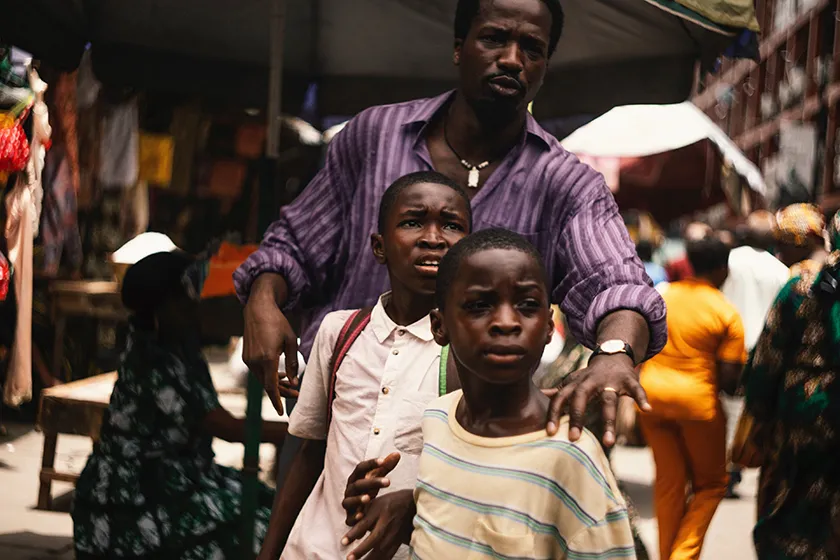
Was it a challenge shooting across a number of settings?
J.E.: It was difficult on location across Nigeria, because the film is, whilst not fast-paced, all about a journey. The characters are always on the move. The most problematic part of the film was the scene where Folarin, Remi, and Aki break down in the bus on the dirt road. It was just so dusty! I had a massive covering over my face.
I think logistically, it was a harder shoot than the actual filming and camera processes. The traffic getting to set in the morning in Lagos was insane. Imagine filming on the M1 in the United Kingdom—that’s what we did on the Third Mainland Bridge [in Lagos]. We had a police escort, large film screw, trucks with scaffolding and equipment, and people would be honking at us!
Influences and New Relationships: Jermaine Edwards on what came before My Father’s Shadow
What other cinematographers, artists, or photographers have influenced you?
Jermaine Edwards: A big one has to be Bradford Young [Pariah] He is an absolute legend. I’ve met him at award shows and visited him on set. He’s a really nice person and so forthcoming about his technical skills and approach to cinematography.
Conrad Hall [Road to Perdition] is also a big influence. The basis of my creative practice is to start with art and then adapt that into filmmaking. It’s an advantage and a disadvantage. Sometimes my brain is in “art mode”.
Films like Playtime and Zazie dans le Métro are really important films to me. They are both so playful, especially their cinematography. None of it is rooted in technique in the most traditional sense. You have to tread the line between the technical side of things and crafting your own voice.
What was it like working with Akinola Davies Jr.? How did you come to join the crew of My Father’s Shadow?
J.E.: I knew Rachel Dargavel through a friend at university, and she was a producer on Lizard [Davies Jr.’s short film, 2020]. I helped on that film; it was the first film set I’d ever been on. Then Akinola and I did a series of documentaries called rituals: unionblack that showed at Somerset House in London. When we were working on that, Akinola told me about the idea for My Father’s Shadow. I didn’t think I’d be asked to work on it, but I was! It was a development process. Rituals: unionblack has a lot of similar ideas to My Father’s Shadow, in that they look at Black culture.
Akinola is great. He is so collaborative and lets people shine. He creates this space where it is calm and there is no wrong answer to anything. It was a first feature film for a lot of people on this shoot, and that probably worried people from the outside looking in. It is a massive testament to Akinola and Rachel and the people around them that it was a success. The people involved in My Father’s Shadow really cared about the film and wanted it to be excellent. That goes a long way.
This interview was edited for length and clarity.
My Father’s Shadow was released in select U.S. theaters, in U.K. and Irish cinemas and globally in theatres on February 6, 2026.