
Despite generating some tense moments, Heysel 85’s fictionalised approach to real events threatens to cheapen a tragedy.
Director: Teodora Mihai
Genre: Crime Drama, Historical, Sports, Thriller
Run Time: 91′
BFI London Film Festival Screening: October 17, 2026
U.S. Release Date: TBA
U.K. Release Date: TBA
Heysel 85 attempts to put a human face on a fatal tragedy, so long as those faces aren’t the dead ones. Teodora Ana Mihai’s fictionalised recreation of the events of 29th May 1985 focuses on people who weren’t there, from a point of view that avoids looking directly at the violence of the story. The avoidance of truth is at the core of the movie, but the film takes a few too many liberties with that story to resonate as much as it wants.
When fans of Liverpool and Juventus assembled in Brussels for the European Cup Final, the city was brimming with optimism. The authorities had just overseen a successful visit by Pope John Paul II, and having the handsome (but crumbling) Heysel Stadium filled with expectant fans for one of football’s most anticipated events would be the icing on the cake. The beaming faces of Brussels’ mayor Dumont (Josse De Pauw) and police commissioner Simons (Fabrizio Rangione) suggest all is well. Dumont’s daughter/press attaché Marie (Violet Braeckman) is not so relaxed, extolling her father’s recent successes while rolling her eyes as he downs another glass of whiskey.
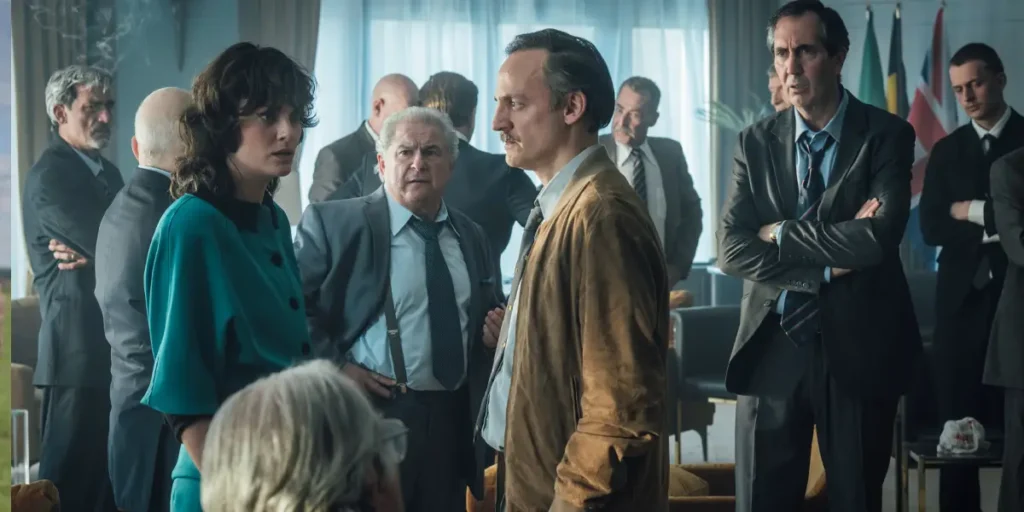
Heysel 85 is a film that uses its ironies to its best advantage. In the melee that was to follow, alcohol was repeatedly blamed for the violence and resulting crush that killed 39 people, but Mihai and her co-screenwriters frequently have the attending officials toasting the game. The tragedy unfolded on a sunny evening in an open-air stadium, but the film takes place in the smoky offices and dank corridors of Heysel’s underbelly. Mihai’s film is impressively claustrophobic, as the camera persistently stalks Braeckman through the stadium corridors. The gloomy blues of Marius Panduru’s lensing paint the venue as a netherworld doomed not to let some people escape.
Among the people trapped (either physically or by their duty) in Heysel is Luca (Matteo Simoni), an Italian journalist attempting to report on the unfolding chaos while trying to track down his own family at the ill-fated ‘Z’ stand behind the goalline. Heysel 85 pings back and forth between Luca and Marie’s storylines but, at barely 90 minutes long, the film is too slight to bear the weight of these competing priorities. Braeckman carries the film on her shoulders, her hurried walk never letting up as she seeks out answers, help and some measure of truth. Simoni does his best with his role, but Luca is merely a cypher to inject some personal stakes into the narrative. This would be more egregious if everyone else here wasn’t also made up.
Most of the characters in Heysel 85 are caricatures or composites of their real counterparts. Presumably the story is told this way either to avoid legal repercussions, or to take liberties with the characterisations. That explains why the mayor ends up a rambling drunk, the other authorities become hectoring ditherers, and not one player on either team is referred to by their name. These changes are simply unnecessary; years of enquiries have apportioned the blame, and the details of the calamity are readily available. Indeed, Heysel 85 nods to the myriad errors that accumulated across the stadium to compound the disaster, from cracked infrastructure, to uncoordinated police forces, to faulty radio communication. Alas, these details get lost in the film’s rush to get to the finish line.
There are enough drama and pain in the true story of this disaster to allow liberties to be taken with the narrative, but the script simply isn’t researched or developed enough. The resulting film is too short and fast-paced to explore the minutiae of the story in a compelling way. The movie is at its most compelling when the stadium building fills with the dead and injured, but those more human stories get lost in the need to hang the blame on a boogeymanned version of the real authority figures. The most truthful moments are the inserts of real TV footage of the disaster. The bodies glimpsed in this harrowing footage lie uneasily next to the fictional characters that Heysel 85 forces to shoulder the blame for their deaths.
The template for Heysel 85’s retelling of history is September 5, as both films recreate an unbearably tense atmosphere around journalists thrown into situations they couldn’t have expected. Tim Fehlbaum’s film about the massacre at the 1972 Munich Olympics may have hedged its bets about how to feel about its central characters, but at least it tried to stick to the facts. Heysel 85 conjures up an impressively oppressive atmosphere, but it’s populated by people who can never be as real as the events happening just outside. A scene in which Marie goes to visit a makeshift morgue outside the stadium rings false because it reeks of manipulation. It’s easy to con the audience into a feeling with unnecessary liberties, but the real disaster deserves more insight than Heysel 85 can offer.
Heysel 85: Movie Plot & Recap
Synopsis:
A Belgian translator and an Italian journalist get caught up in the chaos of the unfolding Heysel Stadium disaster.
Pros:
- Shot and edited tightly and nimbly, evoking potent claustrophobia and tension
- The lead actors are decent
Cons:
- The film fictionalises events in a way that’s reductive, if not unnecessary.
Heysel 85 was screened at the BFI London Film Festival on October 15-17, 2026.