
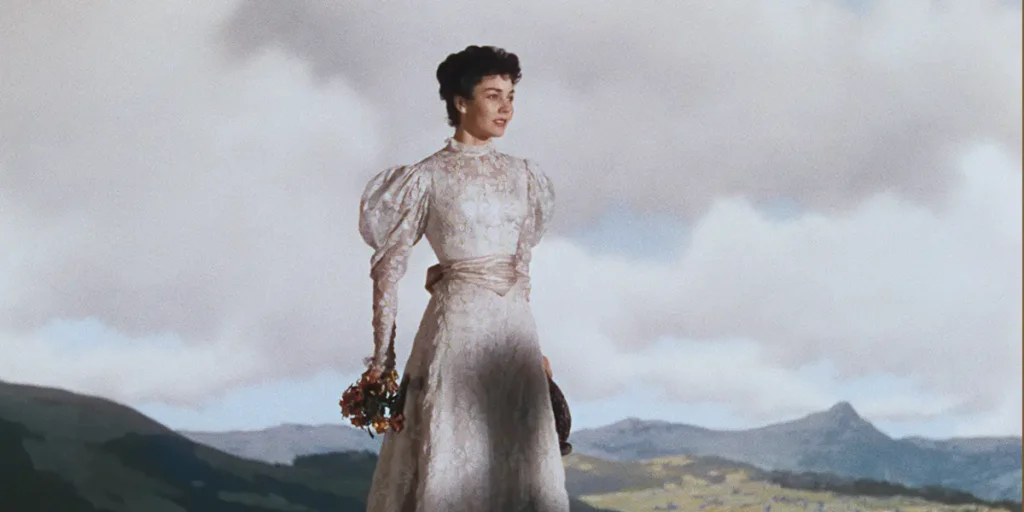
Powell and Pressburger’s restored Gone to Earth is a Technicolor wonder about a free-spirited woman of nature and the men who lust after her.
Directors: Michael Powell, Emeric Pressburger, Rouben Mamoulian
U.S. Title: The Wild Heart
Genre: Drama, Romance
Run Time: 110′
BFI London Film Festival Screening: October 7, 2026
Original Release: November 6, 1950
2026 Restoration Release: TBA
In terms of Archive showcases at this year’s London Film Festival, Ken Russell’s The Devils has taken most of the attention, and with good reason. After decades of being censored, Russell’s extraordinary tale of religious persecution finally being shown as intended is a big deal. However, it is not the only restored classic at LFF. Made in 1950 by the incredible Michael Powell and Emeric Pressburger (aka The Archers), Gone to Earth is an often overlooked film in their careers. That is understandable, partly because of the pair’s killers row of masterpieces (A Matter of Life and Death, The Life and Death of Colonel Blimp, The Red Shoes) and partly because of producer clashes.
The film was a co-production between Alexander Korda’s London Films and US producer David O. Selznick. Dissatisfied with the finished film and unable to assume full control, Selznick made an American cut called The Wild Heart, enlisting Rouben Mamoulian to direct major reshoots and making his changes directly onto the film’s negative. More than 75 years later, long-time Archers fan Martin Scorsese has rebuilt the original version, with help from the BFI’s own print, his own Film Foundation and (surprisingly) Walt Disney Studios. It means Powell and Pressburger’s potent Technicolor melodrama can finally have its day in the sun as intended.
On the Wales/Shropshire border in the 1890s, Hazel Woodus (Jennifer Jones, of Madame Bovary) lives in God’s Little Mountain. She is a country girl who lives with abandon among nature and with the animals: her pet fox, Foxy, a cat, a rabbit, even bees. She often rebels against her coffin maker/harpist father (Esmond Knight, of A Canterbury Tale), whilst a ‘Spells and Charms’ book has been inherited from her late mother. Soon though, Hazel finds herself drawing the attention of two men.
One night, Hazel is making her way back home when rich squire and hunter Jack Reddin (David Farrar, of Black Narcissus) charges out of the shadows. After their encounter, Hazel tries her best to avoid Jack, who scours the meadows for her. She later marries the new Baptist minister, Edward Marston (Cyril Cusack, of The Small Back Room). However, he chooses not to consummate their marriage. And the lure of Reddin quickly becomes too much to bear for Hazel.
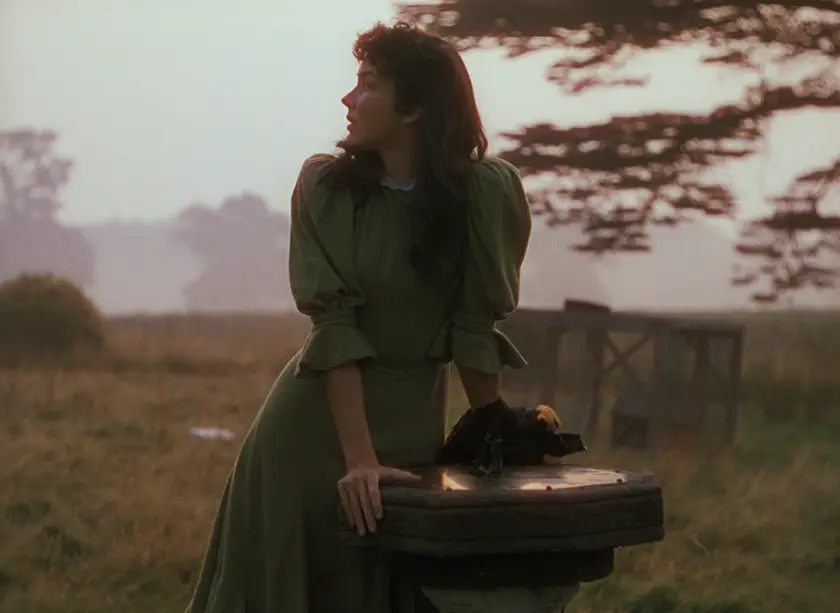
Gone to Earth is an adaptation of Mary Webb’s 1917 novel, which has been compared to Thomas Hardy. And though this isn’t as strong as other Powell and Pressburger films (which would be a real feat considering their catalogue), the directors’ craft is on full display. For one thing, it is a gorgeous-looking film, with DP Christopher Challis wonderfully capturing the windswept landscapes where Powell once spent his summers (his father was from Shropshire). Additionally, Gone to Earth was shot in Technicolor, and the restoration here reveals nuanced detail in the colouring. Sky blues and golden sunsets are vivid. The reds of Ivy Baker and Julia Squire’s costumes stand out, as do the natural countryside greens and browns.
Of course, you didn’t need a restoration to capture the grandeur of Brian Easdale’s dramatic score, which incorporates harps and hunters’ trumpets, nor the complex performances from all three leads. Jones’ Hazel is a determined, self-reliant woman more at home with animals. Yet over the course of the story, she is turned into a ‘proper’ woman, married and baptised. It seemingly operates as a comment on the role placed on women in this Victorian society, as well as the brutality of civilisation intruding on nature. Cusack’s Marston is a calm but naïve gentleman still living with his mother, even after his marriage. And Farrar is as brooding and intriguing as he is in Black Narcissus, as a man who will stop at nothing to win Hazel even after Marston marries her.
That is what Gone to Earth boils down to: two men fighting for a woman, and their desires trying to dictate and control her whilst ignoring her autonomy, ultimately leading to tragedy. As a passage from Webb’s novel reads: “She wanted neither. Her passion, no less intense, was for freedom.” Powell and Pressburger’s film is about a free, untamed spirit who belongs to the earth. And it is a Technicolor wonder of a film that is joyous to watch throughout, visually splendid but with an eerie undercurrent that gives it profound substance.
Gone to Earth: Movie Plot & Recap
Synopsis:
On the Wales/Shropshire border in the 1890s, a woman of nature is caught in a love triangle between a rich squire and a Baptist minister.
Pros:
- It’s a gorgeous-looking Technicolor wonder of a film.
- It’s a potent melodrama about an untamed spirit of the earth, and the men who desire to control her.
- Powell and Pressburger were filmmaking masters, and their craft is on full display here with this restoration.
Cons:
- It’s not as strong as Powell and Pressburger’s other brilliant movies.
The new 4K restoration of Gone to Earth was screened at the BFI London Film Festival on October 7, 2026. Read our reviews of The Small Room and Made in England: The Films of Powell and Pressburger.