
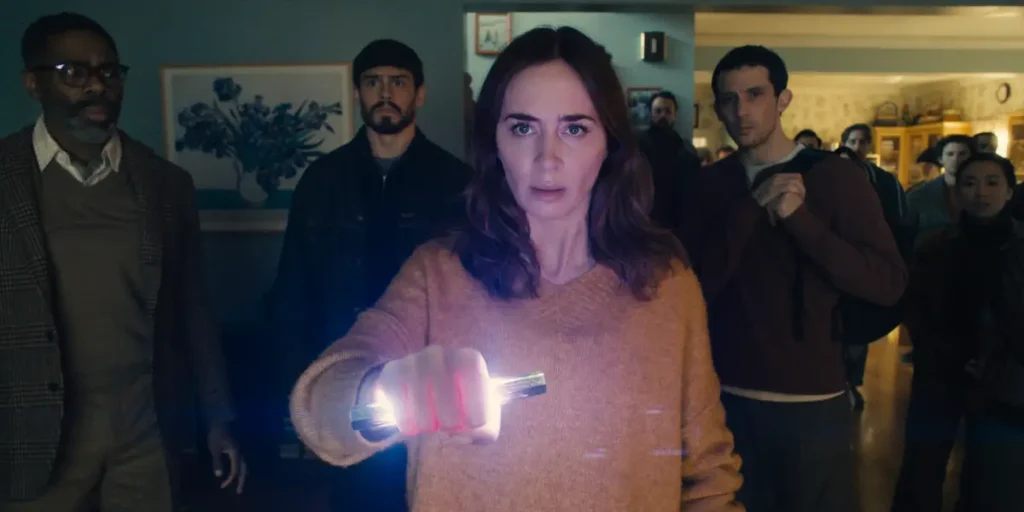
Disclosure Day, despite comments from Steven Spielberg, helped solidify my faith and reminded me where that faith should actually be placed.
“It would shake certain core, fundamental beliefs.” This was Steven Spielberg’s response when asked what would happen if a real “disclosure day” were to occur. As the internet is wont to do, his quote was taken out of context and misapplied until, by the time I heard about it, people were telling me the famed director said Christians could lose their faith simply by watching his latest film, Disclosure Day. While Spielberg’s point may have been lost to an online game of telephone, the film nevertheless depicts the very thing he says would shake someone’s beliefs, my beliefs. As a film critic who happens to be a Christian, was I committing an act of defiance (or even sin) by exposing myself to something that could deconstruct my faith?
I will admit that Spielberg’s comments, along with the discourse I was hearing in my community and online, had me more interested in seeing Disclosure Day, not less. Spielberg seemed to be asking whether Christian doctrine, and our interpretation of it, could stand up to the discovery of alien life. I was curious to see what kind of scientific, theological, and extraterrestrial arguments he would make, and if my own apologetics (the act of defending one’s beliefs) could withstand those arguments. I was surprised, then, when the film strengthened my faith instead of weakening it.
The word “Christian” can mean many different things to many different people, containing a wide swath of denominational, cultural, and even (unfortunately) political connotations. As a result, one individual “Christian” may have a certain view on the relationship (or lack thereof) between the Bible and aliens while another “Christian” may have a completely different, if not the opposite, view. In my experience, Christians have often shied away from and even scrutinized the “do aliens exist” conversation. Growing up, I heard a plethora of answers to the alien question, ranging from “they simply don’t exist” to “they are actually demons in disguise.” The latter answer meant that any story about a potential UFO sighting should be shunned, and in fact viewing any depiction of aliens in media or culture could invite a demonic force into your own life.
Disclosure Day, however, directly challenges many of these modern American Christian assumptions about aliens. The movie does so not by suggesting that aliens disprove God’s existence, but by asking whether belief in God can peacefully coexist with the existence of intelligent life outside of Earth.
The plot involves cybersecurity analyst Daniel Kellner (Josh O’Connor) as he is on the run from his former employer, Wardex, with material that would disclose this company’s discovery and mistreatment of extraterrestrials. In a short but crucial exchange, Kellner’s girlfriend Jane (Eve Hewson) asks her former mentor, Sister Maura (Elizabeth Marvel), if her faith would be shaken should she learn that humanity is not alone in the universe. The nun quickly assures Jane that it wouldn’t, while also quoting a translation of the Genesis creation account that says humans are God’s supreme beings “on Earth.” She also states that she doesn’t believe Jane has lost her faith in God, but instead her faith in people.
This conversation is the turning point of the movie. It reveals that Disclosure Day is really not most interested in whether aliens exist, but in whether our faith is built on stone or sand.
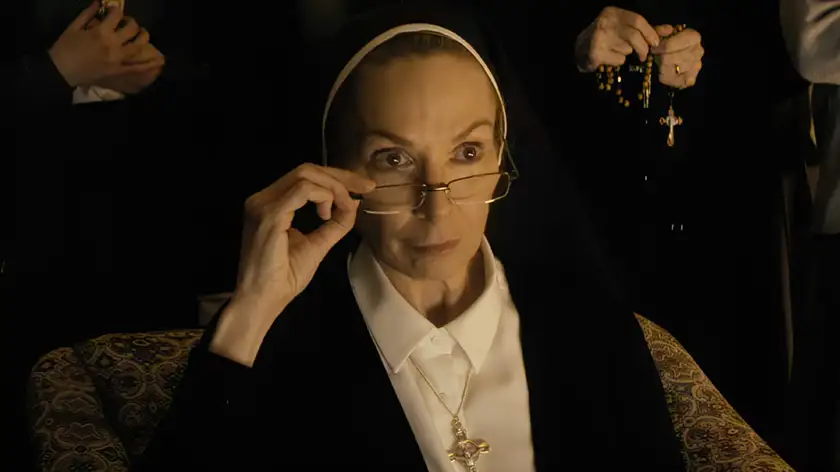
This moment accomplishes two things. First, it grounds the idea of God as the infinite ruler of the universe, putting all things—including aliens—“in subjection under him” (1 Corinthians 15:27). The wise nun’s point is that if we truly believe in an all-powerful, all-knowing God, we can peacefully assume that even these unknown, otherworldly beings are under his control and authority.
Second, this moment reiterates the idea that people often lose faith not because of God, but because of other people. A conflict that seems to be the beginning of World War III rages in the background of Disclosure Day, reminding the audience of the terrible “wars and rumors of wars” that humanity is capable of (Mark 13:7…a passage that speaks of these horrible things but telling Christians to “not be alarmed”). Along with these terrible acts comes the idea that people, even well-intentioned ones, are able to misinterpret Scripture, draw conclusions that are incorrect, or even blatantly use Scripture to manipulate people. These failures often act as the source of one’s lost faith.
Rather than attacking or critiquing faith itself, the film asks its audience to consider how strong our faith truly is, what we are actually placing trust in. Too often, Christians mix their trust in human ideas and human-made institutions with their trust in the sacred. Their faith and values are often compromised as a result. To give a recent example, so many American Christians tied themselves to a particular political party/candidate in 2016, to the point where many now cannot differentiate the values of Scripture from the values of Donald Trump or the Republican Party.
Whether one agrees with those values or not, this kind of misplaced trust weakens faith because it centers belief in fallible humans rather than an infallible God. We see this deficient trust in human institutions presented in the film itself. I view the film’s wild and unexpected opening shot to be a metaphor for how competing factions and institutions beat down the populace, leaving us, as Colman Domingo’s Hugo says, “starved for the truth.” It can be assumed that people put trust in Wardex, only for the company to abuse that trust by acting unethically.
While I’ve been speaking from within my own experience in the Christian tradition, I believe this logic could apply to people of all religious beliefs. If one’s faith can be shaken or even destroyed by something like an alien encounter, how strong was that faith to begin with? If Christianity, for example, is true because Christ rose from the dead, the discovery of little green men in spaceships would not make that resurrection any less true. These are separate questions. While the discovery of extraterrestrial life would undoubtedly change our understanding of the universe, it would not undo the core claim of Christianity.
In the movie’s final, wonder-inducing sequence, Emily Blunt’s Margaret Fairchild—interpreting the alien that has just been revealed—tells the world to “listen.” I heard, but did not listen, to the people saying I should reject Spielberg’s film on religious grounds. Instead, I listened to what the film was actually saying, and by doing so, walked away with a strong reminder that faith is safest when it rests in God rather than our finite assumptions about His created world. My faith is all the better after Disclosure Day.
Disclosure Day was released globally on digital platforms on July 21, 2026.