
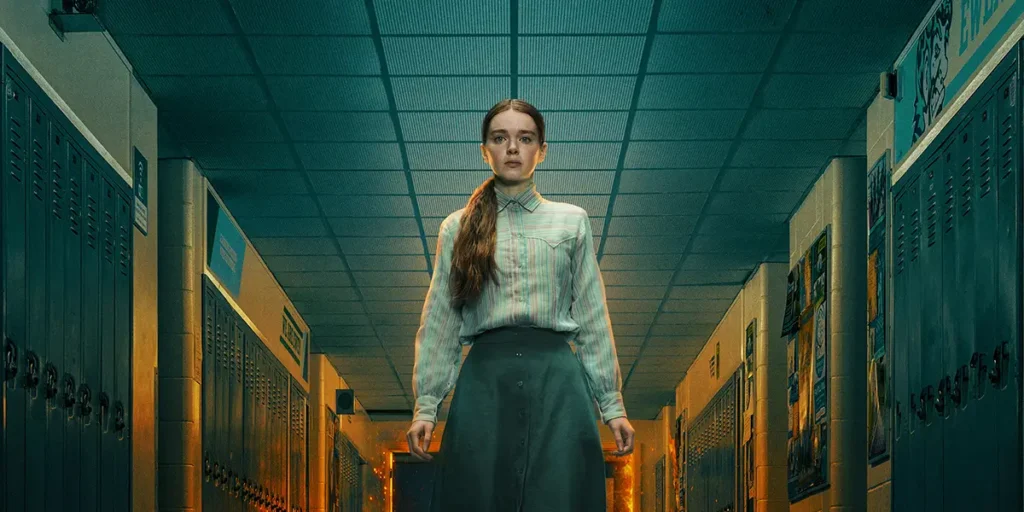
Mike Flanagan expands and interrogates Stephen King’s Carrie through an audacious modern-day adaptation of one of the greatest literary tragedies.
Director: Mike Flanagan
Genre: Horror, Psychological Drama, Supernatural Horror
Number of Episodes: 8
Release Date: October 7, 2026, released all at once
Where to Watch: Stream it globally on Prime Video
“Do we need another adaptation of Stephen King’s Carrie?” was my first thought when Amazon announced an eight-episode reimagining of King’s debut novel by Mike Flanagan. Brian De Palma’s 1976 film is an unquestionable masterpiece – it moves (and devastates) us in ways that few horror movies do, because it fundamentally understands that Carrie White’s story is a tragedy, starting from her abusive, isolated childhood to a prom night that ends in senseless bloodshed.
No other adaptation, in film or television, has matched (or transcended) De Palma’s, so why should Flanagan even try?
To be fair, he has successfully adapted King’s Gerald’s Game, Doctor Sleep, and The Life of Chuck to the screen, but Carrie is different. It’s a sacred text adapted into a seminal film. Flanagan didn’t have the luxury of messing this up, and De Palma’s film remains such an aesthetically and thematically daring object, even fifty years after its release, that following in his footsteps seems like a fool’s errand. In fact, when De Palma-esque split diopters appear in Flanagan’s vision of Carrie, they look so artificial that they almost pull you out of the series altogether. But then there’s a fun tribute to De Palma’s legacy near the end of the show where Flanagan makes clear that he’s not trying to imitate – or surpass – him in the slightest. That film will stand the test of time, while Flanagan’s Carrie audaciously expands King’s text to fit our contemporary sensibilities.
Smartly recognizing that school violence and bullying have worsened with the proliferation of technological devices at our fingertips, Flanagan, alongside directors Kate Siegel, Axelle Carolyn, Kyra Sedgwick, and Hiromi Kamata, envisions a Carrie White (Summer H. Howell) for the modern era. Her Bible-obsessed family warps scripture through the conspiracy theories they believe in by “doing their research” and have purposefully hidden Carrie from society. That’s why, when a social worker enters the home of Ralph White (Tahmoh Penikett), who died in a workplace-related accident, they are shocked to see a little girl hiding in the closet with her mother, Margaret (Samatha Sloyan).
Carrie’s existence is unknown to anyone but her parents, who have “shielded” her from the outside world but, in reality, have prevented the physical and social development she likely would’ve gained from interacting with society, leaving her with a subjective conception of the planet she lives on. The only book she is allowed to keep at home is the good one, and any scolding is met with biblical punishment. School finally sounds like the perfect opportunity for Carrie to learn about things the book her neighbor sneaks to her won’t, and perhaps make friends in the process.
That’s the idealized version of what Carrie thinks school will be, but it is, in fact, a nightmare. Students routinely pick on her because of her doe-eyed view of the world, call her a “freak,” and continually belittle the religious views that were imposed upon her by a mother who has twisted religion to control her daughter. Instead of trying to help someone who has lived a considerable part of her life inside an abusive household and ensure her integration into society is successful, every ounce of Carrie’s innocence is stripped from her by privileged, entitled figures like Christine Hargensen (Alison Thornton).
Of course, one of the central sequences in King’s book that sets the rest of the story in motion is when Carrie gets her first period, with no idea what’s happening to her body. She has never been able to walk outside her home or even know what goes on outside it. Chris prefers to film Carrie’s period as a humiliation ritual and throw tampons at her, as she slips and falls into the shower, and yell “plug it up!” before posting it on social media by creating a new Instagram account dubbed “carriered” for the world to see. What the bullies, however, don’t know about is that Carrie possesses latent telekinetic powers that are slowly unveiling themselves as the physical and emotional toll she feels from her abuse becomes too much to bear.
Carrie’s story is thus no longer isolated to Maine; it is viewed through the prism of the phones we all have. This is, by far, the biggest and most exciting departure that Flanagan makes from King’s text, and it feeds every single aspect of the series. He doesn’t simply treat Chris Hargensen as a psychopathic b–ch who ultimately gets what she deserved, but as a three-dimensional, fully-fledged human being whose bad decisions and abuse of Carrie stem from her tumultuous life – the relationship she has with her not-so-wealthy con artist of a father (played by Michael Trucco) is contrasted with the life her divorced mother (Heather Graham) has made for herself after knowing that her past marriage would lead to nowhere.
Chris’ vulnerabilities are thus projected onto the easiest possible target: someone who has never been to school and has no idea how the world works beyond her mother’s twisted version of the Old and New Testament. The tragedy isn’t simply experienced by Carrie, but by someone whose entire life slips away, even if her decisions cause her own undoing. Sometimes, Flanagan pushes the bullying into extreme, almost cartoonish territory, but he always roots it in what’s happening either physically or on the students’ screens, which feels eerily close to what’s occurring in the world we live in now.
Some purists might not appreciate what he’s doing to such a sacred piece of literature, and it would be understandable if the series wasn’t so thematically rich and narratively bold. Flanagan departs significantly from the book, especially in the show’s final moments, which are bound to cause division among audiences. I’ll admit some choices perplexed me to no end, including one I thought didn’t work at all: a character named Emaline West (Thalia Dudek), who wasn’t in King’s novel. To talk about her would mean spoiling crucial plot points that shouldn’t be revealed in any review, but let’s just say I clocked her trajectory five episodes before the big “reveal.”
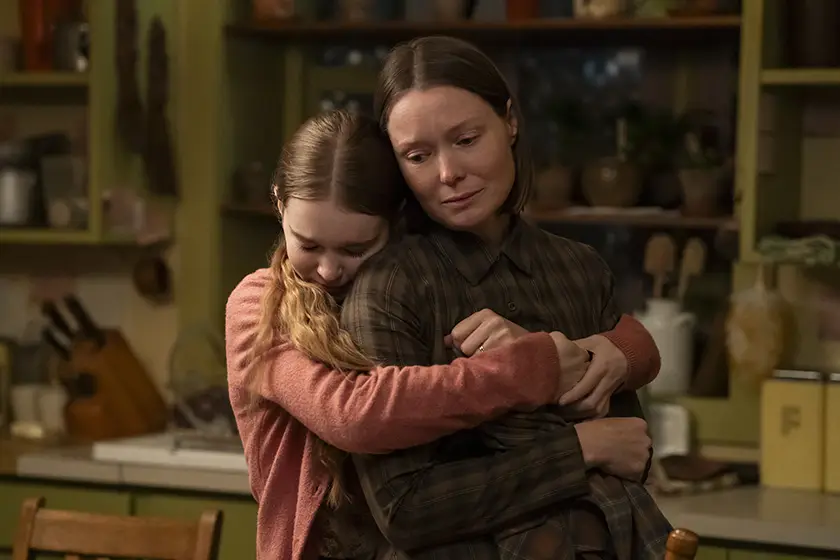
The way in which Flanagan repurposes Carrie’s maternal relationship is also devastating, because there’s an innate love Margaret has for her child that’s essentially shrouded by the psychological abuse she subjects Carrie to, going so far as to become the ultimate stalwart against the “carriered” account and inadvertently become a prominent social media figure. Everything Margaret does is for Carrie’s good, she believes, but it becomes clear she’s only doing this to “absolve” her image in the eyes of God. King’s text was already rich, but Flanagan somehow enhances many of the themes lightly touched on in the book, making them resonate even louder, especially as they build toward the centerpiece of the novel and the film: the prom.
We know what happens. Carrie is smeared in pig’s blood. Her telekinetic powers are now fully realized as she locks the gymnasium up with her mind and unleashes Hell. Why show the same scene again with little to no formal (or thematic) reinvention? Flanagan is too smart a filmmaker to fall into the same remake traps David Carson and Kimberley Pierce fell into when re-adapting the book. Instead, he makes the prom the central sequence of the whole series. The first episode opens with an interrogation of Sue Snell (Siena Agudong), as she recounts what happened that fateful night, which feeds into every scene in the series. It all builds to the prom, but what occurs in that sequence may shock and even surprise you in ways that De Palma’s split-screen finale did not.
As he freezes time and keeps finding new angles to interrogate not only the event but King’s text itself, Flanagan modernizes a classic that felt like the biggest trap the auteur could’ve fallen into. It’s not perfect, but its meditation on the current state of society, as bullying continues to ravage our educational system, is the most pertinent he’s been in a very long time. No one could’ve surpassed De Palma; that much is clear. Flanagan knows this, and he proves all his doubters wrong by showing us why Carrie’s story matters even more than it did over fifty years after it first hit the world. The tragedy is still there, but it somehow hits much harder than it did beforehand, because we recognize a world that is eating itself alive, and the road to recovery, or even common ground, seems much further than we initially thought…
Carrie (2026): Series Plot & Recap
Synopsis:
After being discovered by the authorities, teenager Carrie White begins her integration into society by going to Ewen High School, but her reclusive, warped view of the world makes her an easy target for bullies who take advantage of her vulnerabilities through a social media account dubbed “carriered.”
Pros:
- Flanagan doesn’t pretend Brian De Palma’s adaptation of Stephen King’s book can be surpassed; instead, he transposes Carrie White’s story to our modern-day sensibilities.
- The commentary he draws on online (and physical) bullying is more pertinent than ever, as most of our interactions no longer happen in the real world.
- Summer H. Howell is phenomenal as Carrie, and so is the rest of the core cast, notably Samantha Sloyan and Matthew Lillard.
- Flanagan adds three-dimensionality to Chris Hargensen and gives her a backstory as tragic as Carrie’s, though it leads to entirely different paths.
- The prom scene is a real stunner because of Flanagan’s knack for subversion as he thrillingly interrogates its significance.
Cons:
- Some aesthetic choices, including the use of split diopters, aren’t very good.
- The addition of a new character is the show’s weakest link.
Carrie (2026) will be now available to stream globally on Prime Video on October 7, 2026.