
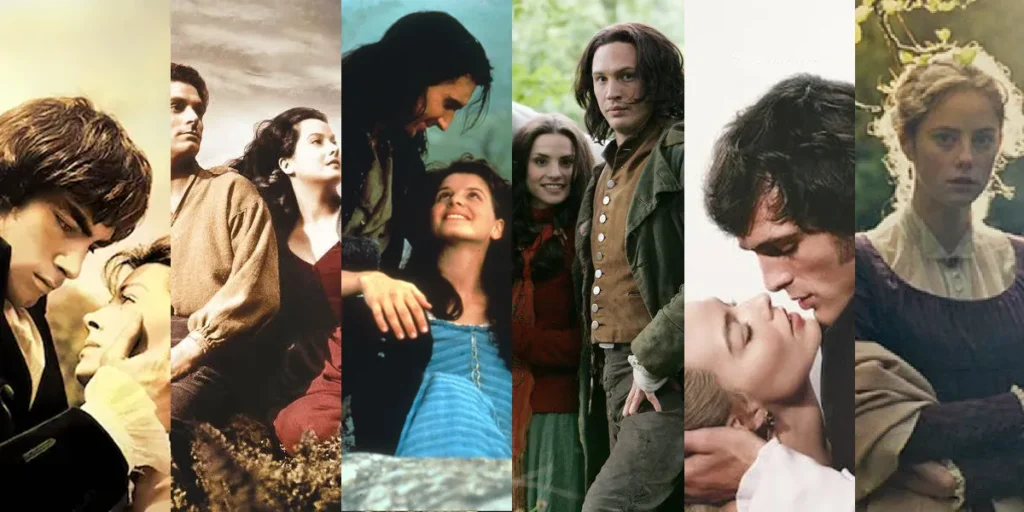
Following the release of Emerald Fennell’s Wuthering Heights, we ranked all the most famous adaptations of the venerated romance from worst to best.
Emily Brontë’s 1847 romantic epic “Wuthering Heights” has blessed (and in equal parts cursed) generations of readers with the torrid story of Cathy and Heathcliff, two lovers destined to be one another’s demise. The tale of these timeless characters and the subsequent aftermath of their romance has inspired and influenced countless love stories in the 178 years since its initial publication.
While “Wuthering Heights” is a behemoth of a story to tell, many have tried their hand over the years to bring Cathy and Heathcliff to the screen. In light of the recent release of Emerald Fennell’s take on the legendary romance, I went back to watch the most famous adaptations of “Wuthering Heights” to see where this one falls amongst the rest and decide once and for all which adaptation reigns supreme.
To measure each film against the others, I will look at the accuracy of the storytelling, the impact of mise-en-scene, the adaptation’s ability to evoke the spirit of the novel through its analysis of its themes and the overall cohesion of the movie’s vision. It’s not uncommon for adaptations of “Wuthering Heights” to solely focus on the first generation of characters as opposed to how the story continues after Cathy’s death, so while storytelling accuracy is a part of the rating criteria, it will stand more as a mitigating rather than definitive factor.
While not a requirement, for a fully immersive experience, I do suggest reading this ranking with either Charli XCX’s “Wuthering Heights” album playing in the background, or Kate Bush’s 1978 “Wuthering Heights” single on repeat. Here are all the most famous movie adaptations of Wuthering Heights, ranked from worst to best!
6. Wuthering Heights (1970)
Director: Robert Fuest
Cast: Anna Calder-Marshall, Timothy Dalton, Judy Cornwell
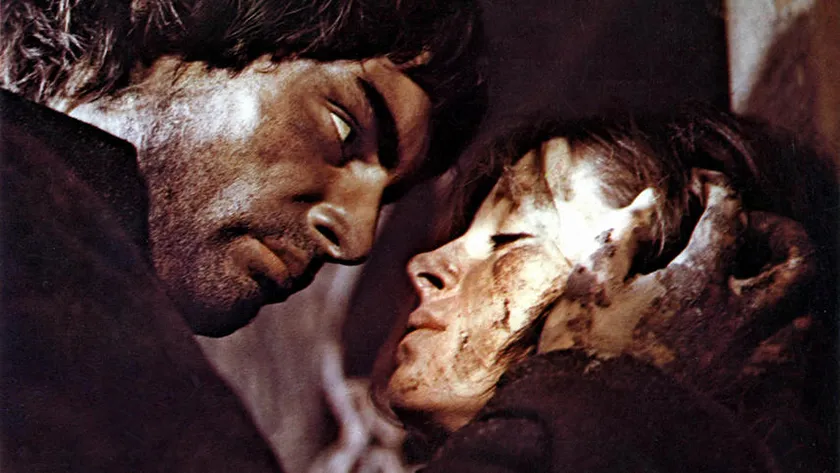
Coming in last is Robert Fuest’s 1970 film adaptation, starring Anna Calder-Marshall as Cathy and Timothy Dalton as Heathcliff. As far as faithfulness to the source material, while it vividly details certain aspects of the plot, it wholly ignores others. Fuest’s film only centers on the first generation of the “Wuthering Heights” story, which doesn’t automatically force a lower ranking if the storytelling and other grading criteria perform well, but in this case, they do not.
The main issue with the 1970 version of Wuthering Heights is its lack of meaningful conviction. Again, this source material is a behemoth of a story. It is widely regarded as the greatest and cruelest love story of all time. The passion the book holds, especially given the context of Brontë’s intensive isolation, is something that still shocks and moves readers to this day. However, Fuest’s adaptation feels devoid of this fiery intensity.
As an audience member, you can feel the story is trying to emulate the epic tales of the Hollywood golden age; however, it puts forth none of the effort to make itself grand in any capacity. Dalton’s Heathcliff feels forced and melodramatic with no undertones of madness to any convincing degree. It’s almost as if they believed there was no way to miss the mark in retelling a story as intense as this, but relying solely on the source material without any conviction makes the film seem self-indulgent as a whole.
In Fuest’s adaptation, it never feels like he is making the story his own. While “Wuthering Heights” is a classic, it works best when constructed to hone in on one of the many themes of the story rather than trying to attack all of them with equal force. Unfortunately, this adaptation reads like it was made out of obligation rather than passion for the source material, leaving the final product feeling dull and uninspired.
5. Wuthering Heights (2026)
Director: Emerald Fennell
Cast: Margot Robbie, Jacob Elordi, Hong Chau
Conversely, Emerald Fennell’s adaptation of “Wuthering Heights” feels like it took far too many liberties from its source material. When the first poster for Fennell’s film hit social media, there was a wide questioning of why the title was in quotation marks. While some thought it alluded to the golden age of epic storytelling the source material lends itself to, Fennell explained, it was because this was simply her interpretation of the classic novel, as she would never be bold enough to say she definitively adapted the timeless book. After seeing the film, this clearly proves to be one of her best ideas for the adaptation as a whole.
Simply put, Fennell’s Wuthering Heights really isn’t “Wuthering Heights”, but moreso a story inspired by it. It’s almost as if she were trying to retell the plot from memory with her own embellishments added in to make the story read the way she wishes it would, or to paint how she translated it in her own way.
Compared to Fuest’s adaptation, which feels devoid of artistic passion, Fennell’s is entirely fueled by it. Cinematographer Linus Sandgren’s work makes the world of “Wuthering Heights” as vibrant and passionate as the story feels when you’re reading it. However, the other aspects of the story embellished by Fennell’s imagination feel like they detract more from the source material than enrich it.
The blatant displays of sexuality end up feeling like a safer creative choice than the innate, raw sex appeal that other adaptations create from the actual absence of sex. This, along with the literal and vivid acts of cruelty are clearly attempts to bring the emotions evoked from Brontë’s novel to the forefront of the film, but as other adaptations will demonstrate, sometimes these themes work more powerfully when they are not so obviously stated.
Fennell’s work is ambitious and passionate, but it ultimately falls short. Brontë’s story becomes more dark, twisted and cruel as it evolves, whereas Fennell’s film immediately shows its audience its hand and then quickly runs out of room to grow. While not a wholly unenjoyable film, it is an extraordinarily loose adaptation of the classic romance.
4. Wuthering Heights (2011)
Director: Andrea Arnold
Cast: James Howson, Kaya Scodelario, Solomon Glave, Shannon Beer
Andrea Arnold’s 2011 film adaptation of Wuthering Heights is by far the most ambitious version of the timeless classic; it’s also the only adaptation on the list that accurately casts Heathcliff as nonwhite. In Brontë’s novel, he is described as having dark skin and a noticeably different appearance as compared to those in Northern England. It makes sense for Arnold to be as faithful to the depiction of Heathcliff as possible, as her adaptation puts Heathcliff at the center of the story, more so than any other.
The strength in Aronld’s movie lies in her careful study of Heathcliff’s character, even opting to forego a typical soundtrack and score in favor of natural sounds that emphasize Heathcliff’s strange new environment and the barren landscape that surrounds him. Heathcliff’s otherness in every aspect of his being is amplified, as is the torture he endures at the hands of Hindley. This extenuation of his torture is perfectly paired with a relationship between him and Cathy that is shown to be innately primal.
As children, they play with an intense curiosity about one another and an unrestricted roughness. While the world around Heathcliff in Arnold’s adaptation is desolate and isolating, his connection with Cathy in the film is the only lively, fiery thing he is able to find in the bountiful moors that engulf him. The adaptation’s strength is in its depiction of the lovers as children and showing audiences that, as a child, Heathcliff’s world revolved around Cathy because it was the only light he could grasp onto.
While the film does not dive into the second generation of characters in the source material, its intensive focus on the childhood of Cathy and Heathcliff and their reunion as young adults creates an origin story for the evolution of Heathcliff that is crucial to understanding why he becomes as cruel as he does. Arnold’s adaptation is experimental and asks its audience to give into the desolate world in which the story is set as a way of fully experiencing this classic story in a brand new light. While it’s not for everyone, it’s a wildly satisfying reward for those willing to give themselves over to Arnold’s eerie and barren vision of life on the moors.
3. Wuthering Heights (1992)
Director: Peter Kosminsky
Cast: Juliette Binoche, Ralph Fiennes, Janet McTeer
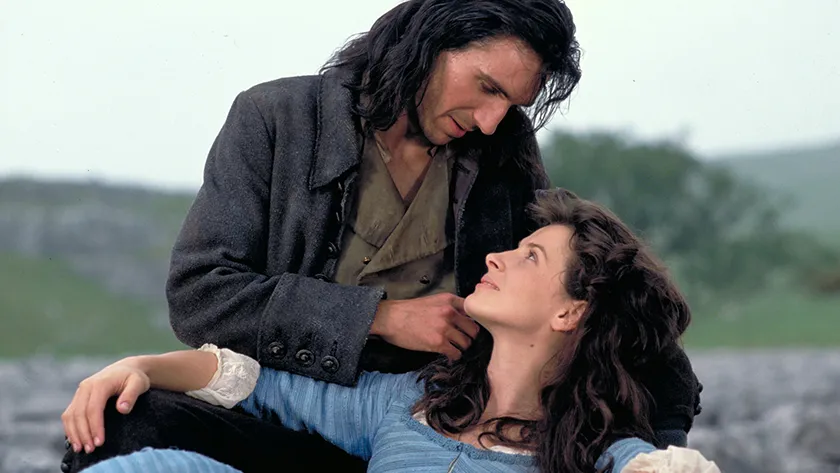
Peter Kosminsky’s 1992 Wuthering Heights is the most even-keeled of all the adaptations in its retelling of its source material, while still being able to maintain its gothic roots. Kosminsky’s film addresses both generations of Brontë’s novel with equal care and effort, emphasising the cyclical nature of multigenerational trauma.
As far as the depictions of Cathy and Heathcliff’s relationship go, Juliette Binoche and Ralph Fiennes, without a shadow of a doubt, create the most loving bond between our tumultuous duo. They are able to carry the childlike curiosity and excitement Cathy and Heathcliff feel when they are first getting to know one another into their adulthood, which makes the betrayal Heathcliff feels from Cathy all the more potent.
As Wuthering Heights turns cold and Nelly says the home used to be full of laughter, this is one of the few adaptations where the loss of that light and the darkness that took its place feels as potent to the audience as it does to the characters in the story.
The true genius of the film, however, lies within the decision to have Binoche play both Catherine Earnshaw and her daughter Cathy Linton. While other adaptations feel the loss of Cathy in the first half of the story as Heathcliff does, Kosminsky’s decision to have Binoche play both parts compounds the ways in which Heathcliff feels haunted by his former lover and maddened by this young girl’s presence. It also adds to the concept that Cathy, both the mother and the daughter, is the only thing that can bring light into Wuthering Heights, and without her, the home feels as barren and hard to navigate as the moors in utter darkness.
2. Wuthering Heights (1939)
Director: William Wyler
Cast: Merle Oberon, Laurence Olivier, Flora Robson
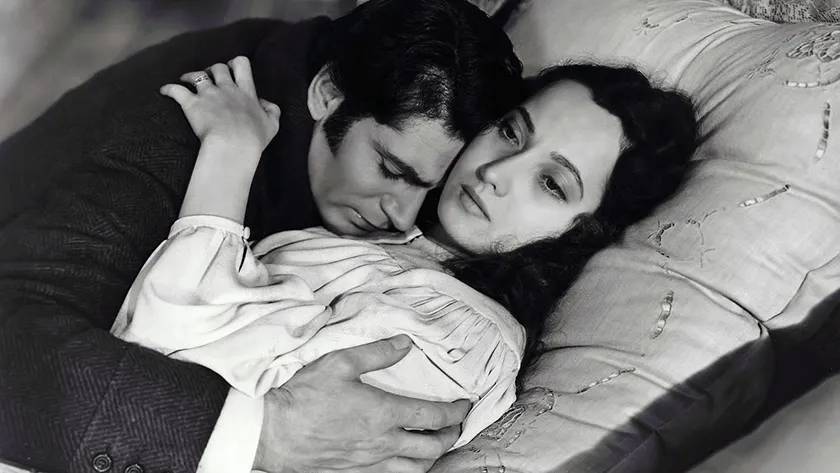
In any, and really every, adaptation of “Wuthering Heights,” there is an understanding that what you are watching is a tale of epic proportions. The story fits so seamlessly with the aura evoked in old Hollywood epics and it feels like all the major adaptations of the novel want to recreate the timeless allure of this era of grand storytelling. However, only one adaptation is able to do so and that is William Wyler’s 1939 Wuthering Heights.
Wyler’s Wuthering Heights enraptures its audience in the intoxicatingly cruel and innately enticing world of Cathy and Heathcliff’s explosive romance. Merle Oberon and Laurence Olivier depict Cathy and Heathcliff’s cruelty and selfishness with a devotion to one another that makes audience members able to look at the darkest parts of their characters with understanding and empathy.
1939’s Wuthering Heights simply captures Cathy and Heathcliff in a totally unique light. It highlights their devotion, darkness and inner struggles in a way that breathes a particular life into Brontë’s characters. More so than any other adaptation, when we leave Wyler’s moors, we do so with a genuine belief that Cathy and Heathcliff’s souls will wander them for all eternity.
While it only focuses on the first generation of the story, it does so with an intensity that makes the audience understand Cathy and Heathcliff’s love is the lifeblood of “Wuthering Heights”. In Wyler’s version, when Cathy dies, it feels like the film itself is following Heathcliff’s thought that the story isn’t worth continuing without her in it. It exudes a passion in its retelling that feels wholly unique and unable to be recaptured.
1. Wuthering Heights (2009)
Director: Coky Giedroyc
Cast: Charlotte Riley, Tom Hardy, Sarah Lancashire
Claiming first place is Coky Giedroyc’s 2011 ITV mini-series, Wuthering Heights, starring the incomparable Charlotte Riley and Tom Hardy. As far as our criteria goes, Giedroyc’s adaptation hits every mark. Any omission of plot or narrative is done in pursuit of exploring the themes of the novel with a distinctly intense rigor, yet it still covers all the major events of the novel. The mise-en-scene is one of the most faithful depictions of the world and characters Brontë created, while also detailing a meaningful creative exploration of her themes of love, obsession, wickedness and cruelty. Finally, it stands as both the most comprehensive and cohesive rendering of “Wuthering Heights” to date.
However, what most exceptionally makes Giedroyc’s Wuthering Heights stand out amongst the rest is the unapologetic darkness of the world she builds. Riley and Hardy’s Cathy and Heathcliff are cruel characters who draw a distinct pleasure from the pain they bring to those around them. They hurt and toy with one another in ways that inflict the maximum amount of suffering, and yet they allow the audience to see the tenderness they helplessly feel towards one another. They bring the obsessive love story Brontë wrote of 178 years ago to modern audiences in a way that feels sexy, intoxicating and desperately relevant.
Hardy feels like the only Heathcliff we get to see driven absolutely mad in his scramble to keep a version of his game with Cathy alive, even if it’s through damning his and her bloodline. Giedroyc’s world is so unabashedly dark, but still entirely accessible to audiences, much like Brontë’s novel itself.
While other versions do a wonderful job of exploring the depths of Brontë’s twisted world and timeless themes, Giedroyc’s stands out amongst the rest as the most artistically fulfilling and faithfully executed adaptation.
Wuthering Heights (2026) is out now globally in theaters.