
Angelina Jolie’s Without Blood clearly condemns the horrors of war, but doesn’t tread new ground and struggles to find emotional depth.
Director: Angelina Jolie
Genre: War Drama
Run Time: 91′
U.S. Release: September 18, 2026
U.K. Release: TBA
Where to Watch: In theaters
In the aftermath of an unspecified war, three men broke into Nina’s (Salma Hayek Pinault, of Eternals) house and killed her father in cold blood. Nina, just a child then, hid under the floorboards as his blood dripped through the cracks. Years later, Nina tracks down Tito (Demián Bichir), the only living person who was there that day. Over dinner, the two exchange stories of lives spent orbiting each other, both irreparably marked by the violence of that day.
It’s a premise more gripping and more emotional on the page. Angelina Jolie’s cinematic translation of Alessandro Baricco’s novel feels heavy-handed and generic, and leaves viewers with a frustratingly apolitical thesis on the morality of war.
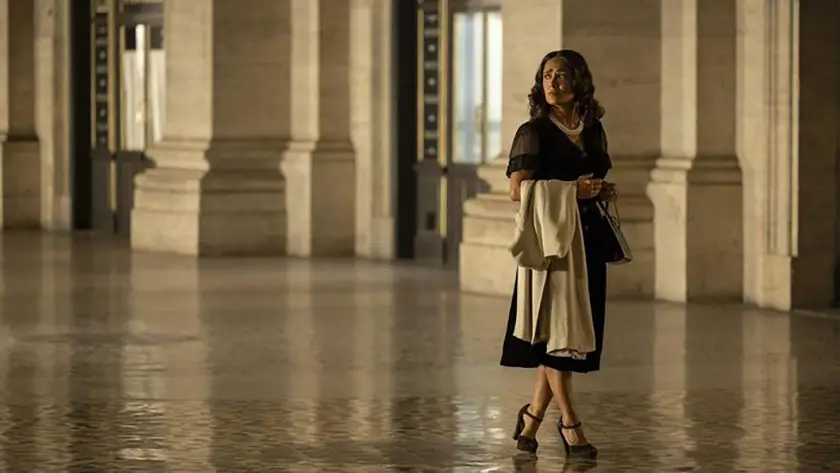
Without Blood clearly engages with the specifically gender-based violence and trauma that results from a society ravaged by conflict. This is where the film shines, and is in keeping with Jolie’s oeuvre. After her father’s murder, Nina is surrounded by callous and cruel men who see her as a literal prize to be won. She is forced into marriage and forced to bore three sons, who are afforded privileges she never was by virtue of their gender. When she outlives her usefulness in the eyes of patriarchal society, she is involuntarily committed to an insane asylum.
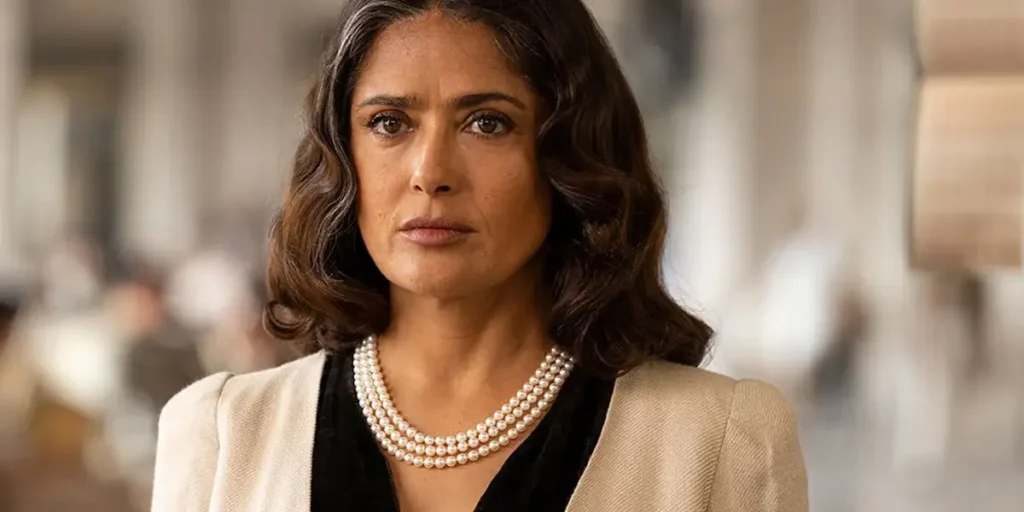
These scenes are horrific, and Karolay Fernandez’s performance as young Nina makes certain scenes as skin-crawling as they should be. Fourteen-year-old Nina’s wedding night to an oily, arrogant count will definitely leave an impact. Hayek Pinault’s performance works in harmony with Fernandez’s, trading young Nina’s skittishness and fear for restraint and control. Her glassy eyes filled with unshed tears, her small, triumphant smirks, and her graceful cigarette handling wind up more powerful than most of the dialogue she is given.
The on-the-nose and overly self-aware conversations between Nina and Tito lack emotion or authenticity, and the near-constant flashbacks break viewer immersion. When Nina tells Tito that “everything changed that day,” the film cuts back immediately to her hidden under the floorboards, in case viewers may not have realized that the two characters are the same person. Multiple flashbacks illustrate Nina’s emotional state by showing her father’s blood dripping through the floorboards, but the repetition feels less like a stylistic depiction of trauma and more like a film that doesn’t trust its audience.
The sheer volume of flashbacks also means we don’t spend much time in the present. As a result, both Nina and Tito feel like stock characters, forced to merely recount to each other the stories we are watching unfold. Nina is now a glamorous, seductive woman of nebulous wealth, a familiar female archetype. And her story itself is one we’ve seen before as well, prompting a question of how we break new ground for female characters while acknowledging the fact that this story is real for many women around the world.
Tito reveals that he has spent years observing Nina from afar, and the amount of time devoted to his consternation at her circumstances comes across paternalistic and unsympathetic. He’s clearly a boy traumatized in his own right, grappling with his own role in Nina’s tragedy, but the film never breaks through the surface of this dynamic. When they are doing something other than summarizing the past two decades, it’s exchanging platitudes about the nature of war. “You won the war. Does this seem like a better world to you?” Nina asks. Tito doesn’t have an answer, and the story moves on.
The present day timeline has the potential to be a compelling entry to the “two people in a room talking” genre. Nina and Tito’s composed back-and-forth over a restaurant table as day turns to night feels like a stage play, doing away with big setpieces or action. These still, commanding moments are Without Blood at its best. But the frequent flashbacks undercut the tension, and the present timeline stumbles as a result. The most interesting part of the story—how the violence has shaped them both into the present day—goes largely unexplored, despite also being the stated intent.
The vagueness seems to be in service of the film’s overall thesis on war: that the details of the conflict don’t matter, it’s the people that interest us. War is often presented as universally destructive, reducing us all, no matter what side we’re on, to base, violent, and selfish creatures. But I’m not compelled by the characters, and I believe that the details do matter.
It does not seem coincidental that in today’s deeply fractured political landscape, the film doesn’t ground its central war in real history, or even touch upon the issues in question. Violence has utterly saturated our media ecosystem, flooding us with images too horrific to truly process, especially when they are scrolled quickly past. But just because it’s overwhelming doesn’t mean we don’t have a responsibility to understand it.
It matters deeply who initiated the violence, and it matters that wars are more than just bloodshed; they also depend on state power and systemic oppression. To condemn war universally almost always winds up helping those in charge who seek to turn our focus away from people resisting injustice.
Film has always had incredible ability to shape cultural discourse, to use fictional characters to offer new perspectives, and to share images that move us in a way only a visual medium can. Without Blood does little reckoning with its own cultural weight, and we lose a rich story in the process.
It’s disappointing to lodge this criticism against Jolie, a famous humanitarian whose work frequently explores the horrors of war, specifically through a feminist lens. I know intellectually that the intention was to examine how war impacts us personally long after an official ceasefire, and to prompt reflections on healing and forgiveness. But it comes across as trying not to “take sides,” or appear overly didactic to audiences. In aiming for comprehensiveness, it becomes trite.
Filmmakers can explore universal themes through specific and intimate stories. And when the story so clearly demands it, they can and should harness the power of their medium to offer meaningful insights. Anything else is bound to come across as frustrating as Without Blood’s anticlimactic conclusion.
Without Blood (2026): Movie Plot & Recap
Synopsis:
A woman tracks down the only living witness to the violent crime that destroyed her life as a child.
Pros:
- Strong performance from Salma Hayek Pinault
- The story is heart-wrenching and compelling, though it never goes as deep as it should
Cons:
- The familiar story treads no new ground
- Flashbacks are overwrought and heavy-handed
- The film’s lack of political ideology stunts its power
Without Blood will be released in US theaters on September 18, 2026.