
Wake Up Dead Man explores the tension between reason and faith to build a constructive path towards truth in a culture captive to lies.
Wake Up Dead Man: A Knives Out Mystery arrives in a cultural moment saturated with lies and deeply uncertain about what truth even is. In this latest Benoit Blanc mystery, Rian Johnson stages more than a clever whodunit; he offers a meditation on truth: how it is discovered, distorted, embodied, and ultimately healed. Set within a locked-room murder inside a church, the film brings faith and reason into direct conversation, refusing the false choice between cold rationalism and naïve belief. What Wake Up Dead Man ultimately says is that in a culture captive to lies, truth cannot survive on facts or faith alone, but must be held together by grace, humility, and embodied love.
“What Is Truth?” – Rian Johnson’s Career-Long Obsession
“What is truth?” – Pontius Pilate, John 18:38
In many ways, Rian Johnson’s directorial career is a sustained attempt at answering that ancient inquiry of the old Roman governor, Pontius Pilate. From Brick’s neo-noir search for the truth of a murdered ex-girlfriend amidst a smog of lies, Looper’s subtextual examination of the truth of who someone really is and what makes them that way (past, present, and future), all the way to The Last Jedi’s infamous burning Jedi library–a subversion of dogma in pursuit of deeper truth–truth is the heart that pumps lifeblood through every vein of his films.
It is only natural, then, that such a preoccupation would drive Johnson to the classical genre of murder mystery in his latest Knives Out trilogy. Few genres are better suited to holding together high-minded existential inquiry and accessible, popcorn entertainment. Set against the cultural backdrop in which these Benoit Blanc whodunits emerge–an era of fake news, algorithmic reality-shaping, and AI-generated deception–the Knives Out films become more than clever genre exercises. They are Johnson’s most direct confrontation yet with a culture that no longer agrees on what truth even is.
How the Previous Knives Out Movies Expose Truth and Lies
This exploration is explicit, both within the story and at a metatextual level, in the first Knives Out installment, which centers on the apparent suicide of wealthy mystery novelist Harlan Thrombey (Christopher Plummer) and the subsequent investigation led by the eccentric detective Benoit Blanc (Daniel Craig). As Harlan’s scheming family and his devoted nurse Marta Cabrera (Ana de Armas) offer competing testimonies about the night of his death, Johnson not only illustrates the subjectivity of human experience with truth by presenting multiple, conflicting accounts of the same events; he also implicates the audience in the search for truth by offering the film’s “big reveal” less than halfway through. Viewers are then forced to reconsider not only what happened, but how they have been watching and what it really means.
In Glass Onion, which follows detective Blanc as he is invited to a lavish private island retreat hosted by tech billionaire Miles Bron (Edward Norton) after the apparent murder of Bron’s former partner, Johnson’s focus turns toward those who shape truth itself. His directorial magnifying glass hovers over our algorithmic and cultural power brokers, embodied most clearly by Bron, a thinly veiled Elon Musk stand-in. Blanc arrives at the island at the request of Helen Brand (Janelle Monáe), who is investigating the death of her twin sister Andi (also Janelle Monáe). Though initially ruled a suicide, Helen is convinced Bron was somehow responsible for Andi’s death and is determined to expose it.
Together, Helen and Blanc devise a plan that manipulates truth on its own terms: because the other guests are unaware of Andi’s death, Helen impersonates her in order to draw out what really happened. Along the way, Bron’s version of events is steadily dismantled through conflicting flashbacks, revealing a truth that is obvious from the outset, yet one both the characters and the audience–conditioned to mistake wealth, spectacle, and performative brilliance for intelligence–remain tempted to overlook.
In Wake Up Dead Man: A Knives Out Mystery, Johnson brings this thematic interest to a crescendo, crafting a mystery that foregrounds faith and reason–too often framed by our culture as rivals rather than partners–and imaginatively reunites them as a salve for a society starved for honest, life-giving truth.
A Zealous Pastor, A Corrupt Priest, and the Perfect Crime
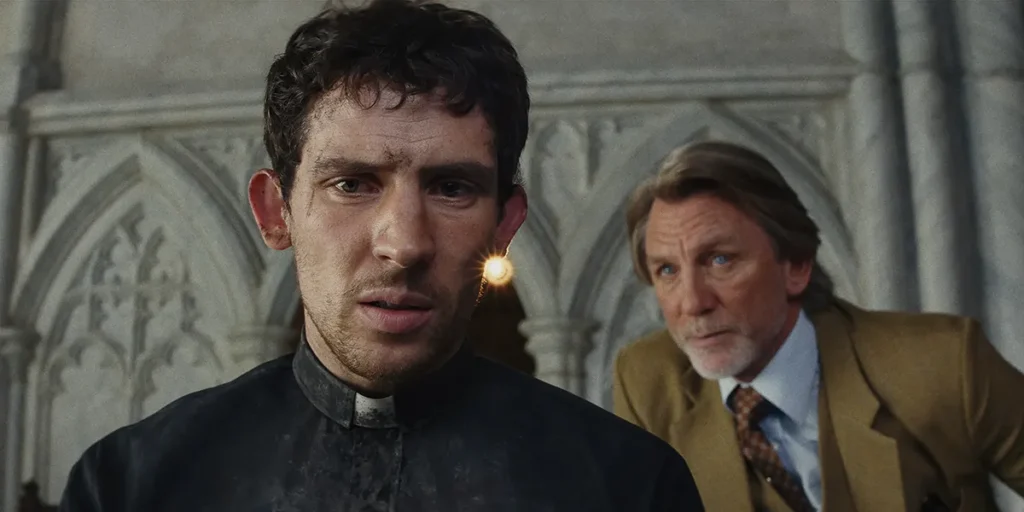
As in previous installments, Wake Up Dead Man introduces a protagonist alongside Blanc who serves as the audience’s emotional anchor. This time, the film opens with a striking thirty-five-minute introduction to Fr. Jud Duplenticy (Josh O’Connor, in a terrific lead performance). A former boxer drawn to the truth and story of Christ and ministry after killing a man in the ring, Jud aptly describes himself as “young, dumb, and full of Christ.” After a regrettable lapse in patience with an admittedly despicable deacon (“Nobody’s that upset that you clocked him–kind of the opposite,” quips Jeffrey Wright’s Bishop Lanstrom), Jud is reassigned to a struggling upstate New York parish where his faithful exuberance might, the church hopes, do some good.
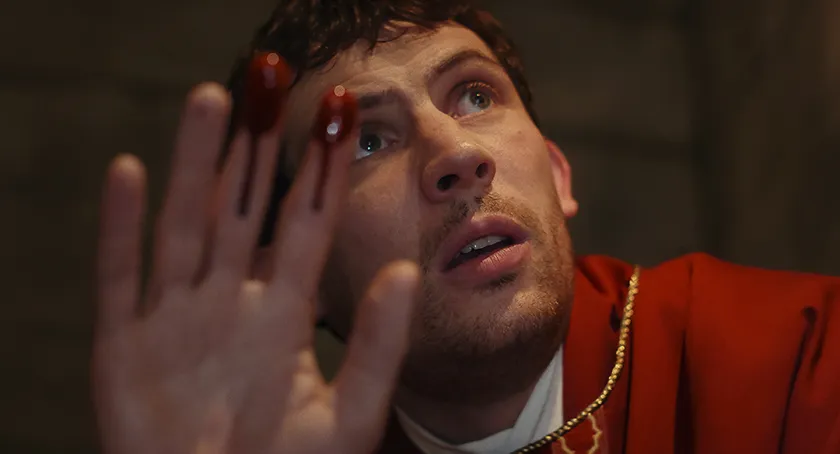
He quickly finds, however, that the presiding priest, Mons. Jefferson Wicks (Josh Brolin) has a devilish sort of pastoral power over the place, using methods like coercion, shame, and self-righteous contempt to control and manipulate things to his advantage. Jud practices patience for this in the early going, but eventually his commitment to Christ cannot stand such out and out anti-Christ dynamics, and so he swears–in a monologue captured by a congregant and posted to social media–to weed Wicks out of power like the cancer that he is. Only a few hours later, Wicks is dead in a classic “locked-room” scenario, and naturally Jud becomes the chief suspect. Enter Benoit Blanc, and away we go.
Locked Rooms, Locked Tombs, and the Search for Truth
There is no more fitting setting for a “locked-room” mystery than the church, given that the Christian faith itself is grounded in the most famous “locked-tomb” mystery of all: Christ’s burial and resurrection. Yet Johnson approaches the church without the contempt or chronological snobbery so common in modern portrayals. Instead, he places side by side Jud–a deeply faithful priest (and, as a minister myself, one of the most accurate and compelling depictions of genuine, Christlike ministry I’ve seen in any in contemporary film)–and Blanc, whose hard-nosed, reason-driven sleuthing reflects an equally serious commitment to truth in cold, hard fact. Faith and reason, belief and rationality, story and fact, placed side by side.
Initially, they are presented in tension: in one of the year’s best scenes, Blanc’s entry into the church, immediately following Jud’s prayer to Jesus to help him, prompts a conversation between the two on their varying approaches to truth. Blanc is a self-proclaimed “proud heretic” who “kneels at the altar of the rational,” and has at the ready a monologue justifiably deriding the hypocrisy of the institution of the church while longing for the truth.
In many ways, his refusal to believe is the most faithful thing about him: right in line with the voices of the prophets, and with Jesus himself, Blanc sees through the facade of performative, power-hungry religion and longs to pick it apart to find a “truth he can swallow without choking.” Jud’s affirmation of Blanc’s diatribe–”You’re right; it’s storytelling,” he says numerous times–leads into his own philosophy of truth, stated as the sunlight pours through the stained glass behind him:
“I guess the question is: do these stories convince us of a lie? Or do they resonate with something deep inside us that is profoundly true, that we can’t express any other way except storytelling?”
From this point forward, the film sets out on a trajectory that progressively harmonizes these two visions of the truth. Jud follows Blanc’s lead in his investigation of facts, timelines, suspects, surveillance footage, and interviews; he even joins him in a humorous examination of the corpse of Mons. Wicks. Jud–and, by proxy, the audience–goes on the expected journey of affirming the centrality of the reason-driven, rational pursuit of empirical truth.
When Truth Is More Than Facts
Yet Blanc also finds himself, skeptic though he is, drawn slowly towards Jud’s sincere, loving, gracious, and sacrificial truth, rooted in a story and a faith that is undeniably compelling when embodied. This communicates a central Christian claim about the notion of truth itself: namely, that it’s not just about factual accuracy, but embodied truthfulness. Christ is described by the bible as the Logos, an ancient Greek term used to capture the divine truth that pervades and undergirds all things (where we get our English word logic). That is, truth within Christianity is the story of a loving God moving towards humanity in grace and forgiveness, giving his life away so that those dying in darkness might live in light.
In this sense, truth is not just abstract fact or argument: it is embodied and lived by God in Jesus through sacrificial love. Like an arrow that we might say flies true (gets where it is designed to go, produces what it promises, is straight and right and accurate, etc.), the life of Jesus is true in the sense that it communicates what is ultimately true about God, humanity, and the world. This is why Jesus refers to himself thusly:
“I am the way and the truth and the life.” – John 14:6
It is Jud’s commitment to this embodied, story-centric vision of truth that compels Blanc, and it is no better expressed than in one powerful scene near the middle of the movie. In the midst of their hectic investigation, a clue leads to a phone call to a local construction company, where Louise (Bridget Everett) picks up and provides a humorous back and forth about information relevant to the case.
Then, in the middle of a hurriedness where both men see Louise not as a dignified, distinct human but simply as a means towards their desired end of truth, Louise begins to cry to Fr. Jud over the phone. She asks for prayer, revealing a dying mother and a strained relationship, and the tone shifts effectively. Jud’s response–”I’m so sorry”–is loaded both with consolation and confession, for he realizes at once that, in embracing Blanc’s cold, objective approach to truth he has neglected his own approach, which is one of unhurried sacrificial love that sees people not as means to ends but ends in themselves, beloved image-bearers of God to be empathized with and cared for.
The Truth in Grace
Jud puts the investigation on a long pause to do his duty and pray with Louise, which annoys Blanc; after all, this priest’s practice of truth is getting in the way of Blanc’s pursuit of it! Yet this moment plants a seed in Blanc that continues to grow until the climactic reveal, where–at the very moment Blanc has the chance to do his grand, anticipated reveal–he practices a radical and seemingly counterintuitive act of grace, refusing to name the culprit and instead implicitly inviting them to confess it themselves, of their own accord and conviction.
He has been moved towards truth that lies deeper than pure empiricism: the truth of his own pride which just wants the answers in order to feel secure in himself; the truth of the real human lives caught up in his rational machinations; the truth of the gift of grace as the real longing of all human hearts, the engine behind reality itself, and perhaps the only way towards an honest evaluation of humanity’s own corruption. In his own words, Blanc reveals this revelation for himself:
“I had to look at the myth that was being constructed, not to solve whether it was real or not, but to feel in my soul the essence of that which it strove to convey.”

And Blanc’s embrace of grace here at the end is precisely what leads to the confession of the perpetrator and their absolution from Jud, the ultimate bringing together of their visions of truth. We find in the confession an expression of the rational, empirical vision of truth, and we find in the absolution an expression of the deep, spiritual vision of grace as truth. It is Blanc’s rationalism that leads to the truth of justice, and Jud’s love that leads to the truth of mercy, not as contradictory, but as mutually necessary and equally beautiful.
So that ancient question which emerged from the cynical lips of Pilate–which is also echoed verbatim in the film with a humorous line delivery from suspect Dr. Nat Sharp (Jeremy Renner)–is answered. Truth is in the blood, and it’s in the soul. Truth is in the body, and it’s in the belief. Truth is data, and truth is divine. To live well, to be truly human, requires both, and in a culture dead to real, honest truth and caught in a polarized battle between these visions, Rian Johnson rings the bell here to us all, shouting forth from the flowering closing title card: Wake Up Dead Man.
Wake Up Dead Man: A Knives Out Mystery is now available to stream globally on Netflix.