
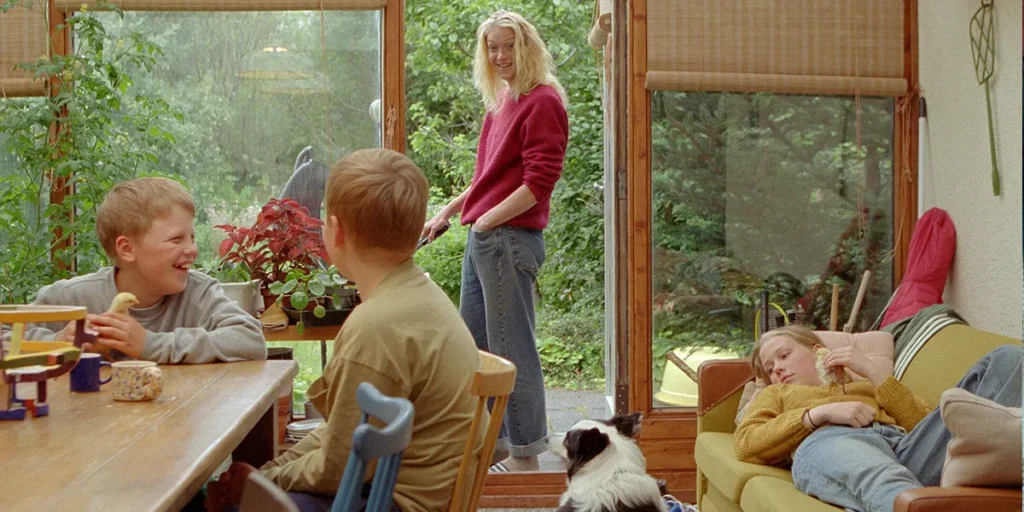
Hylnur Pálmason’s The Love That Remains is a unique entry in the divorce drama canon, balancing tender sincerity with a dark, surreal sense of humour.
Director: Hlynur Pálmason
Original Title: Ástin Sem Eftir Er
Genre: Comedy, Family Drama
Run Time: 109′
U.S. Release: January 30, 2026 in NY theaters; February 6, 2026 in LA and additional markets
U.K. & Ireland Release: March 13, 2026 in cinemas
When young twins Þorgils and Grímur discover that the sweets they are munching on contain gelatine made of pork skin, one of them addresses the brief ethical dilemma matter-of-factly. It’s gross, he admits, but he’ll keep eating it, ‘because it tastes so good’. Hylnur Pálmason’s lighter follow-up to the brooding period drama Godland is full of such little revelations, as the children of separated parents Magnús (Sverrir Guðnason) and Anna (Saga Garðarsdóttir) learn how to deal with the hurdles of growing up in addition to their new familial reality.
The truth is, it’s water off a duck’s back; in The Love That Remains, it is the adults that carry the emotional weight, particularly pining Magnús.
While the breadwinner spends weeks at a time at sea working as a trawlerman, Anna stays at home with their three children, all played by Pálmason’s own offspring. As well as a mother, Anna is a visual artist – the film opens with the roof of her old studio being ripped off by a crane, a blunt metaphor for a divorce narrative if ever there was one. She uses the great outdoors as her workspace; her process involves laying down vast sheets of metal on white fabric and leaving them to rust over time, creating striking reddish-brown patterns and textures.
It’s one example of many drawn-out, often painfully slow processes that the film is preoccupied with. The takes are too short to qualify as slow cinema, but Pálmason repeatedly insists that we take a breather from the plot – if we can even call it that – to immerse ourselves in the minutiae of the family’s day-to-day existence, from Anna’s art to Magnús’s work and the children’s various larks. The divorce, the filmmaker posits, is just another of these processes, not a single catastrophic event but a prolonged, gradual transition.
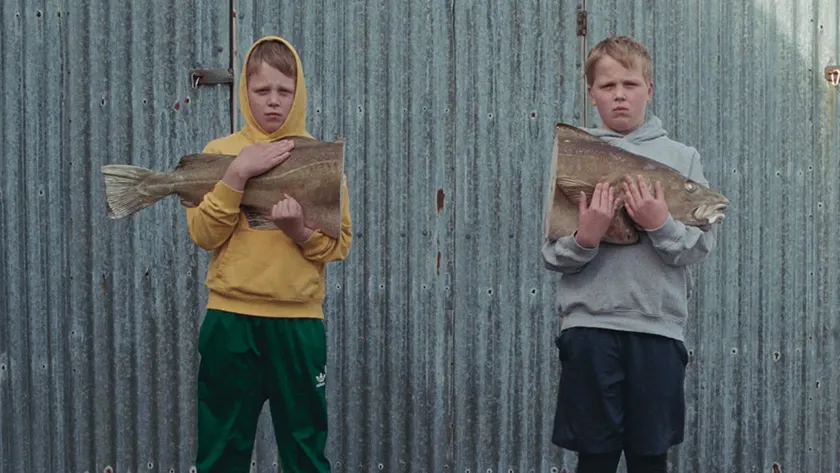
Mundane these sequences may be, but with the backdrop of the Icelandic countryside and the roaring North Sea, the images are rarely anything but arresting. Serving as his own DP, Pálmason shoots on 35mm in Academy ratio, both of which endow the film with the nostalgic intimacy of a family photo album. Harry Hunt’s score is warm and gentle, with a solitary piano playing several short interludes. For want of a more highbrow comparison, it recalls the incidental tunes of the similarly low-key Animal Crossing video games.
However, lurking beneath all this cosiness is a wicked sense of humour that reveals itself primarily through a series of surrealist vignettes. A plane crashes, apparently at Anna’s will; a scarecrow dressed up as a knight and used for archery practice by the kids seemingly comes to life; a rooster Magnús is forced to kill returns, in giant form, for revenge. The tone is akin to that of another superb Icelandic comedy drama, Hafsteinn Gunnar Sigurðsson’s Under the Tree.
The two young boys are particularly adept at delivering the film’s dark comedy, making deadpan observations about their parents’ sex lives and listening to gruesome true-crime podcasts with an apparent immunity to the troubles of the outside world. It is Garðarsdóttir who conveys her character’s pain the most overtly, while teenager Ída is caught between the kids and the grownups – the separation has coincided with another turning point in her life: impending adulthood.
Guðnason’s turn as Magnús is a masterclass in fragile masculinity. His attempts to retain his status as patriarch are pitiful, as are his half-hearted efforts to rekindle the flame with Anna. The cracks in the father’s stoicism are betrayed by microexpressions and limp gestures, at least in the family setting. At work, that hypermasculine milieu in the middle of the violent sea, his frustrations arise in sharp but impotent bursts, culminating in a comically embarrassing scuffle with a fellow trawlerman after an exchange of petty insults.
While Magnús is often pathetic, he is also endearing. The same can’t be said of the opinionated Swedish gallerist played by Anders Mossling, who meets with Anna to see her work but spends most of the visit complaining about political correctness. Mossling is excellent as the narcissistic sleazebag, a droll contrast to the flawed but redeemable Magnús. It seems the sheepdog Panda, winner of the Palm Dog at Cannes last year, is the only adult male to come out of the film with his dignity entirely intact.
Almost two hours at this tempo may test the patience of some, as will the film’s less effective comic digressions. Otherwise, The Love That Remains is a lesson in measured filmmaking – idiosyncratic but not insufferably kooky, sincere but not saccharine. We’ve certainly never seen a divorce drama quite like it before.
The Love That Remains: Movie Plot & Recap
Synopsis:
Magnús and Anna attempt to navigate their new reality as separated parents, while their children continue to live their daily lives and make the usual discoveries as they head towards adolescence and adulthood. As their love fades, both parents’ fears and anxieties for the future are made manifest by a series of increasingly bizarre occurrences.
Pros:
- A dry, surreal sense of humour that offsets the emotional heaviness
- Shot perfectly on 35mm
- Excellent performances, particularly Guðnason’s fragile would-be patriarch
Cons:
- With such a slow pace, the comic digressions can begin to drag
The Love That Remains was released in theatres in New York on January 30, 2026 and in LA and additional markets on February 6. The film will be out in U.K. and Irish cinemas on March 13, 2026.