
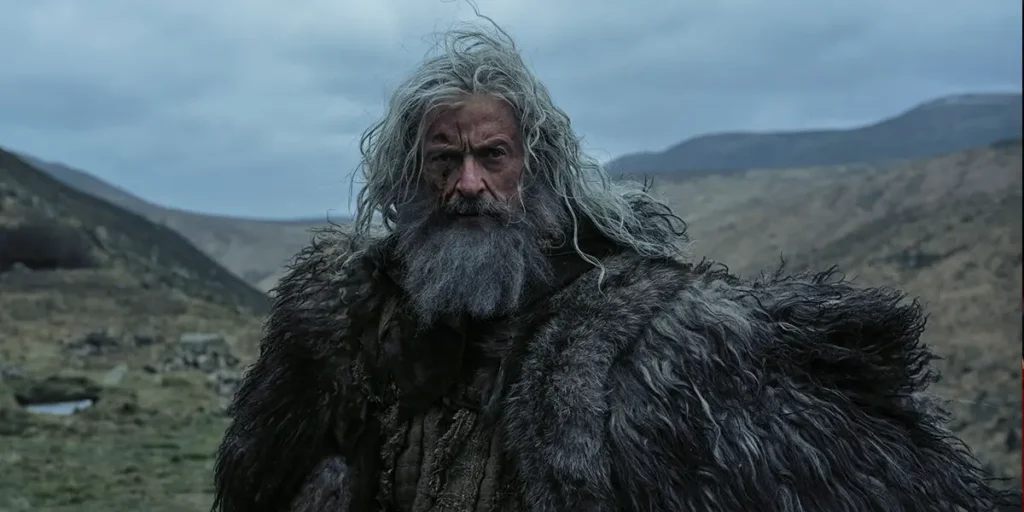
Despite an assured visual style and a fantastic lead performance, Michael Sarnoski’s The Death of Robin Hood comes up very short.
Director: Michael Sarnoski
Genre: Action, Drama
Run Time: 123′
Rated: R
U.S. Release: June 19, 2026 in theaters
U.K. Release: September 3, 2026 in cinemas
Dear God, another Robin Hood movie? Wait – hear me out! Instead of modernizing once again the heroic outlaw with the same tropes that have defined his adaptations ever since Errol Flynn donned the bow and arrow in The Adventures of Robin Hood, what about making him a merciless killer who has lived a life full of regrets and must now grapple with his past mistakes?
This is what Michael Sarnoski’s The Death of Robin Hood offers the audience: it imagines the titular character away from his heroic feats of derring-do. It presents a much darker vision of Robin Hood, in the vein of Robert Eggers’ The Northman and David Lowery’s The Green Knight.
For the film’s first half-hour, Sarnoski’s vision is fully realized. Painterly frames from cinematographer Pat Scola fill our peripheral vision as Robin Hood (Hugh Jackman) and his sidekick Little John (Bill Skarsgård) are on a perpetual quest for violence, and the bloodletting in their wake is significant. However, Robin is eventually wounded in battle – almost mortally so – and is sent to a priory to be tended by Sister Brigid (Jodie Comer). As he heals, Robin begins to wrestle with the life that has defined him and wonders whether his time on this planet was truly worth it.
The movie’s first half is presented in a 2.39:1 aspect ratio, where the reimagination of Robin Hood’s archetypal story is at its most effective. The action is violent and unrelenting. There’s a real sense of unease in watching a character who, throughout popular culture, whether in a “serious” film, a Disney animated adventure, or a Mel Brooks parody, has always been defined as a hero, especially when we see him mercilessly killing a child. Sarnoski immediately positions his film as a fresher, newer take on a character who has defined our imaginations and makes us rethink who Robin Hood is in the pantheon of great legends passed down from generation to generation.
It presents a Robin Hood that’s so far removed from his idealized depictions that we immediately become invested in such a daring proposal, especially during a bevy of amazingly-shot and staged action sequences that aren’t easy to watch but feel like we’re finally seeing something new out of a centuries-spanning myth. And Hugh Jackman is amazing as Robin Hood. No, really. This is the best performance he’s given since James Mangold’s Logan, which is only fitting, considering that he’s playing, once again, a worn-out version of a famous hero. Even when the film slows down, Jackman’s portrayal of a regretful Robin Hood is always compelling, even though Sarnoski asks the audience to invest themselves in a version of the character whose adventures aren’t exciting in any way, but punishing and barbaric.
The supporting cast is also excellent, though many of them (including Skarsgård) have limited screentime, which renders our connection with the people away from Robin Hood moot, even when we sit down with the protagonist in the priory. He spends more time with figures such as Sister Brigid, The Leper (Murray Bartlett), and a young boy named Arthur (Noah Jupe). The latter two still make the most of their limited turns, with Bartlett in particular giving a tangible spiritual dimension to Robin’s inner wrestling as he knows death awaits him. What awaits him after death may not be something he’s willing to reckon with.
However, once the frame opens to 1.66:1, likely representing Robin’s internal claustrophobia and focusing on what he thinks, the movie’s promised action epic turns into an introspective character study recalling Ingmar Bergman’s The Seventh Seal, and starts to lose our interest. It doesn’t happen all at once, but it begins once Jodie Comer appears on screen and delivers the most miscalculated performance of her career. It’s hard to discuss the nature of the character without spoiling anything, but let’s just say Sarnoski has no idea what he wants to discuss about Robin’s newfound purpose and his relationship with Sister Brigid, which slightly complicates itself after she finds out who Robin is.
It attempts to be a meditative piece of slow cinema with tableaux reminiscent of (most recently) Lav Diaz’s Magellan, but Sarnoski doesn’t know where to place his camera, and the thoughtful 2.39:1 frames turn into purposeless images stolen from infinitely better, more thematically resonant pictures. The images look good, yes. Undoubtedly so, but they also hold no significance when we examine them in the grand design of Sarnoski’s character study. How do you fumble a study of an outlaw who was once heroic but is now framed as a monster who regrets every single action he’s made once at death’s door and begins to ask for salvation? This is incredible, and ripe for a film that’s at the crossroads of a swords-and-sandals epic and a theological question on death once we know it’s coming for us next.
And yet, Sarnoski begins to lose our grip and stretches the movie’s pace until it becomes painfully tedious. Once we eventually get to the titular death of Robin Hood, all we want is for the film to get on with it already instead of having Jackman perform an interminable soliloquy that, despite the actor’s good intentions, falls pitifully flat. It also seems misguided for such a promising title that assembled a great cast and terrific artisans and set out to bring a new and unique vision to a character audiences have seen reinterpreted time and again in both film and television.
It’s a shame, because the movie shows immediate promise when it begins, but can never live up to a half-hour of pure violent poetry after attempting to become something it shouldn’t have been. Sometimes, the images say more than overwritten dialogues, which Sarnoski sadly indulges in during the back half of The Death of Robin Hood. If his upcoming Death Stranding adaptation has more mechanical exposition than letting us, the audience, sit with the striking, desolate world that Hideo Kojima introduced in his video game, we’re in a lot of trouble.
The Death of Robin Hood: Movie Plot & Recap
Synopsis:
After being severely wounded in battle, Robin Hood is tended to at a priory by Sister Brigid and begins to question whether his life of senseless violence and death amounted to anything tangible for the outlaw who, in the film’s vision, is no hero.
Pros:
- Hugh Jackman delivers his very best performance since James Mangold’s Logan.
- Bill Skarsgård and Murray Bartlett are equally terrific, even if their screentime is limited.
- This is cinematographer Pat Scola’s best-ever work, creating painterly frames that function as a jaw-dropping storytelling device in both 2.39:1 and 1.66:1.
- The first half-hour of the movie is genuinely exhilarating, as it presents a Robin Hood so far removed from its archetypal on-screen iterations and promises a thrilling reinterpretation.
Cons:
- While the film’s first half is amazing, the rest of it is a painful slog that has no idea what it wants to say about the protagonist’s inner torment.
- Jodie Comer plays a miscast Sister Brigid.
- The cinematography is undoubtedly beautiful, but the 1.66:1 frames begin to lose their meaning when Sarnoski is unable to find a voice of his own, preferring to rip off Robert Eggers’ The Northman, David Lowery’s The Green Knight, and Lav Diaz’s Magellan.
- Once we eventually get to the titular death of Robin Hood, the movie overstays its welcome and has zero emotional impact.
The Death of Robin Hood will be released in theaters in the US and Canada on June 19, 2026 and in UK and Irish cinemas on September 3, 2026.