
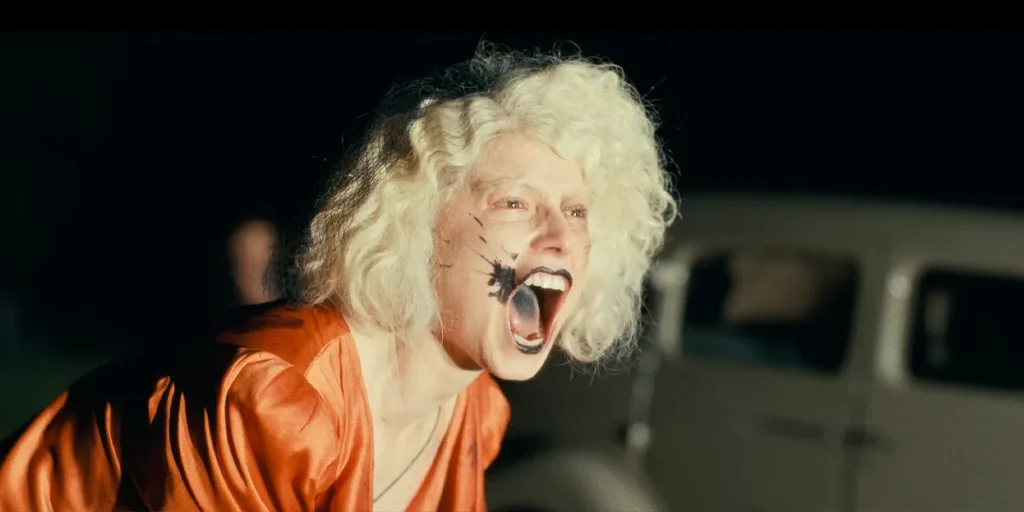
The Bride! might play better as individual moments than as a whole package, yet its bold stylistic choices are beyond admirable.
Writer-Director: Maggie Gyllenhaal
Genre: Horror, Romance, Comedy, Period Drama
Rated: R
Run Time: 126′
Release Date: March 6, 2026
Where to Watch: In theaters
The Bride! owes as much to Mary Shelley–author of “Frankenstein; or, The Modern Prometheus,” which follows a madman creating life from the dead–as it does to movies such as Bride of Frankenstein (1935), sequel to Frankenstein (1931), which uses the creation of the titular bride as a means to explore a woman’s role in a man’s world, and whose legacy in horror is monumental.
Its imagery, since the 1930s, has become a staple of what gothic romance should look and feel like on screen, thanks to Charles D. Hall’s art direction and Jack Pierce’s makeup work, along with Irma Kusely’s hairstyling, which helped create an icon in Elsa Lanchester’s portrayal of the Bride. Despite the praise film historians sing, a common critique of the horror classic is the lack of Bride in a project titled Bride of Frankenstein. With a punk-rock, neo-noir aesthetic, writer-director Maggie Gyllenhaal seeks to expand the character’s mythos while taking bold swings in her first studio blockbuster.
If you’ve seen The Lost Daughter, her feature debut, you’ll understand why Gyllenhaal would be attracted to the idea of helming The Bride! as her sophomore effort. The Lost Daughter tells the tale of a woman (Olivia Colman) on a seaside vacation that takes a dark turn when she becomes obsessed with a young mother, forcing her to confront her own failures as a parent. Gyllenhaal indulges in the darkness that inhabits Colman’s character motivations, painting a picture of creating life, guilt, sexual frustration, and resentment towards oneself and children that slowly gets under your skin. With the Bride’s story including many of these same themes–a crazy scientist gives life to a woman to fulfill his other creation’s sexual needs and immediately regrets it–Gyllenhaal’s sensibilities are sort of perfect for a reimagining of the Bride.
Dr. Frankenstein’s lonely Creature, now going by Frank (Christian Bale, The Boy and the Heron), travels to 1930s Chicago in search of Dr. Euphronius (Annette Benning, Nyad), hoping she’ll create a companion for him. They reinvigorate a murdered young woman named Ida, and thus the Bride (Jessie Buckley, Hamnet) is born. She is beyond what either intended, igniting a combustible romance, the police’s attention, and a wild, radical social movement.
Mere seconds into The Bride!, I could not help but think to myself, “oh, is this the direction we’re taking?”. In my book, if a movie can get such a response that early on, it must be doing something right. Whether intentionally or not, Maggie Gyllenhaal borrows an idea from the Bride of Frankenstein: having Buckley play both Mary Shelley, which Lanchester also embodied in the classic Universal film, and the Bride. The difference here, other than Buckley having more than five minutes of screen time, is that the author’s presence is more prominent, like a ghost that haunts the narrative both literally and figuratively, telling the Bride how to act.
It’s a dangerous thing to undertake as a filmmaker, because not only are you reimagining another artist’s life’s work; you’re also potentially putting words in somebody else’s mouth who is no longer alive to agree or disagree with your beliefs. Shelley is depicted as an angry, irritated woman who has had enough of the patriarchy–the very system that she once criticized, and that is still oppressing women nearly a century after her death. It’s a huge swing that Gyllenhaal is willing to take–one that can be off-putting to some, and exciting to others.
As a result, Buckley doesn’t just have the difficult task of living up to Lanchester’s Bride; she’s essentially playing three different parts in one for the entire runtime: Mary Shelley, Ida, and the Bride. In the midst of winning her first Academy Award for Hamnet, Buckley turns in another stellar performance. It’s such a transformative role, where you’re sometimes unsure which version of Buckley we’re watching. She’s constantly on the brink of overacting, playing a caricature rather than a character, and I can see moviegoers finding this distracting. For me, the fragility, sensuality, and violent side Buckley brings to the film inject it with the energy it needed to match its dazzling visuals.
The Bride! was shot for IMAX, and its scale mirrors the odyssey in which the Bride and Frank embark as they leave behind dead bodies everywhere they go. Lawrence Sher’s photography goes from the 2.39 aspect ratio on anamorphic lenses to the 1.90 IMAX expansion, or 1.43 presentation if your local IMAX theater is capable of 70mm film or dual-laser projection. Anytime Mary Shelley appears on screen, we expand to the 1.43 aspect ratio to capture the author’s looming presence. When the Bride or Frank experiences being alive, let it be through dance or sex, the frame expands as well. The format isn’t exclusively reserved for set pieces or world-building moments. Beyond the obvious immersion this large format offers, Gyllenhaal and Sher use IMAX to get you into the character’s psyche.
This is probably a good time to talk about Frank’s character, as he’s one half of our main duo. What’s great about having Bale and Buckley share the screen is that both are some of the most dedicated actors in the industry. They fully commit to their roles. From the jump, Bale sells the awkward loner characteristic depicted numerous times already with the Creature. He’s very much a teenager, looking up to his favorite actor, Ronnie Reed (Jake Gyllenhaal, Road House), for guidance on how to be a gentleman and court a lady, sort of how a young cinephile would. His sincerity contrasts Buckley’s unpredictable Bride, as they bring the best and worst instincts in one another. It leads to some solid comedy between the two.
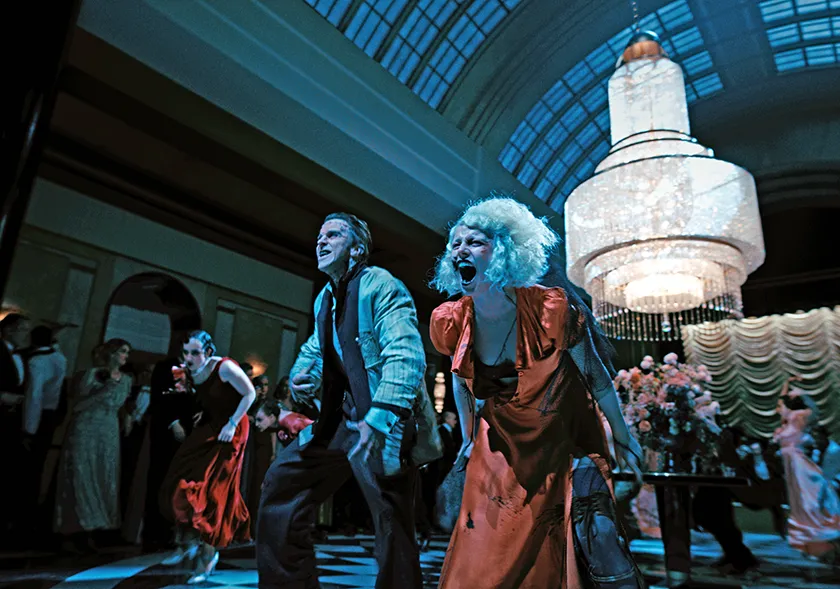
A fair share of the love affair is told through the art department, anchored by Karen Murphy’s production design, Nithya Shrinivasan’s art direction, Sandy Powell’s costumes, and the makeup division. Movie theaters are like large palaces for Frank to hide in, illuminating the sadness of his dreams projected on screen. Dr. Euphronius’ lab, though not as elaborate as Dr. Frankenstein’s in the 1931 Universal film, is like a shrine to Mary Shelley’s memory; a broken memory stitched together to give birth to something new. The streets of Chicago and New York are captured with as much uncertainty as opportunity, juxtaposing the Bonnie-and-Clyde-inspired tragedy of the Bride and Frank.
Upon revealing the first look for The Bride!, the makeup for its titular character may have seemed too simplistic with the black stain on the side of her cheek. Granted, the work done on Bride of Frankenstein wasn’t too complex either, with the thunderbolt-tall hair, but the ethereal beauty Lanchester brought was more than enough to sell her enchanting essence. In comparison, Buckley’s black stain becomes a symbol of defiance. She’s defying beauty standards, proper manners, and the status quo. The Bride!’s costumes support these themes, too, through revealing dresses and sleek lingerie. While the cinematography, art departments, and cast are in sync to bring Maggie Gyllenhaal’s vision to life, it’s actually her writing that ultimately does the film a disservice.
Gyllenhaal’s writing reminded me of Todd Phillips’ Joker movies: two scripts full of social commentary on class imbalance, lack of mental health awareness, and radical movements that clash rather than complement each other. By trying to say a lot, they end up saying very little. And yet, visually, those Joker movies look and sound incredible, probably because they’re borrowing from better exploitation crime dramas of the 70s. Similarly, the punk-rock, neo-noir aesthetic elevates the ideas Gyllenhaal wants The Bride! to tackle. But when it comes down to actually engaging with her own creative decisions that, on paper, should reinforce the Bride’s journey, Gyllenhaal kind of leaves it up to you to piece her half-baked ideas together.
Ida is used as cannon fodder by cops in mob investigations; Frank initially only wants a companion for his own sexual pleasure; there are female detectives not taken seriously in dire cases; the psychiatric state of abused women is perceived as dangerous rather than approached with empathy; taking revenge on those who wronged you might make you into the monster people already believe you to be. These are all compelling themes for a modern take on Mary Shelley’s grand epic. Unfortunately, The Bride! is more interested in laying these ideas on the table instead of exploring them.
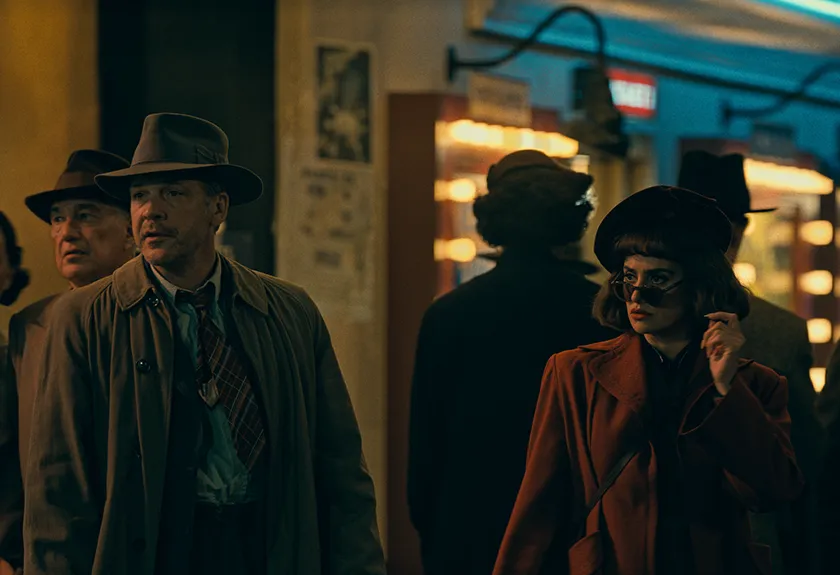
When the film does want to address them, they’re abruptly interrupted by dull storylines, such as Peter Sarsgaard (Presumed Innocent) and Penélope Cruz’s (Ferrari) pair of detectives going after Bale and Buckley, or John Magaro’s (The Mastermind) mafioso, seeking to please his boss by murdering the Bride and shutting down her nationwide spread movement against the institution that protects violent men. Arcs that should be instrumental to the Bride’s are sort of an afterthought. You could cut one of these plot points or both, and you wouldn’t miss much.
The Bride! works less as a narrative film and more as an extended music video. I don’t believe that was what Maggie Gyllenhaal set out to do when she signed on to write and direct the movie. The Lost Daughter demonstrated her ability to handle unlikable protagonists and uncomfortable topics. I believe her mission with The Bride! was a similar one: giving life to a provocative picture plagued with bloody murders, erotica, and rebellious feminist figures. Gyllenhaal does include those elements as she tries to weave her love of musicals, neo-noirs, and romance. What we end up with is a real Frankenstein’s monster of a final product.
I’d be lying if I said I wasn’t engaged for the majority of Gyllenhaal’s blockbuster debut. The Bride! is a mess, but a daring one. It’s the kind of big-budget filmmaking that could terrify a marketing team for days, worry executives for months, and fascinate critics like me for years. As I sit writing this review, part of me wonders if the explanation behind the movie’s choppiness could involve massive studio interference. There are a good chunk of moments when the film seems to hold back, even though it wants to go the extra mile with its nasty body horror.
Truth is, none of it matters. Personally, I’d rather see filmmakers take bold swings and miss than play it safe. That’s precisely what The Bride! does correctly, as Jessie Buckley loses her mind, goes on killing sprees, dances the night out to punk-rock in 1930s America, and falls in love with a monstrous-looking man to match her monstrous self. It might not fully work as a movie, but it’s admirable that it even exists at a time when Warner Bros. Discovery is being sold from one group of men to another who only want to make safe bets. For that reason alone, I dug the risks Maggie Gyllenhaal’s The Bride! takes. Who knows, maybe one day it’ll become a cult classic.
The Bride! (2026): Movie Plot & Recap
Synopsis:
Frank goes to Dr. Euphronius’ home in 1930s Chicago with a proposition: bringing a woman back from the dead so she could be his companion. They dig out the recently deceased Ida, and the Bride is born. She quickly proves to be far more unpredictable than Frank, spreading chaos wherever she goes.
Pros:
- Maggie Gyllenhaal swings for the fences by making Mary Shelley integral to the narrative.
- Christian Bale and Jessie Buckley are fully committed to their monstrous roles.
- Offers one of the coolest uses of the IMAX format.
- A visual and auditory feast.
Cons:
- Though Gyllenhaal’s creative risks are exciting, they’re not the best written.
- Themes feel wasted because the movie seems more concerned with its style.
- Peter Skarsgaard, Penélope Cruz, and John Magaro’s storylines kill any momentum the movie builds.
The Bride! will be released in U.S. theaters, in U.K. and Irish cinemas, and globally in theatres on March 6, 2026.