
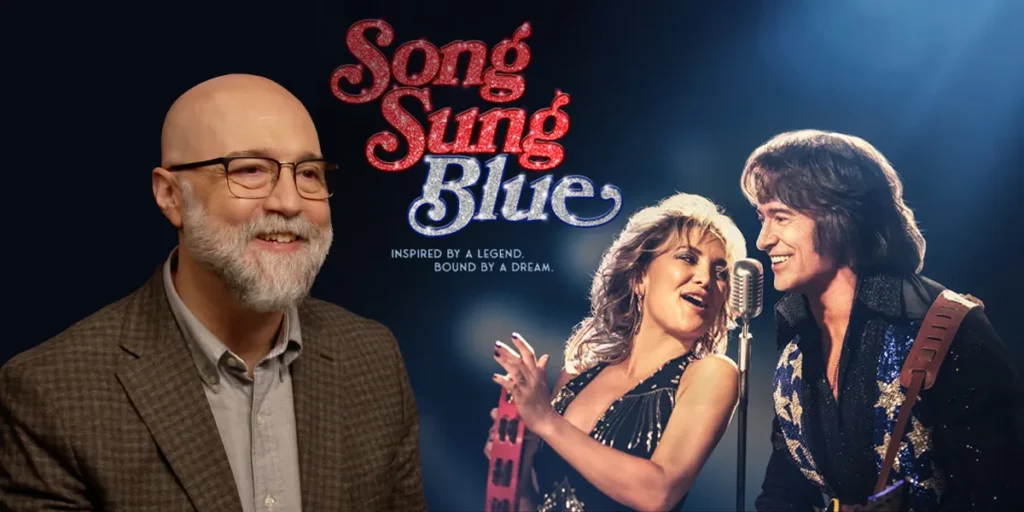
Watch and read our interview with director Craig Brewer, who tells us about Song Sung Blue, Lightning & Thunder and Neil Diamond ahead of the film’s theatrical release.
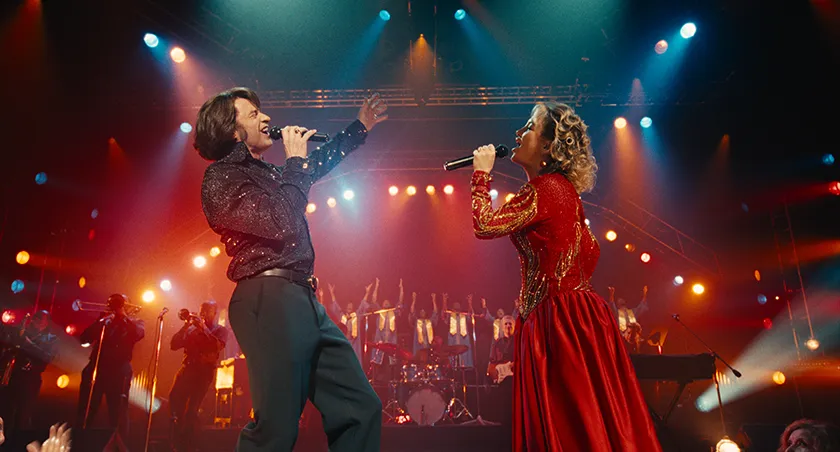
Mike Sardina (Hugh Jackman), a middle-aged Vietnam vet and recovering alcoholic, makes ends meet with a job as a mechanic, but he has bigger dreams. He moonlights as “Lighting”, a cover artist on the local circuit in Milwaukee, but with little success. When he meets Patsy Cline impersonator Claire Stengl (Kate Hudson) at a gig on his 20th anniversary of sobriety, he’s hit by Cupid’s arrow and inspiration. The pair starts working on a project that will lead them to become “Lightning & Thunder“, a husband-and-wife Neil Diamond tribute act.
Based on a true story and on the 2008 biopic of the same name from Greg Kohs, Song Sung Blue chronicles Mike and Claire’s journey, from their passionate road to success to the hardships and heartbreak they experienced along the way. Ahead of the theatrical release of the movie, we sat down with director-writer-producer Craig Bewer, who talks to us about biopics, tribute bands and the brilliance of Neil Diamond.
Watch the video of the interview and read the full transcript below!
Craig Brewer on Lightning & Thunder and the Origins of Song Sung Blue
Congratulations on Song Sung Blue! First, an obvious question: what’s your favourite Neil Diamond song?
Craig Brewer: It’s tough, because it changes every day, but I actually really love the song “Play me”. It’s the first song that we use in the movie, to show them coming together and learning how to play music together. It also does some heavy lifting: two people had to fall in love with each other, basically, in two and a half minutes. [smiles] So if you’re going to do it, I think that’s the song to fall in love to.
When it came around to actually making the film, were you initially drawn to the story of Lightning & Thunder thinking, ‘I also get to play a bunch of Neil diamonds songs’? Was it just the icing on the cake? What made you want to do this film?
C.B.: Well, I saw Greg Kohs’ documentary with the surface fun of, ‘Hey, I want to see a pleasant, delightful movie about a Neil Diamond tribute band’. I like Neil Diamond’s music, and I thought it would be fun. And then, this story started to unfold that I couldn’t believe: I was so moved by it. I was rooting for them in this really great underdog way of just like, ‘Come on, they can do it! They can get through this’. And then, I was hooked. I felt that I had to make this movie about this incredible couple, and family.
So I went into it with the notion of enjoying the music, but then I really became moved by the story, which is what I hope people take out of the film. You know, they go into it thinking, ‘Oh, this is going to be delightful and fun!’, and then it takes a little bit of a turn that puts people on edge where they now care about these characters, and they want to make sure they can get through it.
Given the darkness of the material, was the family all on board with this? Was there anything that they felt that you couldn’t include, or anything that they did want you to include?
C.B.: The great thing about making movies about musicians or artists is that they understand that it’s those darker elements, or those moments where there’s pain, that are truly the ingredients of great music and great art. And not only was nothing off limits, but [the family] supplied me with a lot of other details and stories that really informed me on the script I was writing, but also just on the day: how to how to tackle certain scenes, and deal with the emotions.
I’m incredibly indebted to the the family for being so open, especially because – and I try to remind people this – many people that come see the film are like, ‘Is this a Neil Diamond biopic?’ And I go, ‘Well, you’re half right. It’s a biopic. It’s just not about Neil Diamond.’ I think famous people kind of understand: ‘Of course you’d make a movie about my life.’ But these are two people in the middle of Milwaukee that I don’t think more than about 100 people knew about at the time.
Craig Brewer on Fandom, Music, and Tribute Bands
Even though Song Sung Blue is not a movie about Neil Diamond, I can’t imagine there’s going to be many people who’ll be disappointed by the experience; it’s too enjoyable.
Craig Brewer: No, it’s actually a movie about that kind of fandom, and not “silly” fandom. Mike genuinely loved the music of Neil Diamond, and I do too. In the movie, we try to treat it as something that actually provided him with some grace [when he was] suffering with alcoholism, and with the with the memories that he was dealing with from serving in Vietnam. Living in Memphis, Tennessee, I’ll meet fans of Elvis Presley coming in for what we call ‘Death Week’ – the week that Elvis died – and for the Candlelight Vigils. You see people crying, and they’re like, ‘You just don’t understand what this man’s music means to me’. I respect that; it’s just as strong as any religion.
I think that some people need Neil Diamond, Elvis Presley, Michael Jackson. They need these people whose music got them through things. And I think the same thing could be said about Comic Con, where people who see cartoons or movies want to dress up as their superheroes, and be around people who also feel that as well. That’s why I always have this special place in my heart for tribute bands. It’s not so much about the band; it’s about all the people coming to see the tribute band, because they’re like, ‘Oh, you like that song too? Oh, my God, this is my favorite!’ That’s really, hopefully, what the movie is being in service to.
Looking at your career to date, you do keep going back to these stories of musicians and performers trying to break out and make their voices heard, whether it’s Hustle & Flow, or even Dolemite Is My Name. Besides being a fan, is there anything in your own experience that draws you to this? What’s the connection you have with those kind of stories?
C.B.: Well, I didn’t go to college, but I I really dove into learning about rock and roll in Memphis. There was something about learning about Sam Phillips, who discovered Elvis, BB King and Howlin’ Wolf – and then also Stax Records, which is where Otis Redding, Sam & Dave, and all these artists [signed to]. There’s something about these recording studios in Memphis that really inspired me, and I really found there was a certain element of storytelling that was happening.
The artists themselves lived a certain way, and they needed to express themselves in what I would call a maverick way, an unapologetic way. Jerry Lee Lewis can only play that piano a certain, energetic way: he’s going to do it his way. You could put a Bach cantata in front of him, and he’s not going to be able to play it exactly like Bach; he’s going to put his own essence into it. I found that there was some strength in that.
I’ve been a fan of music; I love singing along, and I don’t play any instruments, but I do love producing music. I do love saying, like Sam Phillips would say, ‘Hey, can you put just a little bit more sex into that guitar solo?’, or ‘You’re trying to do a holler, and I think it should be more of a prayer’, or try to come into dealing with an actor, or a story, with a little bit more of a flair [in finding a way to] describe [something] that isn’t specific. That’s really what I guess I’m attracted to.
Hugh Jackman, Kate Hudson, and Almost Famous
Your leads, Kate Hudson and Hugh Jackman, are known to many people for previous performances involving singing and music. Were they your first choices, or was there a long list of potential Sardinas for you?
Craig Brewer: Hugh was definitely top of the list, if there was a list – There wasn’t a list! [smiles] It was Hugh all along. I remember giving him the documentary by Greg Kohs: he just loved it. He loved the story; he got it, and he was immediately committed to it. I mean, that’s the reason I got to write the script: Hugh Jackman committed to being part of the project, and Universal – at the time, as Focus came in later – said, ‘Okay, let’s make this into a script and see where we go’.
And then, Hugh came to the rescue one more time. He was watching this interview with Kate Hudson on tv. And I’ll be honest with you, I’ve been trying to make a movie with Kate Hudson for more than 15 years, but when it came to the lists that were coming in, Kate wasn’t really on any of those current lists. We saw her in this interview talking about how she was getting tired of waiting around for Hollywood to offer her something, so she was gonna go hit the road, do music, play gigs and write songs, and make an album. And I was like, ‘Oh my God, she’s experiencing right now what we need her to be’.
So Hugh and I just got her on a Zoom, had a conversation with her, and we just decided right then and there that this was our cast. We didn’t look at anybody else; I don’t even think we asked for permission. We just started moving forward with her, and she’s brilliant in the movie.
She certainly is. And it’s lovely to see that progression: people might remember Kate from “Tiny Dancer” and Almost Famous, and now she’s almost come full circle, back to music, in what I think is her best performance.
I would agree. I think she’s wonderful. And I think she also taps into something, with women and men watching the movie, that you’re kind of looking back on. Like, ‘Oh, there’s that girl I fell in love with in Almost Famous more than twenty years ago’. But now I’m older too. I’m a parent; I’ve lived some life, and so has Kate. It’s this beautiful place where we can kind of live through her a little bit, but at the same time, that smile comes out of her and you’re just like, ‘Ah, there she is. There’s that girl again’.
This interview was edited for length and clarity.
Song Sung Blue opened in U.S. theaters on December 25, 2025 and will be released in U.K. and Irish cinemas on New Year’s Day 2026.