
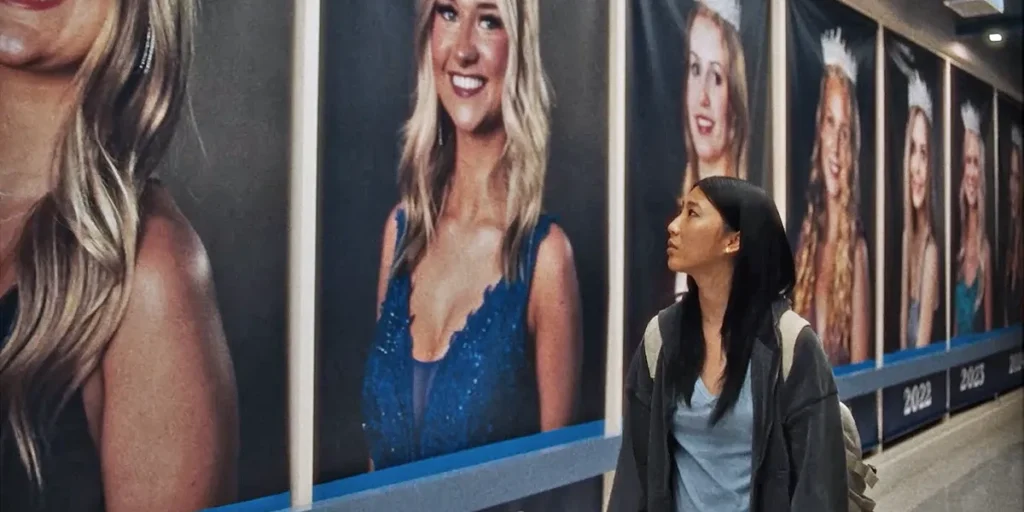
Amy Wang’s Slanted is a thought-provoking and heartbreaking look at the relationship between American beauty standards and whiteness.
Writer-Director: Amy Wang
Genre: Horror, Comedy, Drama, Body Horror
Run Time: 102′
Rated: R
U.S. Release: March 13, 2026
U.K. Release: TBA
Where to Watch: In theaters
Who hasn’t changed something about themselves with the hope of fitting in? Whether it be as major as a cosmetic surgery or as minor as a new hair-do, you would be hard-pressed to find someone who hasn’t altered themselves in order to come off as more conventionally attractive. The beauty and skincare industry thrives on preying on these insecurities, selling people promises of perfection for a price that we more often than not agree to pay.
But at what point do those alterations, nips and tucks and mythologized potions address the insecurities that prompt their need in a truly meaningful way? Amy Wang’s Slanted not only holds up a harsh mirror to the ugly reality of what it’s like trying to live up to idealized beauty standards, but goes one step further to unearth the racism that underlines concepts of beauty in America.
Slanted opens up on Joan Huang (Kristen Cui, of Knock at the Cabin), a young Chinese girl who has just moved to America with her parents. When Joan attends her first day of school, she is immediately met by racist classmates who mock her looks and bully her because of the traditional Chinese lunch her mom has packed her. As she takes in the American culture she is now engulfed in, she begins to see her otherness as compared to her classmates and understands how their racially homogeneous cliques isolate her from integrating into her new community.
We soon jump to meet Joan (Shirley Chen, of Dìdi) in high school, where her obsession with fitting in has only deepened with time. While her parents are proudly Chinese, Joan goes out of her way to minimize that aspect of her identity in hopes she will be seen as the other girls at her school are. Her walls are covered with images of famous white women, she is constantly clothespinning her nose to try to make it appear smaller and she watches makeup tutorials to try to diminish any aspects of her ethnic identity.
When word spreads that the most popular girl in school, Olivia Hammond (Amelie Zilber, of Emily in Paris), will not be running for prom queen, Joan sees this as the ultimate way to achieve acceptance within her community. Soon after she makes the decision to run for prom queen, a mysterious social media account reaches out to Joan, offering her the opportunity of a lifetime, a surgery called ethnic modification that would make her appear white.
After coercing her unknowing parents into signing the release for her to go through with the ethnic modification surgery, Joan says goodbye to her life as she knows it and wakes up post-op as an entirely new woman. With her new appearance, Joan finds an Americanized name and identity to re-enter society as Jo Hunt (McKenna Grace, of Regretting You) and is met with radical acceptance from her community.
While the plot reads as conceptually provocative, Slanted paints a truly eloquent picture of being a young woman in America who has never seen a person that looks like her celebrated within the standard of beauty. Wang’s directorial debut is a thought-provoking, graphic and intricate look at what it means to be a young Chinese woman in America when the socially constructed beauty norms are tied to proximity to whiteness and ethnocentrism.
Wang’s decision to cast and write the film with two lead actresses carrying the arc of the same character throughout the film feels ambitious, but Shirley Chen and McKenna Grace perfectly play into one another’s performances to create a Joan/Jo that feels entirely cohesive. Chen expertly crafts the character of Joan, creating a palpable sense of desperation to fit into a community at any cost necessary, even if it means losing her own identity in the process. Grace steps in to play Jo with a similar air of desperation to keep up the ruse and cross this finish line that is being elected prom queen in order to prove erasing herself really was worth it after all.
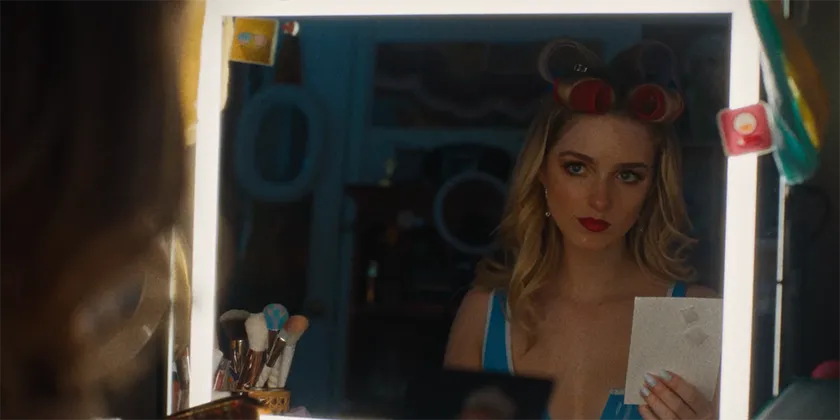
The most potent analysis of these themes comes from Joan’s conversations with her mother (Vivian Wu, of The Last Emperor) and father (Fang Du, of The Blacklist), who have the most visceral reactions to her transformation. In her pursuit of fitting in, her mother plainly points out that she has consequently destroyed who she is. Her father even tells her after her transformation that every time he looked at her before, he saw his mother’s eyes and in that way, she lived on through Joan. Now, when he looks at her, he sees a complete stranger.
Her parents understand Joan is struggling to accept her uniqueness and self as a young woman, but also know now she will never have the chance to appreciate her beauty and individuality because she destroyed it in the name of assimilation. Wang’s script not only hits out against the lack of representation and acceptance in America’s standard of beauty, but also poetically paints the portrait of a young woman desperate to fit in and not able to see the long-term ramifications of pursuing that goal so feverently.
While dystopian and satirical, Slanted really reads as a story that aims to analyze assimilation, preserving culture and accepting your own identity. It has the perfect mixture of absurdist body horror and genuine reflection on the paradigm of attractiveness within America that seems to be centered around whiteness. Wang’s film has and hits beats of dark humor, gory body horror and honest cultural reflections in equal measure, making Slanted out to be a truly singular ride.
Slanted (2026): Movie Plot & Recap
Synopsis:
An insecure Chinese-American teenager goes through with an extreme cosmetic surgery to appear white with the hope of becoming her high school’s prom queen.
Pros:
- Amy Wang masterfully uses body horror to detail her thoughts on the lengths we go to fit an idealized beauty mold.
- Shirley Chen intricately crafts the character of Joan Huang and McKenna Grace beautifully evolves her story as Jo Hunt.
- Wang expertly comments on American beauty standards while also thoughtfully explaining the importance of representation.
Cons:
- There was a missed opportunity to expand upon the absurdist ideas driving American ethnocentrism in the beauty space by not further unraveling Joan’s betrayal of her best friend, Brindha (Maitreyi Ramakrishnan), who also deals with prejudice and discrimination within her school.
Slanted will be released in US theatres on March 13, 2026.