
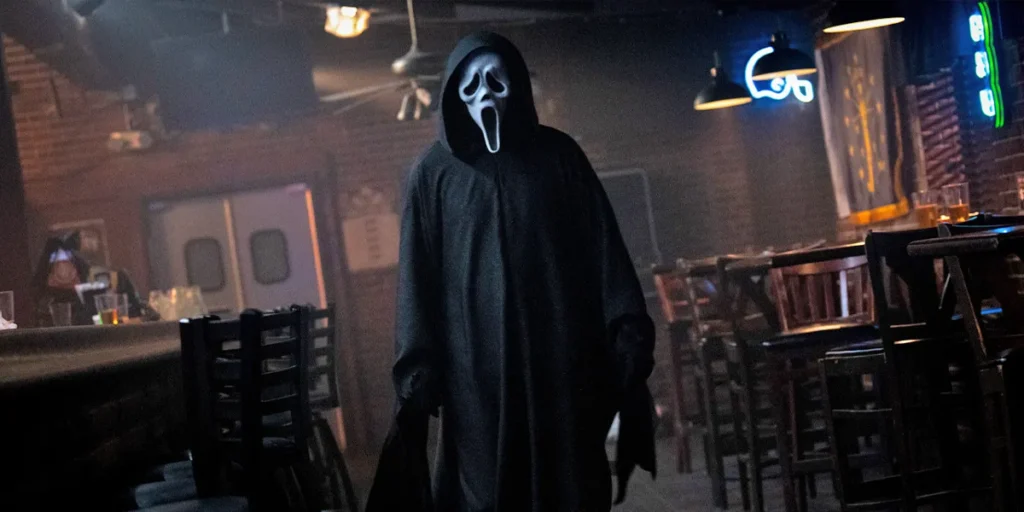
Neve Campbell reclaims Sidney Prescott in Scream 7, a triumphant sequel with brutal kills, brilliant craft and Campbell at an all-time best.
Director: Kevin Williamson
Genre: Slasher horror, Mystery, Whodunnit
Run Time: 114′
Rated: R
Release Date: February 27, 2026
Where to Watch: In theaters
Seven films deep, and Scream is still the smartest horror franchise running. That is not nothing. Most series this long have traded self-awareness for self-parody and called it a sequel. Scream 7, directed by series architect Kevin Williamson in his franchise directing debut, is proof that knowing the rules still matters, especially when you’re the one who wrote them. No spoilers ahead in this review; please keep it that way for everyone else.
Getting here involved a production reshuffling that would make even Ghostface sweat. Key cast members departed. Directors came and went. Expensive rewrites reshuffled priorities. What looked from the outside like a franchise in freefall turned out to be something else: a soft pivot back to fundamentals, one that keeps the events of Scream VI firmly in play while clearing space for the story the series has been building toward since 1996. The Carpenter sisters are conspicuously absent, and the film makes no attempt to explain it. It’s a choice that will register differently depending on how you feel about where this franchise has been. Whatever James Vanderbilt was building with that cast may still have a future elsewhere. Right now, Scream 7 is here, and it is very, very good.
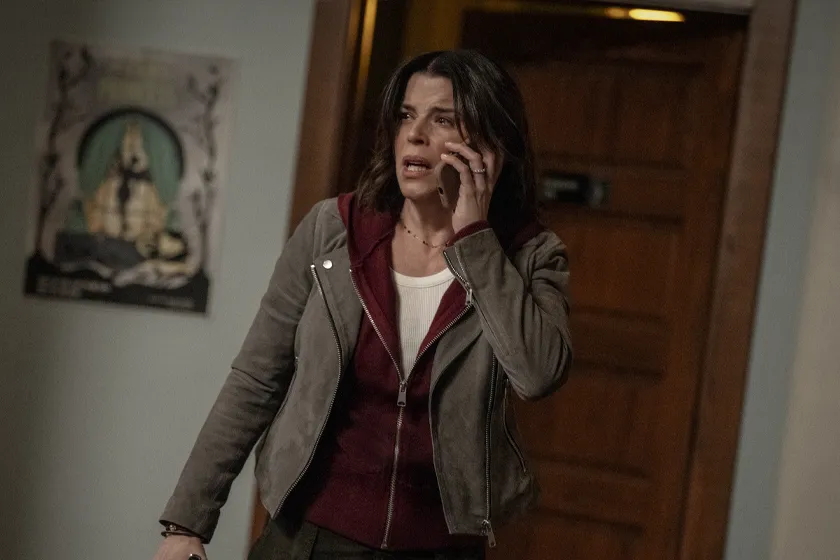
And Neve Campbell is back. That sentence alone deserves its own paragraph. Her absence from Scream VI left a Sidney-shaped hole in that film, and the new installment handles it smartly: multiple characters can’t stop remarking that Sidney was a no-show in New York, a running joke that lands every time. Sidney Prescott-Evans has built a life for herself in Pine Grove, Indiana, running a coffee shop, married to police officer Mark Evans (Joel McHale, Community), raising a teenage daughter named Tatum (Isabel May, 1883) and two little ones who happen to be visiting their grandmother for the weekend. The timing, as it turns out, is fortunate. The closest thing to peace Sidney has ever known lasts about as long as you’d expect.
The film’s timeline asks for a small act of faith: Tatum being 17 in 2026 places her birth two years before Scream 4, a retcon the franchise cheerfully breezes past and clearly hopes you will too. It is not the first time this series has let continuity take a backseat to a good story, and it will not be the last. What matters is Campbell. This franchise has put her through every form of trauma imaginable across seven films, and she has carried all of it with precision and control. What Scream 7 finally gives her is permission to say it out loud, to stop holding the weight in and let someone else see it. She doesn’t step back into the role. She comes through it.
Isabel May is a plucky, sharp match for Campbell’s controlled intensity, capturing the original’s spark without mimicking it. McHale, often deployed for comic effect elsewhere, shows real range as Sidney’s devoted rock of a husband. And then there’s Courteney Cox reprising Gale Weathers, and Williamson finally lets her go somewhere new. Three decades of hard edges have taken their toll on Gale, and Cox doesn’t oversell a single frame of it. She just lets the weight sit there. It is the most interesting version of the character since the original.
Jasmin Savoy Brown and Mason Gooding slot beautifully into this franchise as twins Mindy Meeks-Martin and Chad Meeks-Martin, their chemistry and timing only sharpened across three films. The script’s ambition and streamlined pace lean on them more as narrative connective tissue than as fully realized characters here. That is a function of how much Williamson is juggling, not a reflection of what the performers can do. Mckenna Grace, Asa Germann, Celeste O’Connor, and Sam Rechner fill the screen with the kind of watchable, instinctive energy Wes Craven always found in his young casts. As for anyone else you may have heard about: the film opens with a visit to a location franchise veterans will recognize immediately, the Macher house, where the finales of the 1996 and 2021 Screams were set. That should tell you everything and nothing at all.
The kills in Scream 7 land differently than what we’ve had recently. The 2021 reboot leaned into spectacle to please both fans and gorehounds; Scream VI pushed toward suffering in ways that sometimes felt gratuitous. Williamson finds a different register for his film: deliberate, purposeful, and when it lands hardest, genuinely staggering. There is one sequence near the opening with a deliciously theatrical quality that Williamson can’t quite help himself with, but the film gets truly nasty from there. One attack in particular pulled the air out of the room before the audience erupted in cheers and applause. Ghostface goes back to the knife, almost exclusively. After Scream VI‘s heavier reliance on guns, the correction feels right and necessary. Some things are sacred.
Marco Beltrami returns to score and delivers some of his finest franchise work, weaving new compositions around the original themes, including a haunting reinvention of “Sidney’s Lament” that makes the film sound like a memory getting sharper and more dangerous as it comes into focus. At least one of the original songs used here is a cover with deep franchise roots, and if you catch it, you’ll feel it. Cinematographer Ramsey Nickell earns every scare with thoughtful angles and precise use of shadow, coaxing the audience into comfort before the floor drops out. Production designer John Collins builds locations that feel warm and welcoming from the outside and constructed for terror once Ghostface arrives. The craft is confident throughout.
Fair warning: the motive, when it lands, reads like the hasty rewrite it probably was following the production overhaul. It’s functional, but it doesn’t hit with the gut-punch of the franchise’s best reveals. A few red herrings will feel recycled to the veteran viewer. These are real flaws, and for some audiences they will matter more than they did for me. This will be a divisive one. My hope is that franchise fans and those sitting on the fence because of everything that happened in pre-production will be able to walk in and judge the film itself, not the story of how it got made.
Scream 7 is a legacy sequel that justifies its existence by giving the character who deserves it most the film she has been owed. The Scream franchise has survived the 2000s, new writers, new directors, changing studios, new cast members, and a generation of shifting horror tastes. It keeps finding a way. With an eighth installment reportedly in development, and both Williamson and Campbell already working on ideas, the prospect of more is genuinely exciting for the first time in years.
Neve Campbell earned this film. After thirty years, that’s exactly the kind of horror story worth telling.
Scream 7 (2026): Movie Plot & Recap
Synopsis:
When Ghostface resurfaces with a terrifyingly personal vendetta, Sidney Prescott must fight to protect her teenage daughter while confronting a past that was never as buried as she hoped.
Pros:
- Neve Campbell delivers her finest franchise performance
- Scream returns to its knife-driven roots with deliberate, well-crafted kills
- Beltrami’s score and Nickell’s cinematography rank among the franchise’s best technical work
Cons:
- The motive lacks the punch of the franchise’s strongest reveals
- Savoy Brown and Gooding are underserved by an overstuffed cast
- Carpenter sisters’ absence left unexplained
Scream 7 is now available to watch globally in theaters. Read our reviews of Scream (1996), Scream 2, Scream (2022), and Scream VI (2023).