
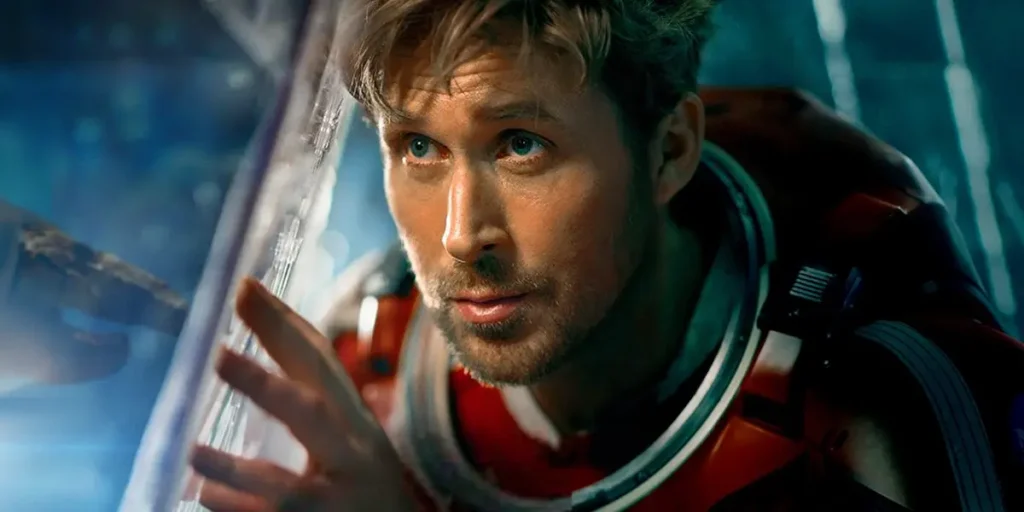
Ryan Gosling and technical execution elevate Phil Lord and Christopher Miller’s Project Hail Mary, which turns its existential source material into a buddy comedy in space.
Directors: Phil Lord & Christopher Miller
Genres: Action, Adventure, Sci-Fi, Space Movie
Run Time: 156′
Rated: PG-13
Release Date: March 20, 2026
Where to Watch: Globally in theaters
I came out of my screening of Project Hail Mary more than a little puzzled, as the combination some elements I adored and others I disliked – and even found borderline unethical – made the movie quite the contradiction. Having spent the past two days reading Andy Weir’s 2021 novel of the same name, on which the film is based, I can now see that most of the elements I didn’t like are the areas in which the movie strays from the book.
Both tonally and thematically, Project Hail Mary is a bit of a mess, and that’s a real shame, as so much could have been done here to bring the novel to life in its existential glory. Despite a fantastic performance from Ryan Gosling and remarkable technical execution, directors Phil Lord and Christopher Miller’s (Clone High, The Lego Movie, and 22 Jump Street) latest, adapted by screenwriter Drew Goddard (The Martian and Bad Times at the El Royale), fails to capture what makes Andy Weir’s book the compelling, philosophically intriguing work that it is, resulting in a half-baked, saccharine buddy comedy that does have its moments but mostly fails to impress.
Which isn’t to say there isn’t anything to like here. The film starts promisingly enough: our protagonist wakes up in space with no memory of who he is and why he’s there, and a computer (Priya Kansara) starts checking his cognitive functions while he tries to figure out what happened to him. “So, are we, like, near Neptune?,” he asks, more confused than ever, recognizing the sun in the distance, only to learn that he’s been traveling for “11 years, 10 months, 14 days and 6 hours”. He stops, taken aback, before it hits him. “It’s not our sun.”
Soon, our astronaut starts to remember things, starting from how he’s not an astronaut at all. He’s a middle school science teacher named Ryland Grace (Ryan Gosling, of The Fall Guy) who led an ordinary life up till the moment his pupils started asking about the “space dots” that are eating the sun. We learn that they’re called Astrophages, and are part of the “Petrova line,” an arc that has connected the sun to Venus and seems to be feeding on solar energy, threatening the Earth’s very existence. “The planet is going to starve?” asks one of the pupils, envisioning apocalyptic scenarios. “The best minds in the world are working on it right now,” Grace responds, convinced they’ll find a way.
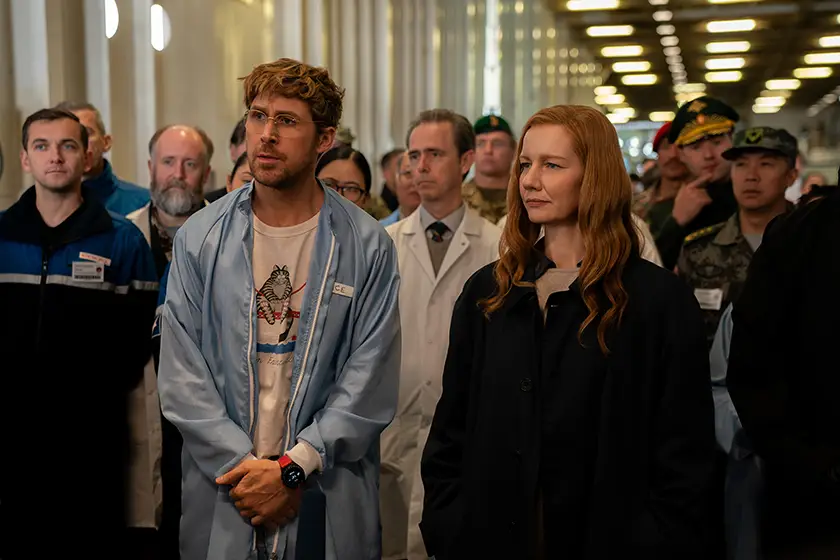
A couple of flashbacks later, Eva Stratt (Sandra Hüller, of Anatomy of a Fall) shows up at Grace’s school to tell him that it’s not that simple. Mostly, though, she’s come to recruit him for a high profile mission that she somehow believes he’d be perfect for. “It survives on the surface of the sun,” is all she has to say to have Grace’s attention, as that immediately tells him that the sun is about to die. In the present timeline, Space-Grace learns he doesn’t have enough fuel to return home. “It’s a suicide mission. She sent me here to die,” he whispers to himself, while Earth-Grace is back on Earth, making the decision to follow Stratt, and signing his death sentence.
Just like the book, Project Hail Mary is told through different timelines, and the jumps between the present, with Grace in space, and past, with Grace back on Earth as he’s being recruited for the trip, make this story so fascinating. It’s thanks to these strategic, non-linear cuts that the movie reveals itself in real time to the audience, as we discover pieces of the story gradually, just like Grace does. And since both past and present unfold simultaneously for us, the film – and the novel before it – fascinatingly tells us that time doesn’t matter when we look at a bigger whole.
Cinematography (Greig Fraser, of Dune: Part One), visual effects (Paul Lambert, of Blade Runner 2049) and editing (Joel Negron, of Thor: Ragnarok) are superb here and really help deliver tone and immersion. So does Daniel Pemberton’s (The Trial of the Chicago 7) irresistible score, which evolves with our protagonist and even feel part of his journey, while a gorgeous soundtrack of pop-rock, folk, country, and Americana classics adds nostalgia and humanity to both timelines, with many needle-drops you’ll recognize.
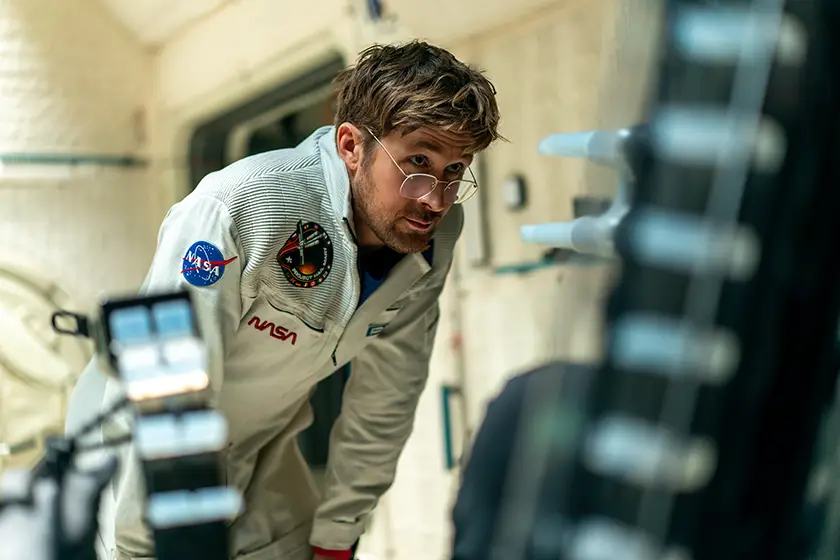
As for Grace’s trip to space, it doesn’t take our hero long to remember about joining the titular project. It all comes down to a mission to a faraway star named Tau Ceti – the only star the Astrophages aren’t eating, for reasons our scientists can’t figure out – that might just put a stop to the apocalypse after all. In present time, Grace is quite close to the star. But what can he do, when the rest of a crew he doesn’t even remember meeting is dead and he’s completely alone, unable to drive a spaceship, too far away to contact Earth, and all-too aware that this mission was always meant to be a one-way trip?
Enter Rocky (James Ortiz), a cute, rock-shaped alien scientist who’s also on his own, trying to save his home planet of Erid. Soon, the two learn to communicate and eventually coexist, and as we watch them interact, Project Hail Mary fully evolves into a buddy comedy, with plenty of gags that involve anything from cultural misunderstandings, invasions of privacy, impromptu dance sessions, thumbs-up fails, and discussions on eating habits to Grace venting about his new roommate in his video diaries to Earth, with said roommate complaining about it being “Dirty, dirty, dirty, dirty, dirty; why room so messy, question?”.
This is where the film’s flaws really start to show, as while Grace and Rocky’s relationship does give the movie an emotional core, with a couple of standout scenes in particular that are bound to make you tear up, the childish, repetitive jokes don’t always land, outstaying their welcome not long after their first meeting. There are some surprises to be found here, and Ryan Gosling‘s performance manages to elevate most of the film’s awkward moments, with impressive physical acting and emotional control that makes us really care about Grace even if his character arc is not as well-developed as that of his book counterpart.
In fact, if you’re simply looking for a lighthearted, feel-good space comedy that looks and sounds great, with two likable protagonists that form an unlikely friendship, you’ll probably have a great time with Project Hail Mary. Still, its tonal and narrative flaws will also make it a hard project to fully embrace for those who enjoy films with some depth. On one hand, the movie seems intent on making you laugh from start to end, with silly gags that pretty much define who Grace is as a person. But on the other hand, it also wants to be a serious space film about a man acquiring a sense of purpose through his interactions with an alien, and it tries to do so by combining some of the novel’s most meaningful material with many soppy, melodramatic moments.
Setting aside the fact that the jokes often fall flat, Project Hail Mary never seems to understand which kind of film it wants to be, resulting in a final product that, at the same time, is too childish and lighthearted to be taken seriously, and takes itself too seriously to work on younger audiences, without the tonal control it needed to convey real depth. And clocking in at 156 minutes, a third of which is spent on Grace and Rocky being goofy, it’s also too long for what it delivers.
***Major spoilers in the next four paragraphs***
But the biggest issue in Project Hail Mary is its treatment of Sandra Hüller’s Eva Stratt, who makes a controversial choice that I absolutely didn’t see coming. Just like in the novel, the revelation comes when we least expect, right at the end: it turns out Grace never agreed to go on this mission, but Stratt needed him to, and decided it didn’t matter. So, she took away his free will by putting him in a coma that would cause him amnesia when he’d wake up on the ship, hence sending him to his death without his consent. In the book, finding this out changes both Grace’s and our own perception of Stratt, and makes Grace’s journey so much more meaningful as a whole, given the way it changes him as a person. It all leads to a choice he makes in the end that allows him to find purpose and redemption on his own terms, and finally start living for something.
It also changes our thoughts on the novel as a whole, as it shifts the subject from a hero’s mission to save the planet to matters of human rights, ultimately asking us if the end justifies the means, what the cost of salvation should be, and whether any authority should have the power to decide our individual fates. The book does answer that question by portraying Stratt as a cold, manipulative figure whose debatable actions include methodically wiping out Antarctica to trigger a methane release that might give Earth a few more years – something she knows will probably put her in jail for the rest of her life for abuse of power.
While we never learn what exactly happens to Stratt at the end of the book, she’s never framed as a positive character either. “Hell’s coming back to you, Stratt. In the form of me. I’m hell,” Grace says in the book the moment he remembers exactly how he came to be on the ship, and this resentment plays a huge factor in the evolution of the character as a whole, and his actions at the end. Sadly, none of this is present in the movie, where Grace does suddenly recall Stratt’s actions and feels slightly surprised for a little while, only to never think about it again.
More than that, when Grace eventually does get to have a dialogue of sorts with Stratt, the issue is never approached, and the Project Hail Mary commander comes across as a ‘mentor’ figure who knew what was best for him even when he didn’t know himself, and who’s even rewarded for making that choice. And in a movie that tries to pass Stratt’s karaoke rendition of Harry Styles’s “Sign of the Times” as one of its most poignant moments, its normalizing and even celebrating her behavior raises ethics concerns, sadly depriving it from what makes this final flashback, and the novel as a whole, so complex and thought-provoking.
***No more spoilers from here***
Andy Weir’s book was never going to be an easy novel to adapt to the screen, but Project Hail Mary feels like a missed opportunity. Ryan Gosling is the saving grace (pun intended) of the movie, and a great lead performance, impressive technical execution, and some strong scenes that really convey the emotion make this a film that some people will still enjoy for what it is: a lighthearted buddy comedy in space that will deliver an enjoyable family night without demanding too much of you. Still, given the potential to really delve into many compelling, provocative themes that are so very relevant to our current times, it’s just a real shame that it isn’t more than that.
Project Hail Mary: Movie Plot & Recap
Synopsis:
Science teacher wakes up alone on a spaceship with no memories of how he got there, and no fuel to go back to Earth. As his memory returns, he remembers he’s there to save the sun from dying, and makes a very important friendship.
Pros:
- Ryan Gosling is superb as a charismatic, likable lead
- Remarkable technical execution, from cinematography, editing and visual effects to score and soundtrack
- A few well-crafted emotional moments conveyed through Grace and Rocky’s relationship
- A lighthearted sci-fi buddy comedy that you’ll enjoy if you take it for what it is
Cons:
- It simplifies the novel’s philosophical and ethical themes
- Tonal inconsistencies: too silly to be taken seriously and too serious to work on younger audiences
- Too long for what it delivers
- Childish, repetitive humor that often overstays its welcome
- The treatment of one of its characters removes the complex moral issue that makes the novel so thought-provoking
Project Hail Mary will be released in US theaters, in UK and Irish cinemas, and globally in theatres on March 20, 2026.