
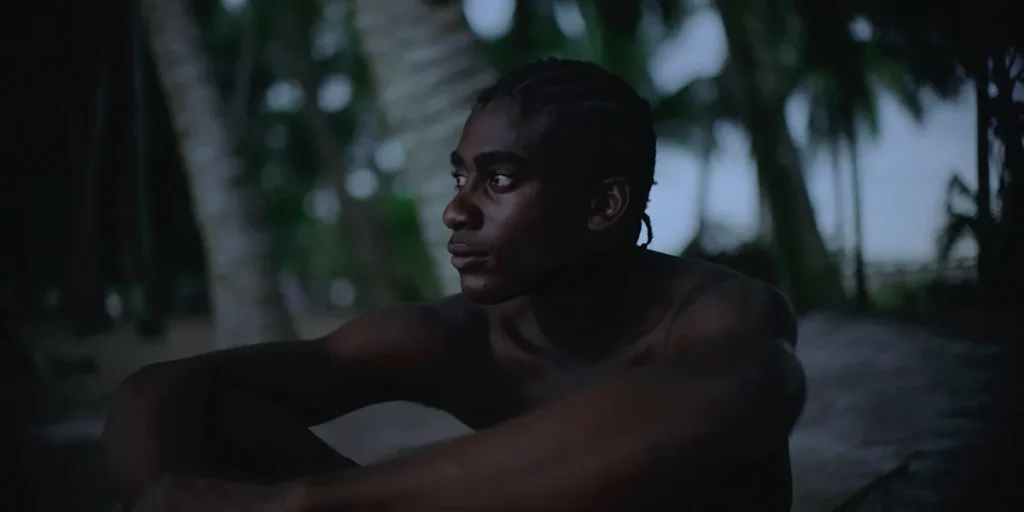
Paradise is a confounding filmic experience that is at times supremely enchanting and at others wholly baffling, with the central plot never finding its footing.
Director: Jérémy Comte
Genre: Drama
Run Time: 90′
Berlin Film Festival Screenings: February 14-21, 2026
Release Date: TBA
For all its notable flaws and uneven tone, Paradise is a largely memorable feature film debut by Jérémy Comte—although not always for the right reasons. This enigmatic, curious movie flits from Canada to Ghana constantly, with a storyline that just as freely roves between magical realism and farce.
It is unclear how much of Paradise Comte intended to be as bizarre as it is, but what is apparent from this Oscar-nominated filmmaker (for his 2018 short film Fauve) is that his vision is uncompromising. There is promise here for a filmmaking future that could prove to be as audacious as it is strange.
The opening of Paradise is mesmeric, instantly grabbing your attention with its attentive camerawork and ethereal voiceover. A man sits on a beach amidst the trees and witnesses a large industrial boat sinking, its flames causing people to leap overboard. Next, we’re with a young boy called Kojo, before the bulk of this story goes forward to his teenage life (portrayed here by Daniel Atsu Hukporti). Concurrently, we’re introduced to another teenager, Tony (Joey Boivin Desmeules), in Canada, who lives with his single mother (Evelyne de la Chenelière, Monsieur Lazhar) and never knew his father. Their respective lives intersect in ways that are expected—both teenagers lose their fathers in their formative years—and wholly random—Tony’s mother’s plotline with Kojo is bizarre, to say the least.
After this very intriguing opening to Paradise, the film loses its footing. There is a plot twist midway through the story that threatens to derail the story completely, although credit to Comte, he never allows this to fully happen. The two worlds of Canada and Ghana collide in unexpected ways, and by the conclusion of Paradise, there is a thrilling feel to proceedings. Comte directs these moments with aplomb, intensely capturing a situation that is escalating continually without signs of letting up. The plot is never disastrous as it lurches across its myriad of tones, but it never feels comfortable or certain in what direction it is going to take next.
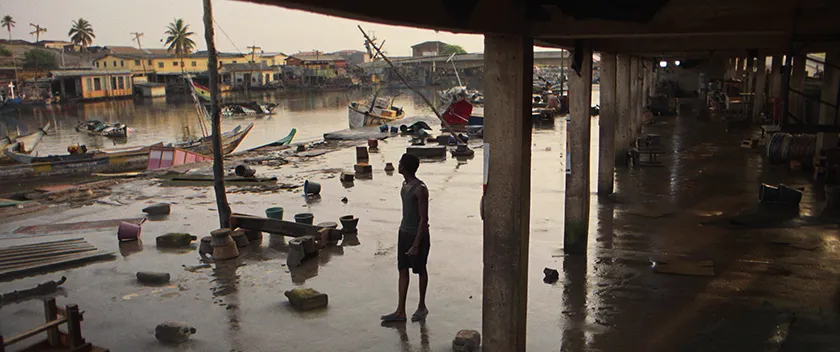
On the whole, DOP Olivier Gossot (Peak Everything) adds a unique, ethereal quality to Paradise with drifting camerawork. There is a regal quality to the film, most notably in its earlier sections, enhanced even further by a beautifully restrained original score by Valentin Hadjadj (Close). These components make the jump from magical realism to thriller that much more jarring. Many elements of Paradise are impressive, but all of them are let down by the film’s central storyline and the direction in which Comte leads it.
Aside from these stuttering aspects that struggle to cohesively mix, Paradise doesn’t ever succeed in fitting and intertwining the two settings and stories together. The basic connections between the lives of Kojo and Tony are obvious, but the intersection of their journeys is never achieved in a believable or emotionally moving way. This is also because the characters themselves feel undercooked and one-dimensional, despite solid performances from all the actors. Paradise starts and ends in similarly ethereal fashion; the middle of the film verges into trashy. The post-watch thoughts and feelings therefore are ones of confusion, spurned potential, and tonally jarring filmmaking.
Paradise (Berlinale 2026): Movie Plot & Recap
Synopsis:
The lives of Kojo and Tony, two young men from Ghana and Canada respectively, collide in unexpected ways. The globe-trotting journey brings the latter to Ghana on a quest for answers and justice.
Pros:
- Impressive moments of intense magical realism
- Memorable cinematography and original score
Cons:
- A stuttering screenplay of jarring tonal shifts
- A plot that is too bizarre and chaotic to ever truly work
Paradise premiered at the Berlin Film Festival on February 14-21, 2026. Read our Berlin Film Festival reviews!