
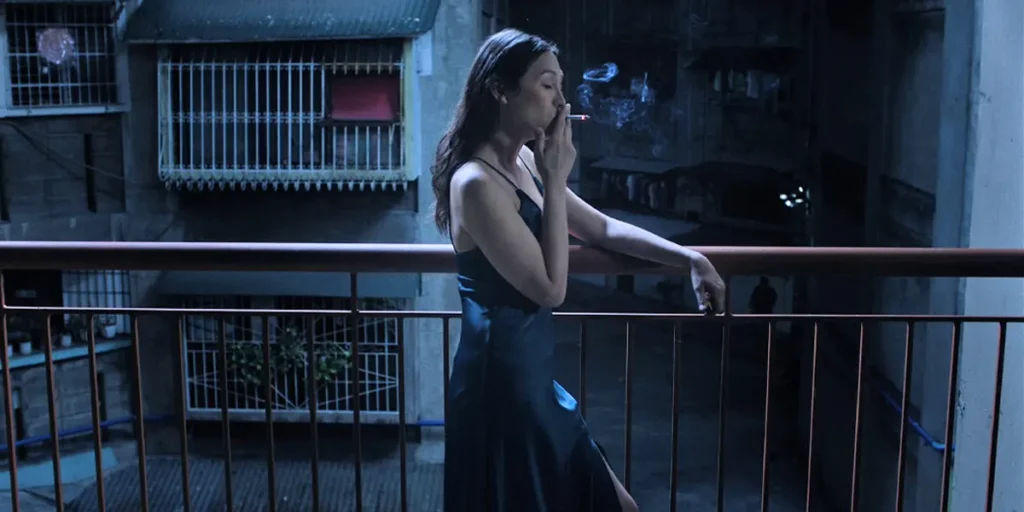
Isabel Sandoval directs and stars in Moonglow, a languid neo-noir about a detective disillusioned by corruption in 1970s Manila.
Director: Isabel Sandoval
Genre: Crime, Thriller
Run Time: 108′
BFI London Film Festival Screening: October 15, 2026
U.S. Release Date: TBA
U.K. Release Date: TBA
US-based Filipino filmmaker Isabel Sandoval made her breakthrough with her brilliant previous feature Lingua Franca, where she wrote, edited, directed and starred as an undocumented trans caregiver trying to avoid deportation from the United States. Following that, she directed episodes of Under the Banner of Heaven and The Summer I Turned Pretty. Now she returns to the Philippines for her new film Moonglow, which Sandoval has written, directed and co-edited, and stars in.
The neo-noir is set firmly in the reign of controversial President Ferdinand Marcos, a time of martial law and mass corruption, Moonglow has an intriguing premise.
Manila, at the tail end of the 1970s. Disillusioned detective Dahlia (Sandoval) is assigned a new case by her boss, the crooked police chief Bernal (Dennis Marasigan). His house was broken into, and all the money was stolen from it. Bernal has chosen Dahlia to investigate because she is a trusted aide, with the chief suspecting someone else in the police department stole the money. However, Dahlia is actually the one who committed the robbery, stealing the money so it could be given back to slum dwellers after a recent fire. Think of her as a Manileña Robin Hood.
To help with the investigation, Bernal has also brought in his nephew Charlie (Arjo Atayde, also a politician in the Philippines), a former officer now working as a lawyer. Coincidentally, Dahlia and Charlie dated more than a decade ago. For Dahlia, an already messy situation becomes complicated as the former lovers recall their past and maybe re-spark their relationship.
“People are trapped in history, and history is trapped in them” is the James Baldwin quote that opens Moonglow. For the central pair, whose dynamic is sensual and star-crossed rather than erotic and fiery, their personal history has been shaped by what has happened in between their parting and their reunion. It is also a relationship full of what-ifs. What if Dahlia went to America with Charlie? What if he stayed instead of leaving, having only recently returned to care for his father?
There are some interesting moments in terms of the film’s look and sound, which help Sandoval as she attempts to create a tangible atmosphere. This is a neo-noir full of low lighting and cigarette smoke, perhaps calling back to a yesteryear film noir. There is one cool shot which lingers on an ashtray and a shared cigarette (DP Isaac Banks, who shot Lingua Franca, likes to use wide long takes). The initial heist is very Rififi-esque with no score. That is one way the sound design by Tu Duu-chih (who has worked with Wong Kar-wai and Edward Yang) is encompassing, whilst also evoking period detail. And Keegan DeWitt’s otherworldly score delves into jazz at points, fully turning the film into a classic Hollywood noir.
Conversely, this emphasis on style has drawbacks. Take the middle-of-the-film title card, a showy flourish that sees Dahlia in a dress on a balcony, the title flowing in cursive. An indelible image? Sure. But it feels detached from a film that has been unsure of itself up until that point. The same goes for presenting Dahlia and Charlie together in wider shots rather than up-close.
Moonglow picks up afterwards as it starts to show the full effect of the Marcos dictatorship, and the extent of Dahlia’s involvement and complex nature are be pried open. Yet it takes so long to get to that point, which isn’t helped by the slow pacing. The dialogue is expository and even clunky. And the relationship between Dahlia and Charlie, which could have been the heart of this film, is underdeveloped, with their scenes mostly telling us about their past. You are left disconnected from it as a result, as you are during the rest of the film.
Moonglow certainly has an intriguing premise with its look at the impact of martial law and corruption. And with Marcos’ son Bongbong now in power in the Philippines, it is relevant too. So it is disappointing that Sandoval’s film proves to be so languid and ineffective.
Moonglow: Movie Plot & Recap
Synopsis:
Manila, 1979. Disillusioned detective Dahlia teams with her former lover to find out who robbed the corrupt police chief, but Dahlia herself committed that crime.
Pros:
- Thanks to several collaborators, the film’s look and sound are interesting and help Isabel Sandoval in her attempts to create the atmosphere of Marcos-era Manila.
Cons:
- Disappointingly languid and ineffective as a neo-noir, taking so long to get properly going.
- The relationship between Dahlia and Charlie, which could have been the heart of the film, is underdeveloped.
Moonglow will be screened at the BFI London Film Festival on October 15-16, 2026.