
Materialists and Eternity are two of the most talked-about romantic films of the year, but what do these films tell us about the state of romance in 2025?
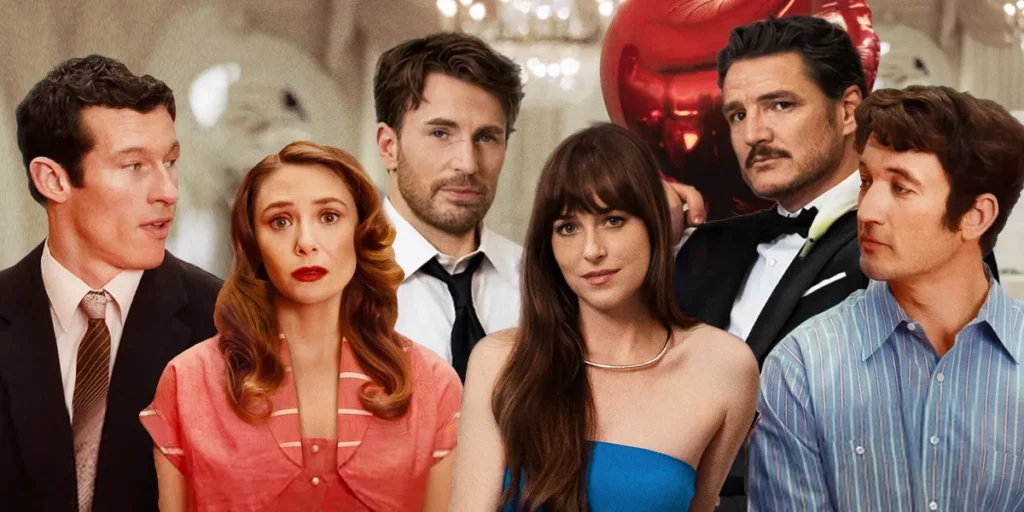
In 2025, A24 gave us two of the year’s biggest romantic features that analyzed the state of modern romance through drastically different lenses. This summer, Celine Song delivered her contemplative sophomore feature, Materialists, centering on Lucy (Dakota Johnson, of Splitsville), a numbers-driven New York City matchmaker in her mid-thirties, torn between the perfect man on paper, Harry (Pedro Pascal, of Eddington), and her helplessly imperfect ex, John (Chris Evans, of Honey Don’t!).
This fall, David Freyne delivered the delightfully campy and unabashedly heartfelt Eternity. The film tells the story of a dead woman named Joan (Elizabeth Olsen, of The Assessment) deciding if she wants to spend her afterlife with her first husband, who died in the Korean War, Luke (Callum Turner, of Rose of Nevada), or her second husband, Larry (Miles Teller of Spiderhead), whom she spent 65 years married to.
While Song’s Materialists takes a magnifying glass to the harsh economic realities infiltrating the modern dating sphere, Freyne’s Eternity takes a fantastical approach to breaking down the definition of a soulmate and measuring one’s life in love. When combined, these two unique analyses of what constitutes a successful relationship reveal both what’s truly important and coveted within romantic relationships in 2025. Spoilers for both movies ahead.
How Materialists Analyzes Connection in Modern Romance
In Materialists, the end-all be-all for Lucy’s matchmaking clients is marriage. When we meet Lucy, she has officially made nine matches that have resulted in marriages, making her the toast of her agency as well as her boss’s most promising protégé.
As a matchmaker, Lucy strips people down to their nuts and bolts in order to see where their parts fit in best with her other clients. While people come to her describing who they are and what they want, she takes notes of the material things about them such as height, weight, age, education level, job title and most importantly, salary. She turns these clients of hers into a saleable product on the dating market.
While this approach might seem harsh, it’s perhaps the most modern depiction of what dating assistance outlets and algorithms truly analyze in the 2025 dating sphere. People make their profiles full of quantifiable data and trust the powers that be, whether it be matchmakers or dating apps, to find people out there with complementary and/or preferred statistics. With the origins of marriage being rooted in familial, social and economic alliances, Materialists’ borderline primal view of humans and their values seems to show that the origins of marriage have always been reliant on logistics and rooted in survival.
Which is to say the film does not condemn its characters with materialistic motives, but rather takes the time to explain why conversations around finances and logistics are vital in modern-day romances, specifically in such uncertain economic times. Lucy grew up poor and has finally built a life she finds suitable. When she evaluates her desire to get married, she can’t help but think of the financial implications of her partnership because she grew up in an environment where her parents’ financial situation directly impacted the way she saw and interacted with the world around her.
Regardless of how logical Lucy is about the numbers behind dating, she can’t help but secretly hold on to the hope that love will find its way into the equation when it’s her future in question. When Harry begins pursuing Lucy, she is impressed with his statistics. Harry is handsome, older, established, attractive, polite, charming, and most importantly, filthy rich. His stats are so phenomenal in fact, she cannot fathom what he is doing spending his time on her. As the film progresses, Song’s script weighs the weight of economic motivations against the magic of genuine chemistry and connection.
As Lucy’s professional and interior life begin to crumble with the revelation that her favorite client, Sophie (Zoë Winters, of Succession), has been sexually assaulted as a result of one of her matches, even though she is about to embark on her dream vacation with Harry, she calls John. John is the one she can call when her life is falling apart and she knows she can talk to him without fear of judgment or him recoiling at her vulnerability.
In this moment, she comes to face the reality of what a life spent with Harry would be like. While it would guarantee financial stability, she cannot speak to Harry the way she can speak to John. He provides none of the emotional safety or comfort that her past relationship did. Even though Harry is everything Lucy has said she wanted, he isn’t the true partner she is looking for, and she can no longer deny that John simply is. This sense of comfort in being herself with her partner stands as the unquantifiable, intangible statistic that no algorithm can predict or math can ensure.
How Eternity Deconstructs Quantifying Love in 2025
While economic statistics are not a motivating factor in the decision Joan is forced to make in Eternity, she is asked, rather, to take on the impossible task of measuring her life in happiness and in the depth of her greatest loves. Whereas Lucy’s journey to self-actualization was seemingly informed and guided by cold, hard numbers and definitive material aspects, Joan’s journey is lined with memories of warmth that she must find a way to successfully compare against one another.
Eternity asks its main character to choose between young, fiery love and a love that has endured throughout several decades. The absurdity of the story’s central conflict has Joan trying to find every conceivable way to make the “right” decision, even though it seems like no right decision is possible. She didn’t love one husband more than the other, but rather loved them both so deeply and so differently.
The big twist of the film comes through a realization spun from its own mythology. In Eternity, when you die, in the afterlife, you revert to the age you were when you were the happiest in your life. For Luke, it is when he is visiting a church while serving in the Korean War, thinking about starting a family with Joan when he gets home. For Larry, it’s in his mid-thirties when he’s at a restaurant with his firstborn, and Joan is there, pregnant with their second child. What ultimately motivates Joan to go to eternity with Luke is Larry realizing he never knew her with hair as long as it is in the afterlife because she cut it short after Luke had died.
Larry rushes to tell Joan she needs to go spend eternity with Luke because it was when she was happiest in her life. Joan feels betrayed by this revelation because she wants Larry to understand she was always completely happy with him as well, but Larry understands nothing can compete with the passion and fire of your first love.
However, after spending time in eternity with Luke, she can’t help but go and visit the archives showing her memories of her life with Larry and their kids. She sneaks off, spending every moment she can manage looking back on her imperfect life rather than enjoying her seemingly perfect eternity with her seemingly perfect Luke.
No matter how many epic adventures await her and Luke, she can’t help but stay stuck in the mundane memories of everyday life with Larry. When Luke finally confronts the fact that Joan is clearly not happy, she explains she has realized that love can’t be measured just by your happiest moment but rather by all the little moments where you decide to choose the same person over and over again.
She and Larry fought and bickered and complained, but every day they chose to be with one another over everything else and cared for each other unconditionally. They never had to pretend to be someone they were not and always found ways to accept one another’s shortcomings without judgment. While her happiest moment might have been the moment she fell in love with Luke, her life with Larry was filled with endless moments that reminded her every day why she chose to marry him.
Materialists, Eternity and the State of Romance in 2025
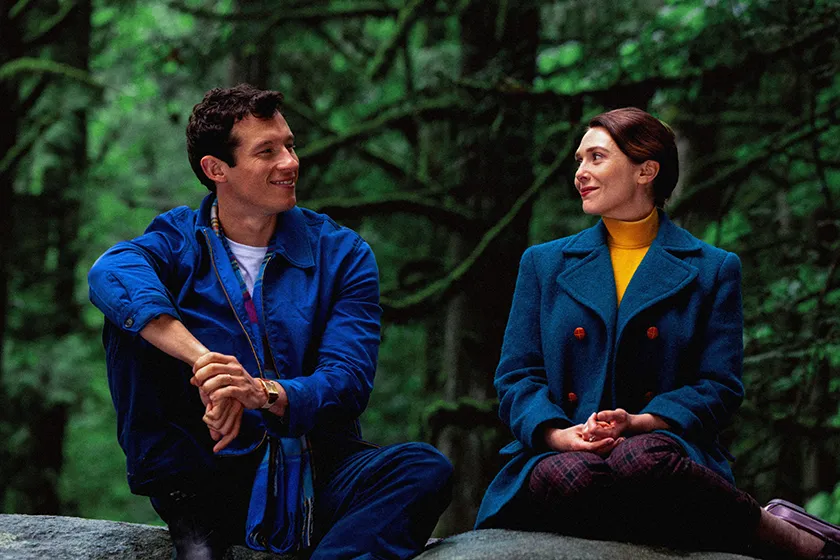
While Eternity eliminates the questions of economic security and safety that Materialists poses, it still analyzes the emotional motivations behind choosing someone to spend forever with and ultimately, Freyne’s film reaches the same conclusion as Song’s. Both films show the ways in which we have complicated questions of love and marriage beyond recognition in 2025, when the answers have been in front of us all along.
These films show us that love is not something you can plug numbers into and expect an answer out with a 100% success rate. It’s also not a singular moment you can pinpoint as the time you felt the happiest without any further analysis. To receive the everlasting, genuine love you want, you need to be vulnerable and open to the tough moments as much as you are open to the good ones. You need to understand it can be messy and frustrating, but hunkering down through the tough moments is the only way to make it to the most stupidly happy ones.
These films hint at these lessons in their opening scenes, but we as an audience need to experience the films in their entirety in order to properly digest their messages. In the opening of Materialists, we meet a man in the Paleolithic era picking wild flowers. He brings these flowers back to his mate and ties one in a knot around her finger. While this may seem like the first material exchange signifying romantic ties between two human beings, in all actuality, it’s driven by the man’s desire to share something beautiful with this woman. Their smiles indicate no material gain, no economic security, but rather the joy of sharing this moment with one another.
In Eternity’s opening, we see old Joan and old Larry bickering in their car over nonsense. Larry is groaning about the gender reveal party while Joan tells him to let their kids have some fun. Even while Larry continues to protest and complain, Joan can’t help but laugh at all the qualms he raises. There is a feeling in this scene of the unbridled comfort that exists between this couple, like they would be happy anywhere doing anything as long as they were together.
With both Materialists and Eternity, 2025’s romantic films are reflecting their audience’s desire to be seen and accepted for who they are as a whole, rather than being broken down into idealized moments and their most attractive statistics. Audiences want to be understood and taken as they are, rather than manufactured to be a perfect accumulation of ideal traits or a collection of their very best moments. In 2025, we as a culture realize relationships are never as clean-cut and picturesque as we hope they will be. However, Celine Song and David Freyne seem to tell their audiences that if we can accept that our relationships will never be as perfect as we envision them, maybe we can start appreciating the true beauty in their imperfections.

Materialists and Eternity are now available to watch on digital platforms.