
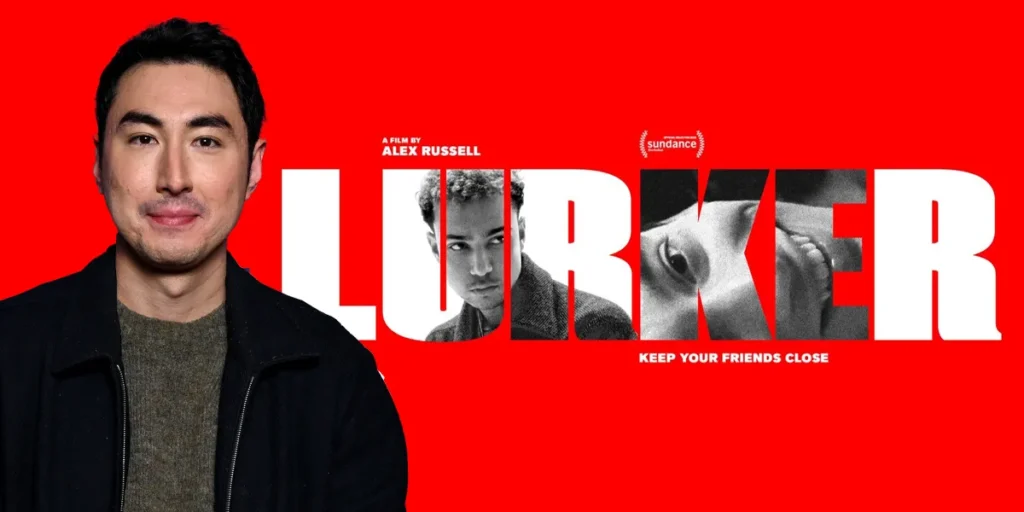
We interview writer-director Alex Russell about his feature debut Lurker, working with Théodore Pellerin and Archie Madekwe, the themes of the film, and more.
When twenty-something retail employee Matthew (Théodore Pellerin) notices that Oliver (Archie Madekwe), an up-and-coming artist he really loves, has entered the store where he works, he knows that trying to get his attention would get him nowhere. Instead, Lurker‘s protagonist opts for another approach: since he’s in charge of the music in the shop, he carefully selects a track he knows will get Oliver’s interest. Needless to say, Matthew’s plan works, and in no time, he makes it to Oliver’s inner circle. Not only that, but Oliver, who immediately considers him a friend, soon puts him in charge of filming some footage for his upcoming album.
But things aren’t as easy as they seem in writer-director Alex Russell’s feature debut, which uses its constantly evolving central relationship to look not only at the cost of fame and celebrity culture, but also at obsession, ambition, loneliness, toxic masculinity and manipulation, relationships between men in our modern world and, above all, self-worth in a conflicting, ever-changing society. What’s most astonishing about Lurker is that it does all this while also presenting us with a gripping, genre-defying story that will surprise you in many ways. Thanks to fantastic characterisation and superb performances from Théodore Pellerin and Archie Madekwe, it’s up to you to decide the exact nature of our protagonists’ relationship, and this makes the movie even more impressive.
At the BFI London Film Festival, we sat down for an interview with writer-director Alex Russell. Here’s what he told us about the themes of the film, what his characters want, working with Théodore Pellerin and Archie Madekwe, the parallels to Almost Famous, and more.
Alex Russell on Self-Worth, Attention and Fandom in Lurker
Thank you so much for this amazing film! I really loved your depiction to the central relationship, not just in terms of power dynamics and fandom, but also of the idea of self-worth. Matthew gets to feel like he’s worth something by standing close to the ‘sun’, which is Oliver. But at the same time, Oliver is surrounded by ‘yes men’ and this gives him ‘value’.
I really love how this contrast highlights their similarities too, such as how lonely they both are.
Alex Russell: It’s ultimately a story about attention, and who you want it from. I think both of these characters are similar in that they have massive egos, and depths in themselves that require a certain type of attention on them in order to feel self-worth. And they’re also very specific in the kind of attention that they want. They want to control it, and they want it to be shining on them in a certain type of way, and not a rampant way, if that makes sense. What makes their relationship symbiotic is that they both know what kind of attention the other wants.

I think that you use the word ‘love’ very cleverly in the film to reflect this ‘specific kind of attention’ that they want. There are so many times when random people tell them “I love you”, or “I want to be like you”, and this makes them so uncomfortable, which is a contradiction, as it’s actually what they’ve been working to achieve.
A.R.: Yeah, that’s a good point. I think that’s because the light shines brightly when it’s direct, you know? When someone says something out loud like that, it’s almost blinding, to these characters, if that’s what they really want.
You mentioned in other interviews that Almost Famous was among the movies that inspired the film. I can see the connection: “It’s all happening” in Lurker too, for Matthew, at least at first, even if the concept of ‘fandom’ has changed, culturally. But you also address this by showing several characters reacting negatively to the idea of someone becoming a ‘fanboy’.
A.R.: I think that same tension [between being a fan and a friend, and what ‘fandom’ really means] is there [in Lurker too]. In Almost Famous, the main character starts out as a fan and has this guise of, I’m doing this Rolling Stone piece on you guys [the band he’s following on tour]. But the closer you get to the end, the more you feel his anxiety about this friendship [with the band] not lasting. The the ending of Almost Famous gives us this moment where the Rolling Stone story is published, and [we ask ourselves,] ‘Will [the band members] still be friends with him after?’. That’s the big question.
And I think, what’s going on in that kid’s mind in Almost Famous is, ‘Are these people really my friends, or am I disposable?’. That’s true of Lurker [in terms of Matthew’s dynamics within Oliver’s group] too. ‘Am I really important to these people, or am I disposable?’ Those are the things that that tether my very modern movie to that one.
Matthew and Oliver’s ‘Beautiful Usefulness’ and the Nature of their Relationship in Lurker
I can really see that conflict. Your story is also more complex, because we never really fully know the nature of Matthew and Oliver’s relationship. There’s a moment when they’re in Oliver’s bedroom and Oliver asks Matthew, ‘What do you want?’. As a viewer, you ask yourself the same thing.
Is it friendship? Are they enemies? Is it an artistic collaboration? Are they attracted to each other?
Alex Russell: I think they love each other. I think, ultimately, they find a beautiful usefulness in each other, as grotesque as it ends up being: everyone gets what they want. And Matthew ends up being key to that for Oliver, you know. It’s sort of spoken about in the first ten minutes of the movie, and in them sitting down in Oliver’s bedroom. Matthew ends up being the person that can unlock what Oliver wants, and what Matthew wants is proximity to that.
It’s such a clever scene, because depending on the answer, Lurker could have become a completely different kind of film. It could have become a love story, but it could also have tapped into horror movie territory.
A.R.: I think Matthew’s being cheeky with his his answer to the ‘What do you want?’ question, but you’re right about the scene either turning horror or romantic. That’s sort of the expectation that’s set up, especially in that wrestling scene: Is this going to finally turn violent or finally turn sexual?
In the end, they sort of end up in this gravitational orbit of each other that weirdly finds its equilibrium, and it feels like they’re just going to be spinning through space together forever.
Alex Russell on Working with Théodore Pellerin and Archie Madekwe in Lurker
What was your collaboration with Théodore Pellerin and Archie Madekwe like?
Alex Russell: They made it super easy for me. They’re just both very serious, professional young actors, and they really understood what the movie was about.
The first scene we shot was them meeting each other, and that was the only day I got emotional, because I knew that the rest of the movie was going to work. It was just the two of them, in a room, looking at each other and… exchanging something. And that’s what the whole movie is, you know? I didn’t have to extract performances from them. They were always doing interesting things, and the first take was often usable. Then we would just try out different stuff for the rest of the takes, and then we’d keep it moving.
Thank you so much for speaking with us!
This interview was edited for length and clarity.
Lurker will be released in U.K. cinemas on December 12, 2025. In the U.S. and Canada, the film is now available to stream on Mubi, and to rent and buy on digital platforms.
Header credits: Alex Russell attends the Lurker screening during the 69th BFI London Film Festival at the Prince Charles Cinema on October 10, 2025. (Stuart C. Wilson/Getty Images for BFI) / Poster for Lurker (Mubi)