
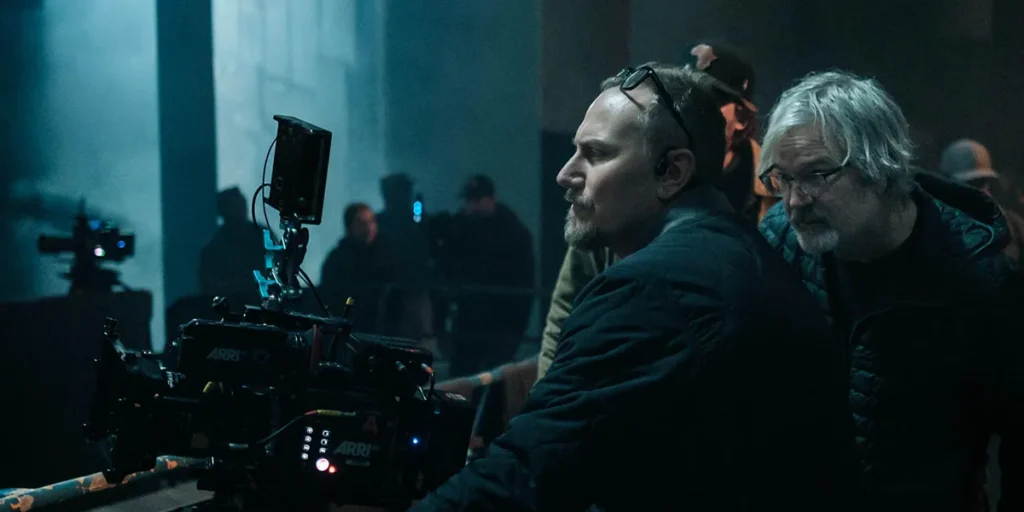
We interview James Whitaker ASC, DOP of Good Luck, Have Fun, Don’t Die, about working with Gore Verbinski, shooting the movie, lighting, genre, and more.
“This isn’t a robbery! I am from the future!” says a strange-looking man at the start of Good Luck, Have Fun, Don’t Die, to the bewilderment of all the LA diner’s patrons whose meal he’s just interrupted. The man comes from the future – a future that “goes horribly wrong” – and he’s come to recruit some people to help him save the world. Except he’s already done this exact same speech 116 times, and always failed to execute his plan. Is Man From the Future (Sam Rockwell) telling the truth? Should they, and we, trust him? As you try to figure it all out, our hero and his team set out on a mission, and chaos unfolds.
Good Luck, Have Fun, Don’t Die is a very special film, and one that will surprise you in many ways. While its premise might seem straightforward, the talent both behind and in front of the camera make this a tour-de-force of a movie that, despite its very limited budget, manages to be both entertaining and poignant, tackling several genres with humor and heart and ultimately leaving us with much to think about.
Ahead of the Good Luck, Have Fun, Don’t Die‘s theatrical release, we sit down for an interview with DOP James Whitaker ASC, whose work on the movie helps make it, in no small part, the stunning, immersive and engaging gem that it is. Read what he told us about working with director Gore Verbinski, Matthew Robinson’s “punk rock script”, building the set, shooting the film, the state of the world, and more.
James Whitaker’s First Conversations with Gore Verbinski about the Film, and His Visual Inspirations
Thank you so much for this fantastic film! How did you get involved in the project?
James Whitaker: I shot a music video for Gore in 2003: it was for a song called “Born Too Slow,” from the band The Crystal Method. Gore wanted to explore Edward Muybridge: he’s a photographer, one of the founders of cinema. We shot that music video a very long time ago. We lost touch because he was filming two giants Pirates of the Caribbean movies after that, but then he saw a show I did called Patriot, on Amazon. His friend Steve [Conrad] is the showrunner/director; Gore called him and said, ‘Who shot this show? I want to work with him.’ And then Gore called me a year before we started shooting Good Look, Have Fun, Don’t Die, and asked if I’d be interested in being involved. I said, ‘Of course!’. He said, ‘You’ll have to work for free for a long time, trying to help me figure out how to make this movie for next to no money in his world.’
I’ve read about the low budget! It’s so surprising, given he’s such a well-known filmmaker.
J.W.: Exactly. And that’s the thing, too. That’s why I got super excited, right off the bat. I was like, ‘You’re kidding me, Gore? It doesn’t matter what the script is. Who cares? I’m there’. I asked him to tell me what the story was about, and he said, ‘Let me just send you the script’. And then he asked, ‘Well, what did you think?’ and I said, ‘Well, it’s batsh*t crazy’. That ended up being something we said to each other for the entire movie: ‘It’s batsh*t crazy!’ Matthew Robinson’s script is very punk rock.
It’s absolutely the most appropriate word to describe the film! I also love that you mentioned that Crystal Method music video inspired by Edward Muybridge.
I was reading the press notes for this movie and saw that you cited photographer Gregory Crewdson and painter Maxfield Parrish as inspirations. Is that how you usually approach projects?
J.W.: I’ve been constantly exposed to art and photography throughout my whole life, so it’s an everyday thing for me. It’s not like, ‘I got a project starting to come up, so I’m going to go to a bunch of museums’; I go to a bunch of museums all the time, and I’m constantly looking for new photographers that might inspire me for my own work.
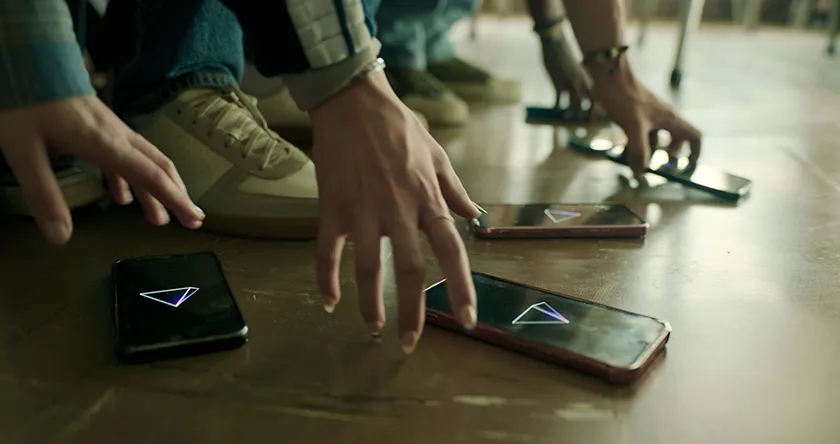
It’s interesting, as I’ve been shooting now for a very long time, and as I go, I become less interested in looking at other films, and other art in general, when trying to find reference for movies. But I come back to those touchstones of photographers that I really love, and I do revisit them, or it’s already in my brain. [For example,] when we’re shooting through a window, and it’s got a lot of mist, and rain, and smog, and atmosphere, like when the teenagers have all their cell phones out [in a scene from the movie, my brain] is already like, ‘Hmm, it would be great if this felt a little bit like a Saul Leiter photograph!’ or something like that.
What was the first meeting with Gore like?
J.W.: For almost every movie and show I do, I put together a lookbook for my interview. I knew that I was going to have my first meeting with Gore before I officially had the job. He had asked, ‘Would you be interested in doing the movie?’ and I had said yes, so he had said, ‘Absolutely. Let me send you the script.’ but I didn’t have the job yet. So I went and visited him at his office, which is an old firehouse: it’s amazing. We sat down and we started talking about the story, and then I brought out a presentation where I had pulled a bunch of images from photographers and painters, and even some movies. He really wasn’t interested in looking at it, which I appreciated so much.
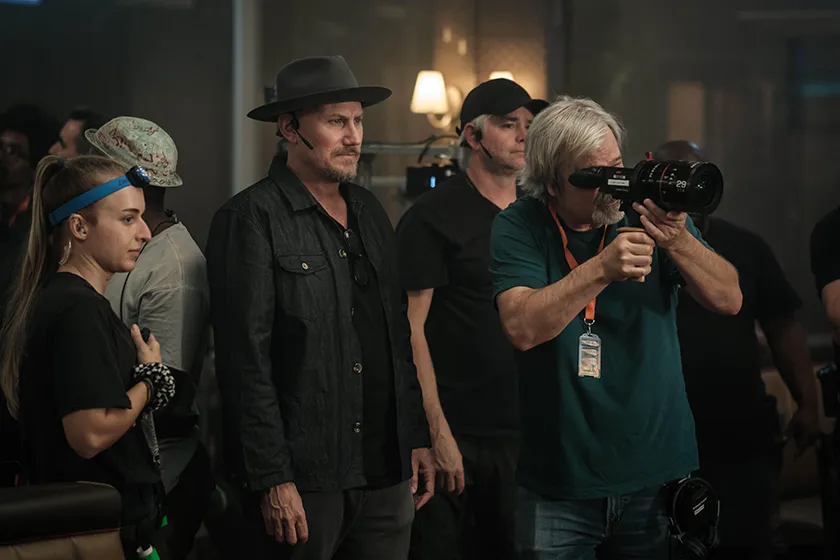
I think Gore, especially, is about ‘What’s our vibe? How are we going to do this together?’ and ‘Are you going to be willing to get into the trenches with me? Because this is going to be brutal.’ At the beginning phase, he really felt like he needed 80+ shoot days to make this movie. He brought me on board to help him figure that out: How do we get 80+ shoot days?
Because of the limited budget, right?
J.W.: Yeah. I couldn’t imagine a possible scenario where he would get anywhere near 80, maybe not even more than 40 or 45 days, for the $15 or $16 million that he was talking about at the time. So I think he really wanted to know, ‘Are you going to be one of my soldiers, that’s going to help me – from the beginning and all the way through the project – get through this thing?’ And I was. That’s how we got into it together.
Building the Set for the AI Room in Good Luck, Have Fun, Don’t Die
With this kind of budget, I think it’s amazing that you were able to make the movie look as good as it does! I’m thinking of that final scene in particular, where our heroes have a confrontation with AI (to avoid spoilers): that must have been quite a challenge to shoot. Did it look very different from what we’re seeing on screen?
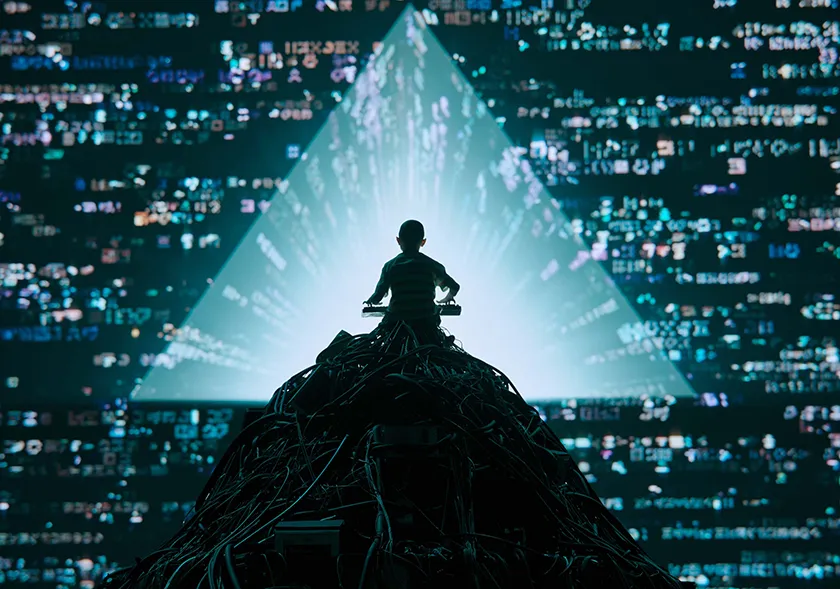
James Whitaker: I wouldn’t say it did, except for a little bit of green screen stuff that was in there. That room was real: that was a perfect example of where Gore took our script and elevated it. Because if you read the script, it doesn’t read like it’s this massive room inside of a house; it reads like it’s a little boy’s room. You’ve got an AI boy with a bunch of different computers around, maybe, and some cables. And there are some robots that come to life. When I read it, it was a slightly oversized, 20 ft. × 20 ft. bedroom, or something like that.
But right from the beginning, Gore felt like that was a place he really wanted to elevate Matthew Robinson’s script. And so we came up with an idea, which was to have an LED screen at the end of the room that would be the computer monitor for AI boy to be typing his quantum coding, basically, which you see in the movie: it’s Gore’s version of what quantum coding might look like. [smiles] And then, the set was designed around that screen.
Oh, I love this!
J.W.: We asked, ‘How big should the screen be?’ And well, it ended up being 40 ft. wide by 50 ft. tall, and that was a real screen that we built in Cape Town. Then, [production designer] David Brisbin designed the set knowing that it would be the central piece of the production design. The room ended up being 150 ft. long by 50 ft. wide in the middle, and 40 ft. wide on the ends. It was massive. That cone made of cables that the boy sits on was probably 15, 16 ft. tall, which is quite tall. It had to be reinforced with a steel structure underneath it, because we were going to have actual people sitting on it, so it had to be safe. People needed to walk up and down it all day long. There were actually built-in little sets of stairs on the sides that you can’t see!
So how did you manage to create the most visually striking sequences in that part of the film?
J.W.: We knew that there were going to be many different things happening in the room [and we created the look of the room with this in mind]. There was going to be this tornado, so we needed to have interactive lighting that felt like a tornado could be in a room. Then there’s the whole AI boy journey where he takes Ingrid [one of the patrons recruited for the mission, played by Haley Lu Richardson] through her lifetime of memories. Each one of those things had to have their own interactive lighting and look.
It was really all production design, visual effects, and special effects. We had the LED wall content guys helping us out a lot, and then interactive lighting from all my departments, costumes, everything. It was crazy. Right from the beginning, we had visual effects teams: Gore’s priority in the number of things we had to attack when we got to South Africa – that’s where we shot the movie – was getting all the content for the screen, because pretty much the only one that’s real is the AI quantum coding. They might have touched it up a little bit, but we needed that to be mostly real for the interactive lighting – the triangle of light – for me to then create the light that comes from the triangle.
Using Lighting, an LED Screen, and Creativity to Shoot the AI Sequences at the End of the Movie
How did you create that tornado of light and make it look so realistic?
James Whitaker: They gave us a rough-looking tornado that was the spinning element that they put on the screen. That’s actually not in the movie, of course, because the tornado is in the middle of the room, but we had this gigantic tornado that had flashes of light in it, so that, when we’re looking towards Sam and toward Haley and toward Juno [Temple, who plays Susan, another recruit], you’re feeling all of that on the wall. Then we enhanced all that by taking a couple of 4K projectors and tying them together, marrying the images together so they’re really bright, and putting that same tornado content into the projectors as well. That way, we could project on the actors’ faces so that you would see the ropes, the cable lines on the faces, and stuff like that. Then we would further that by having some grips, and there were people in our department holding foam cables and shaking them in front of the projector lights.
That’s amazing! Was that sequence challenging to shoot, with all that light coming from the LED screen?
J.W.: Yeah. Fortunately, and unfortunately, we pushed this set piece: it was the very last thing we shot of the entire movie. We spent the last 10 days of shooting in that AI room, filming not only that shot with the AI, but also the AI kid’s memories as he’s walking Ingrid through. Because we had that gigantic LED screen in that space, we didn’t want to build a second LED screen; it would have been much helpful to have it in a different space, but instead we had to shoot it inside of that same giant AI room space.
The fortunate thing is it allowed us a ton of time to prepare, because it was the very last thing we shot. But unfortunately, it was all we thought about for the entire movie, and it was all consuming. How the hell are we going to do that? How are we going to break this down? We took most of the ceiling out of the AI room, and built a gigantic lighting rig above it that would have light boxes that could have interactive light, as well as rock and roll lights and strobe lights that would allow me to pulse the light or flash the light, depending on which look we were going for.
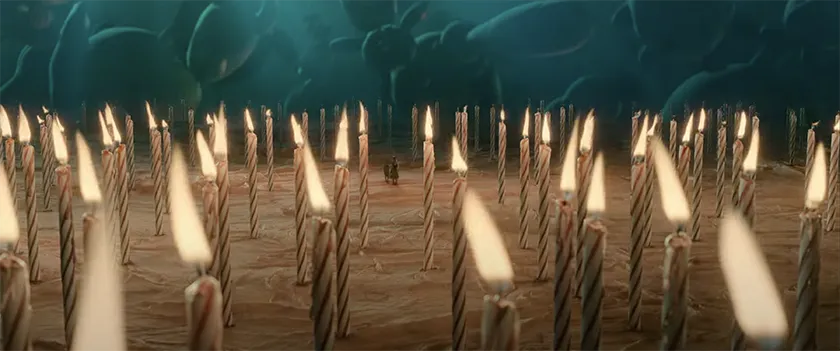
But we had some references. We had some content that you could put on the screen, for example with the birthday party in Ingrid’s memories, when she’s on a birthday cake.
Another gorgeous sequence! How did you approach shooting that?
J.W.: That bit of content could be on the screen: we could photograph it and it would emulate some light. And then we put giant, 12-foot stands with 500-watt photo floods, which are incandescent bulbs that are really bright. We had about 20 of those around the set, and hent we added flicker to make them feel like candles that were replaced later with visual effects candles.
Then there’s a scene where Ingrid’s standing in the middle of the field, which Gore referenced very early on: [the visual reference for] that would be Maxfield Parish, who painted these incredible, almost dreamy skies, with pinks and blues and ambers; we knew that’s where we were going to head for that world. So we had a piece of content on the screen behind her that looked like a Maxfield Parish painting, and then I built giant soft lights with an amazing amount of lights behind them that would create ambient daylight from above, but also a beautiful key light for her and gorgeous backlight for her that would feel like it would come from sunlight that they would put in the shot.
That was the idea from the beginning: let’s start with some reference that would be in books or actual paintings, that we could all look at, and then build the world from there.
James Whitaker on Shooting the Opening Scene and the Importance of LA’s Norm’s Diner
I love the opening scene of the film, especially that nighttime drone shot that then moves downwards to show us Norm’s, where it all begins, and we see all the neon lights. It gave me a very film noir vibe that I feel reflects the ambiguity of the film’s themes so well.
James Whitaker: Norm’s Diner is a real place in Los Angeles: it’s a historical place that people have gone to for a very long time. It needed to be Norm’s; there was no question. There were initial ideas that we would maybe build or find another location in South Africa, where we were shooting, that could maybe be a diner. But it was just like, no way. This had to be Norm’s, and it had to be in Los Angeles, which is where Norm’s is. It’s a very Los Angeles story to Gore. I think there are some parallels to film noir, like you said. But for example, that drone shot you’re talking about that comes down and sees the Norm’s sign – that was stolen during pre-production in Los Angeles. We did not have permission to do that.
Oh, how interesting!
J.W.: We set up a small drone and shot it. I’m probably going to get thrown in jail for that! [laughs] it’s a really important shot in the movie because about two blocks of Norm’s Diner and the boulevard in front of it were built on a stage in South Africa.
We’re not going to spoil the film, but there’s another drone shot of Norm’s toward the end.
J.W.: That one was actually was shot in Cape Town, and they added the Norm’s sign as an element.
I love that the movie itself references how important the setting is. Doesn’t Sam Rockwell’s character say something like, “This is where it starts; at a f*cking Norm’s in Los Angeles”?
J.W.: Yes!
It’s such an amazing scene. And you shot Sam’s actual monologue from so many different angles: it feels so dynamic. Can you talk me through it?
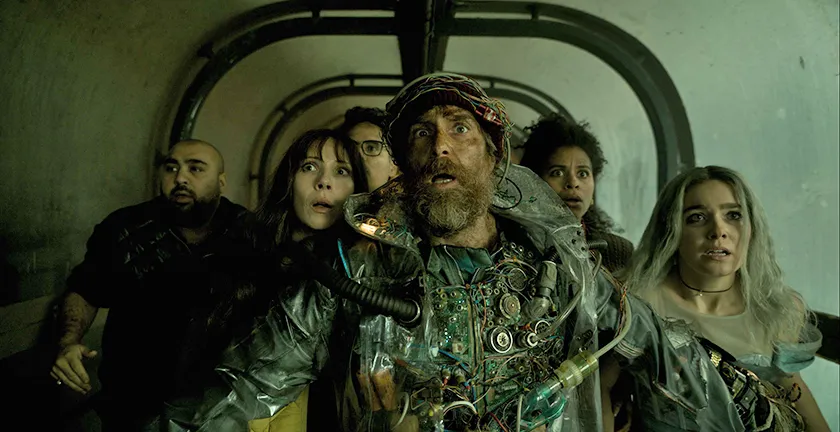
J.W.: I think it took 8-10 days to shoot that scene. First of all, we storyboarded it. Gore storyboards everything on a daily basis, but for that sequence we knew what Norm’s was going to look like, as far as a shot plan and structure, and the rough outline of how it would be done, probably ten days before we started to shoot it. And then, Sam showed up. You know, “Welcome to Cape Town, Sam. Try on this absolutely batsh*t crazy costume. Good luck.” It was about 40 pounds, that costume, so it was pretty uncomfortable. He started wearing it everywhere because he had to get used to what it would feel like.
First, Sam and Gore rehearsed inside the diner for three or four days, just by themselves. Then they brought in some people in: some of the players that would have just a single line to her or a couple of lines to him. They rehearsed again for another full day, and then they brought in myself and the assistant director to start talking about camera angles, how to make this really dynamic, and how to build on it: how to add punctuation, like when he kicks the cake off the counter that blasts into the lens.
All those things were really talked about. It was really important for Gore from the beginning that there was tons and tons of coverage, so lots and lots of angles and shots. While we were at Norm’s Diner, we shot between 50 and 70 shots a day: it was an incredible amount of footage. We had to approach the lighting for that space in a way that could allow us to move that quickly. All of the lights that are in the ceiling are on dimmers, so that we could quickly turn around, look the other direction, turn that half of the room off.
“Let’s dim down the one that’s above his head. Let’s dim it down to 10%, so it’s just a little tiny bit. Let’s turn up the one behind him because it feels a little bit like a back light. Okay, quickly, let’s put a little something on a stand, and let’s put up a little key light just to catch his eyes, and then let’s shoot, and let’s go, and let’s go again.” The floor was totally flat so that we could push the camera across the floor on dollies, or do circle rotations around Sam, without having to lay track.
That set was built in a very thought-out way that would enable us to shoot very quickly, so that Sam’s performance could come across as strong as it did. Gore – and I think that’s part of the great success of this – had a very thin line, a sharp edge he had to ride, because it needed to feel like a crazy person was walking in off the street and was terrifying these people, almost in a terrorist way. Then, he’d have us maybe believe that maybe he’s telling the truth here, let’s see where this is going. Gore is just such a master. He’s an incredible master when it comes to blocking scenes and working with the actors.
James Whitaker on the Many Genres of Good Luck, Have Fun, Don’t Die and Using Satire to Explore Serious Themes
I really love that once the characters leave Norm’s, it feels like the film’s genre changes a little bit, both story-wise and visually. There’s obviously sci-fi, with zombie elements in the Zazie Beetz / Michael Peña story and dystopian element in the Juno Temple one. But then, there’s also noir, horror, adventure, and even a little bit of romance too.
James Whitaker: I think you’re right; it’s genre-esque. At the beginning of the film, it’s reminiscent of Pulp Fiction, right? When they stand up on the booth and shout, “Hey, motherf*ckers!”. At the beginning, it feels a little bit like a ’70s film. Then we leave there, a especially when you get to the teenagers with all the cell phones, it feels like a horror film: a totally new genre. And then, the end of the film feels much more sci-fi.
I think blending those genres was in the script, but I’m glad it comes through. And then, you have all the flashbacks, which I wanted to feel more normal, and more restricted. We have the very dynamic camera world of present day, which is Sam and the five or six people that are going on the journey with him, where the camera is very dynamic.
Then you have the Haley Lu Richardson / Tom Taylor romance story, where you just let the camera sit and watch them. It’s not a lot of camera movement. It’s very much like it feels like an indie film from the ’90s or something like that. Sometimes the most beneficial thing you can do is just let the camera sit and watch, and not try to do too much. Then, the Juno Temple scenes, which was actually a nice piece for me because Gore really wanted my input on it.
***Spoilers in the next four paragraphs***
That part of the story… It’s a very difficult one, and one that in America could hit some nerves in a really bad way. I suggested shooting her approach to the school very much from her point of view. We were just on her face, and on shots of people walking by the lens, so that we could feel a little bit of what it might feel like from the chaos of a situation like that. When I described that scene to my older son, he told me, “Dad, you’re going to get canceled. You shouldn’t make this movie because it’s very personal.” [Young people in America] live in a reality where, when they were going through school, these situations happened all too often. There were even lockdowns on a daily basis. I don’t want to give away too much about the story; it’s just, they’d be sitting in the middle of English class and [the school would say], “Let’s run a drill just in case. Let’s all know how this could be if it happens.” It’s just terrifying for your kids.
I know what you mean. I think you handled it really well, though. You framed it all in a way that makes it so clear what your stance is on everything, even though you’re using humor. There’s a certain sadness to it all. I’ve recently watched Pluribus, which also uses humor and absurdity to delve into some worrying themes in a way that I feel is similar to this. I think a lot of creatives want to explore how worrying the state of the world is nowadays.
J.W.: I think satire is a beautiful way to always explore really serious subjects. Because if you stay in a really serious subject, it can start to feel like you’re wallowing in the heaviness and the sadness. Humor allows you to be a little bit more poignant in the point you’re trying to get across. You can have this heavy situation with a little bit of comedy, and then you see the absurdity in it all as humans, and it’s like, what’s wrong with us?
My favorite scene in the whole movie is when Juno goes to the house where all the women are, and it’s like a party for all the people who have been killed. She goes in and she’s talking to that couple; they start telling her about how they’ve cloned this kid four different times, and they started playing with it it. Like, “Let’s just mess it up a little bit. Let’s make her Muslim. Maybe she’s a little bit racist.”
That’s such a clever line!
***No more spoilers***
On AI, Humanity, and How We’ve Evolved since the Film Was Shot
I’ve read that you shot the film years ago.
James Whitaker: We finished it in May, two years ago.
Were you at all worried that the world was going to change too much, by the time you’d get it out there?
J.W.: Yeah, for sure. We were worried as soon as Gore sent me the script! He sent it to me in 2022, so now we’re almost four years later. And from the beginning, when I read the script, I was like, “Oh, this is already old news.” And so there was a real urgency to make the script soon; I think Gore really felt that. He was pushing really hard to make this movie, and he wanted it to happen sooner than later. Of course, then it took us six months to shoot it, then he had to post the movie for over six months, and then he had to find a buyer for it. Now, here we are. I was definitely afraid that it wasn’t going to become as important as it was four years ago. But actually, I feel like it’s landing almost at the perfect time.
I agree with you. I think it’s absolutely what we need to see right now.
J.W.: Yeah. If we think about it, in 2023, the guys who created ChatGPT told us that they were creating it because they felt like the world would be at big risk if we didn’t have AI out there in a way that could be studied, so that we could then figure out how to regulate it. I feel like it’s more poignant now, because that regulation is not in place. I agree, it could be quite dangerous for the world. We talk about regulation for AI, but we’ve got regulation for the internet, yet there is still the dark web, right? People can create chat rooms and things like that, which can create very scary situations. I think that will exist for AI as well. So what will become? We don’t know. I think, that’s maybe the key message of it all. What I love about the movie is that it leaves us with a lot of uncertainty. It doesn’t try to answer all the questions for us.
I think it does ask one question, though. Do we deserve to be saved?
J.W.: No, I don’t think we deserve to be saved. Now, will we fight to save ourselves? Always. We always do; That’s human nature, right? But we’ve done everything we can to create hazards in the way of ourselves. We keep thinking we’re creating things that make us better. But are they actually making us better? Are they making us more vulnerable? They’re certainly making us more confused.
James Whitaker on Making Movies
Why do you make movies?
James Whitaker: [thinks] Because I’m a sadist? [smiles] No, I guess there are multiple layers to it. I love the creativity of it. The thing I love most, as I’ve been doing for a very long time, is the camaraderie that comes together of all the filmmakers that are included in making one project. I love that it’s not a single person sitting at a canvas painting, although I admire all that. To me, it’s quite amazing because I might be the cinematographer of the shoot, but I can’t do anything without all the people surrounding me. I love the collaboration of it.
Then, you get to be inspired by certain geniuses, like Gore. How he does it, how he is good at what he does, and how he knows everybody’s jobs probably better than they do, but yet doesn’t get in the way of that. He doesn’t get in the way of your creativity and still wants your opinions. I love that so much.
Then, when a project turns out great and people react to it, and it really touches them – and I hope this is one people will talk about – you feel like maybe you’ve done something that changes things a little bit.
It must be amazing to be able to watch people react to something you’ve made, and that you’ve watched on the small display of your camera, but that you then get to watch in a theater with a big audience.
J.W.: Yeah, I’ve probably seen it 10 times now, because I stayed on to color the film. After Gore edits the film, I then work with the colorists and Gore, to make sure the image looks absolutely perfect, and to fine-tune some of the visual effects.
I’ve seen the film in a small theater with a pretty big screen, maybe 10 times. Then, I’ve seen it at a slightly bigger theater with about 60-100 people. That was great, because I stood outside when the movie was over and just got to watch everybody’s faces like, “What the hell? That was amazing. That’s crazy.” Then all the questions that came were fantastic. I haven’t seen it in a really big movie theater with, hopefully, hundreds of people; hopefully that’ll happen in the next few weeks.
I hope as many people as possible turn up for it at the theater! Thank you so much for speaking with us.
This interview was edited for length and clarity.
Good Luck, Have Fun, Don’t Die was released in U.S. theaters today and will be out in UK & Irish cinemas on February 20, with the Berlinale screening also taking place today. Read our review of Good Luck, Have Fun, Don’t Die!
Header credits: James Whitaker and Gore Verbinski on the set of Good Luck, Have Fun, Don’t Die (Graham Bartholomew, SMPSP)