

We sat down for an interview with director/writer Kirk Jones and lead actor Robert Aramayo to discuss their drama I Swear.
There have been various documentaries about activist John Davidson since the 1990s, but I Swear is the first biopic centred around the 54-year-old from Galashiels. Kirk Jones’ (Nanny McPhee) inspirational, moving drama starts in the present day, where John is receiving an MBE for his work with the Tourette’s community, before circling back to his childhood (in these scenes, he is portrayed by Scott Ellis Watson). The bulk of I Swear then charts John’s journey through adulthood (here, Robert Aramayo is John), showing us how his relationship to his Tourette syndrome has changed over the years and how society’s perception and understanding of the condition has also shifted.
For many reasons, I Swear is a miraculous drama, but perhaps most of all, it is Jones’ incredible ability to balance between the pain and humour that stems from John’s Tourette’s. This balancing act is undoubtedly difficult, but Jones, along with Aramayo and a wonderfully nuanced performance, achieves it with staggering effect.
Shortly after its release on digital platforms, we sat down with the man behind the camera, Kirk Jones, and the man bringing John to life on screen, Robert Aramayo. Here, they talked about the aforementioned balancing act, the crucial research that went into making the film, how they accurately brought John to the screen, and more. Read the interview below.
Setting the Tone: Kirk Jones And Robert Aramayo on Humour and Tragedy in I Swear
Thank you so much for speaking to us today. I Swear is such a brilliant film; so many people who have seen it have been blown away by it. It recognises some of the humour that accompanies Tourette syndrome, like telling the Queen to f*ck off in its opening scene, but the film never mocks Tourette’s or the people who have it.
How did you both avoid straying into a mocking tone?
Kirk Jones.: To come back to your first question as well, I wanted to start the film by letting the audience know that they could laugh. That scene with the Queen is a very clear comical moment and might have been the number one reason why I started the film with it.
Ultimately, I trusted my own instinct, which was that I found Tourette’s to be one of the most upsetting and awful conditions that anyone could imagine, but the nature of it can lead to people saying the weirdest, strangest things. As a writer and director, the collision of humour, emotion, and tragedy was appealing. Some of the best moments of John’s life have been ruined by Tourette’s, so I was sensitive about understanding the condition. When I first met John, one of the first things I said to him was that if I identified a level of humour in the film, would that upset or anger you? He said, no, that his life had been the most tragic and most hilarious thing you could imagine.
John talked about the church community, how they laughed together, how he laughed at his own things. He basically said that you have to laugh, otherwise it’s just a depressing condition. Knowing that I had his blessing was massive. One of the key elements of the film was to remind people that only a small percentage of people with Tourette’s swear, whilst others have other symptoms such as eye blinking, twitching, punching, and so on. It is exhausting.
It was really just about treading that line between humour and tragedy and using my own instinct. With John as an Executive Producer on the film, it meant he had a huge input and voice. He could highlight any issues, watch final cuts, change details.
Robert Aramayo: The key for me was that I never thought about comic timing with the tics or about putting them in the “right” place. There are moments that really raise John’s anxiety, such as when he goes for an interview. It’s a new place, the hall is really echoey; all of these environmental factors would contribute to an increase in tics.
Ultimately, certain moments were only funny because of John’s reaction or the people around him. Those elements made scenes funny, or dangerous, such as in the nightclub when a fight breaks out. It’s down to the people around John and how they react to his tics.
Kirk Jones on the Research Behind I Swear
As Kirk said, Tourette syndrome isn’t just about swearing. There is a minor moment in I Swear when John is making a cup of tea and as he’s pouring from the kettle, he puts his finger under the boiling water a few times. What moved you to include this very small moment in this scene?
Kirk Jones: That moment was very interesting to me. During pre-production, Robert was deep into his research. Each night he would be talking to people with Tourette’s, chatting to John extensively, and he would keep feeding me bits of information that I wasn’t aware of. If they were important, then I would include them in the script.
Rob told me about John having a particular issue with OCD (Obsessive Compulsive Disorder). Once something enters his head, he has to do it. One of those things was the boiling water, and because this is a film about John, his life, and his struggles, we included that moment. I wanted to show some of the things that John faces on a daily basis.
Robert Aramayo and Scott Ellis Watson both portray John at different stages of his life. Both of them are absolutely fantastic. What was the casting process like and after that, how was it working with them?
K.J.: We only found Scott about two weeks before we started filming! We had been searching for months, with someone on the ground going into sports clubs, youth clubs, places like that. They would walk around shopping precincts talking to kids, seeing if they were interested in auditioning, but we had no one that I felt comfortable with.
There was a theatre company that Scott’s brother attended, and he auditioned on camera for the part. Scott’s Mum suggested he also audition, and he was just brilliant, on another level. We had a little casting session face-to-face and at the end, I offered him the part. Like with all good actors, whether they’re young or old, his instinct was just right and he understood the material.
For Rob, the casting director [Lauren Evans] told me about an actor, Robert Aramayo, and as soon as I watched him, I saw something behind his eyes. It didn’t feel obvious that he could be John Davidson, but there was a presence that he had on camera.
We went to Galashiels together, introduced Rob to John, and immediately I could tell how seriously he was taking the role. From there, he did around three months prep, living with John, going to the shops with him, everything.
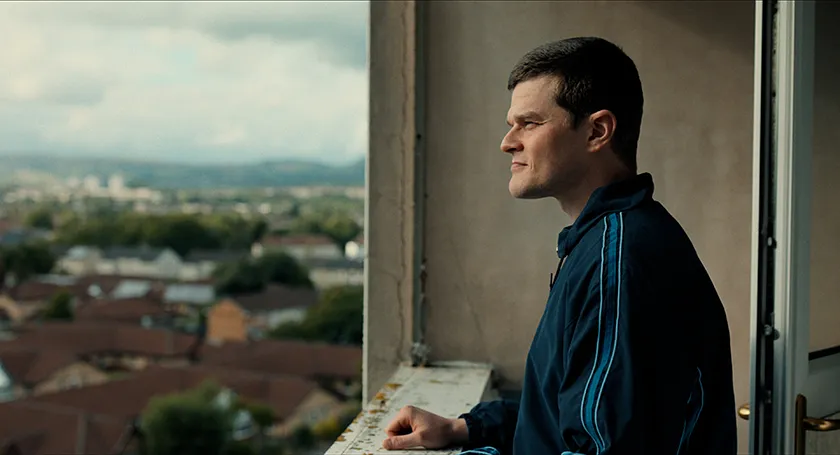
I Swear starts and ends with the main character, John Davidson. receiving an MBE. What was your thinking behind structuring the film like this?
K.J.: I knew that it was a key moment [when John receives the MBE]. In another film, I would have just allowed it to play out and eventually we would have got to it, but in I Swear, there were a couple of things that made me include it at the start.
Firstly, I’m aware of the dangers of a time jump where you see a different actor playing the same character. It is most significant when there is a jump in age, so I put the receiving of the MBE at the beginning of I Swear to smooth this transition [from young John to old John].
The other key thing was needing a strong opening. In my first film, Waking Ned (1998), I started with a massive lottery win. In Nanny McPhee (2005), the kids have just eaten a baby! I like to make an impact early on in my films.
When I listened to all of John’s stories, he told me this MBE-centred one quite late. I kept asking if there was anything else he could remember and he said, “I told the Queen to f*ck off!” As soon as he told me that, there was my strong opening. It’s completely unexpected and summarises John’s world and his life with Tourette syndrome.
I always assumed the final scene of the film would be the MBE one as well, but while I was working with John, he told me about a trip to Nottingham where a device to control tics was tested on him. He described how unbelievable it was and how much it reduced his tics, so this became the final ending scene.
Being John: Robert Aramayo on Bringing John Davidson to Life on Screen
Robert, congratulations on your award for Best Lead Performance at BIFA 2025.
Robert Aramayo: Thank you. It was unbelievably exciting and very surprising! Everyone says it, but even just to be nominated in one of these things, it’s amazing. You’re in the room with these incredible people.
It was fully deserved. What was your research process like behind this role?
R.A.: I started by reading. I brought as many books as I could, ones about people’s specific experiences of having Tourette’s, and others being more analytical material. This progressed to YouTube videos, to Zoom calls with people, and so on. I based myself in Galashiels and just sort of shadowed John for as long as I could. I immersed myself in his life, to try and get some understanding of what he was like when he was younger.
What was your relationship like with John? There is always a bit of pressure with biopics when you’re portraying a real-life figure who is still alive.
R.A.: We bonded together over football! And we also have a very similar sense of humour. John was so gracious and amazing in letting me spend time with him, like I was a fly on the wall at times. There were no barriers, which goes back to what the film is trying to do. It’s trying to do something, to show how much John has achieved in his life.
You imbue John with such a strong warmth and charisma. His humour really comes across in your performance. How did you achieve that? I Swear isn’t just a film about John’s Tourette’s. Your performance is also steeped in lots of details and very intricate moments.
R.A.: A lot of my work went into creating this guy with an amazing heart. John is a very empathetic, strong man, one you can admire. There are so many amazing qualities about him that I wanted to make sure were there. I also wanted to show how his relationship with Tourette’s developed as he got older.
I wanted to work on as many specific details as I could. One moment in the film is when John is in Dottie’s (Maxine Peake) house. He is still living with an impulse to try and stop his tics, but from there, he develops other techniques to do this. I was keen to chronologically show how John had adapted to his Tourette’s syndrome over the years. They are part of his understanding, so it was down to a lot of collaboration that we achieved this depth. It wasn’t just about Tourette’s, but also about bringing elements such as intrusive thinking into it.
It is very complex and I was keen to explore things that you wouldn’t necessarily associate with Tourette’s, or tics that you wouldn’t initially realise were, in fact, tics. The only thing that is predictable about Tourette syndrome is that it is so unpredictable.
How did you originally join this project? What appealed to you about it?
R.A.: Honestly, my agent is incredible! She has such good judgement and was very excited about this script. I read it myself and loved it, then watched some of Kirk’s films, such as Waking Ned. There is such a high quality to that film, it’s like lightning in a bottle. It has an energy to it that is so singular. I was so excited by this film and the person who made it. From there, it led to talking with Kirk, and just hearing from the very first instance that I Swear would be about telling John’s story the right way.

Kirk Jones and Robert Aramayo on the Importance of Working with the Tourette’s Community
There is a scene in I Swear between Rob and a teenager, played by Andrea Bisset, who has Tourette’s in real life. It’s such a brilliant, cathartic scene. What was your thinking behind it?
Kirk Jones: Even before approaching Rob, I considered casting someone with Tourette’s to take the lead role in the film, but I wasn’t sure if that would work, considering how complex the condition can be. We did a glorified screen test over three days with John. He was already used to working with camera crews as he’s appeared in many documentaries before.
We both realised that a lot of the issues John struggles with on a daily basis affected his acting. For example, if someone told him what to do, it would be very common for him to do the exact opposite. On set, I asked him not to look into the camera. From that point on, he kept looking into the camera. John also got incredibly tired really quickly because he was trying to suppress his tics. In one of the scenes, he wasn’t even supposed to be ticking. In the camera test, he told me how Tourette’s really doesn’t work like this. Asking John to tic at certain points and not at others made us both uncomfortable. It got really muddled.
Around 30 crew members are part of the Tourette’s community, though, and that extended to Andrea in her scenes. She is absolutely amazing, an incredible young actor, aside from anything relating to Tourette’s. She now has an agent in Scotland and is up for a role in a BBC production.
Robert, how did you find this particular scene? How helpful was it having a large part of the crew made up of people with Tourette syndrome?
Robert Aramayo: It was amazing, as I’d had so many meetings with parts of the crew that I knew a lot of them well. I hung out with Andrea a lot and just loved working with her. She’s such a talented actor. That scene in the alleyway and car was one of the best things I’ve ever had the chance to work on as an actor, because she was just so good.
Those moments, along with the days set at the community hall with John meeting others with Tourette’s, reaffirmed why we were making this film.
Thank you both for speaking to us today!
This interview was edited for length and clarity.
I Swear is now available to buy and rent from digital platforms and will be available to own on Blu-ray and DVD from 29 December 2025.
Header credits: Robert Aramayo and Kirk Jones pose in the Getty Images Portrait Studio Presented by IMDb and IMDbPro during the Toronto International Film Festival at InterContinental Toronto Centre on September 06, 2025 in Toronto, Ontario. (Gareth Cattermole/Getty Images for IMDb) / Poster for I Swear (StudioCanal)