
We interview Good Luck, Have Fun, Don’t Die director Gore Verbinski about making the movie, the women in the film, the opening monologue, and more.
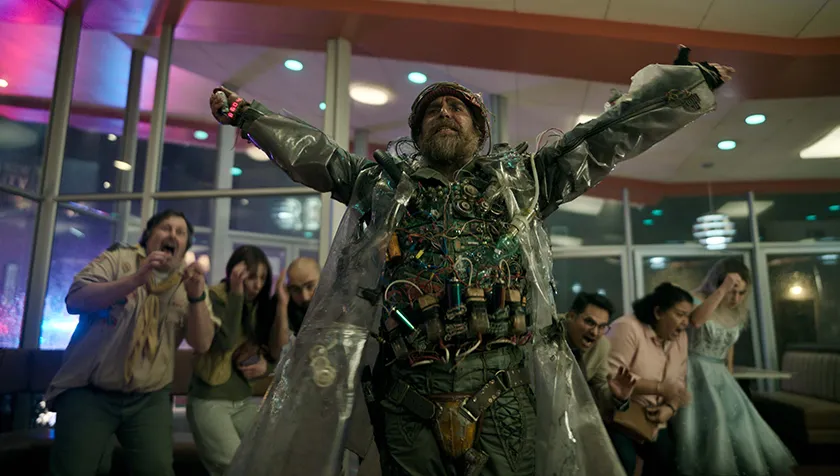
When a man who claims to be from the future (Sam Rockwell) enters Norm’s Diner, at the start of Good Luck, Have Fun, Don’t Die, telling patrons that the “future goes horribly, horribly wrong” and that it’s come to recruit them to save the world, it’d be easy to dismiss him, given the state he’s in. But 12 minutes later, after listening to a monologue he’s already recited 116 times before to this exact same audience – having failed on his mission each time – we might be willing to hear him out. Soon, he finds enough recruits for his quest, and chaos unfolds. Gore Verbinski teams up with screenwriter Matthew Robinson and a fantastic cast to bring us a movie that’s just as crazy and absurd as it is fun, thought-provoking and full of heart, and that might even surprise you when you least expect it to.
Ahead of it’s February 13 theatrical release, we interview director Gore Verbinski on this stunning movie, putting it together “by hand”, working with his cast, the theme of motherhood, and more. Read what he told us and watch a clip of this interview below!
Gore Verbinski on Good Luck, Have Fun, Don’t Die‘s Opening Monologue and Score
Hello and thank you for speaking with us! I really loved the film: I had so much fun with it, and I wasn’t expecting to cry at the end! I’d like to ask you about that amazing 12 minutes-long monologue at the start. I interviewed your DOP, James Whittaker, who was telling me that you rehearsed it a lot with Sam Rockwell. How did you approach it all?
Gore Verbinski: When I first read the script, I thought, ‘That’s the challenge’. I mean, that [was] the scary part, for me. You don’t normally start a movie with an eleven-page monologue, so it’s probably the part I worked on the hardest: breaking it down, recording it myself, and then recording it with Sam, taping out the flow of where he was going to move and who was going to sit where, and then using those taped-out marks to set him to set construction… The actual set was built in order to allow the path to happen.
I think the patrons of norms are like the audience: you’re either with us at the end of that, coming along for the ride, or you’re not. There’s that whole journey, from dismissing this guy – he looks like he crawled out of a dumpster and don’t really trust him – to the threat of those bombs and a suicide vest, [when you’re like,] ‘What is that?’ And then, this idea of the future, then all hope is lost, then he’s given up, then he’s back, and then he can pull a knife, and he’s dangerous…
Every one of those is a chapter, until we finally get to the place where he’s found his recruits, and he’s going back out on this mission. So there’s a hidden musicality, almost, to the sequence. Everything’s musical when you break it down; every scene has a hidden tempo. That one was just a challenge, and [it was] really special. I think we’re all very proud about how it came out.
You’re right; it does come across as musical! I was also so impressed by the actual music in the film. The score, and that title track in particular, are so good! Did you also write or perform part of it? [One of the tracks, “Good Luck, Have Fun, Don’t Die”, is listed as “by Gore Verbinski and Anton Verbinski” in the end credits]
G.V.: I wrote some demos that ended up in the movie, but Geoff Zanelli; he’s somebody I’ve known for a long time. We talked extensively about trying to make the beginning of the movie a little more analog, almost like Captain Beefheart or Mike Watt, or this sense that it’s made… at a house with pots and pans – Like Sam’s outfit: wires and cables. And then, slowly twisting that towards the synthesizers and the synthetic as we get closer to the antagonist of the movie. So thank you for picking up on that: it was a lot of work. We had no resources, so we just made it by hand. And yeah, there were some demos that ended up in the final, and all of that crazy business. It was just good fun.
“It’s a Hard Time for Original Material” – On a Movie that was ‘Made by Hand’ and the Theatrical Experience
You mentioned Sam’s outfit; how did it all come together?
Gore Verbinski: We went to the this electronics store in the valley called APEX: I always used to go there when I was first starting out to do a little stop motion, because they had widgets, strange Soviet-era tubes and gaskets, and just rows and rows and rows of weird, obsolete parts of electronics. So I went out there, and we knew we had to make three versions of the suit, so I was just grabbing triplicates of every part I could find. And then we laid them out on a table and started designing the vest, and the plastic, and the wires, and the cables.
I think the first prototype weighed about 150 pounds. So we worked with our Costume Department to say, ‘Okay, well, how do we…? Because Sam can’t [possibly wear something so heavy]’! By the end, I think it was about 40 pounds still, even when we reduced it. So it’s a good metaphor for the entire movie; it was just made by hand.
Yeah. I’ve read [you mention in the press notes] that you tried pitching this to so many big studios and nobody wanted it, at first: it just feels incredible to me. It’s a bit of an obvious question, but why do you think that is? Because it doesn’t feel [like something studios would want to pass on out of fear of it not doing well].
G.V.: Well, let’s prove them wrong! If people can show up in the theater, maybe we can say, ‘Hey, It’s okay.’ I think ultimately, the theatrical experience is tricky right now, because they want sequels. They’re very risk-averse, and it’s a hard time for original material. But I think, when we watch this movie with an audience, there’s something really joyous about it. Some people are laughing at one thing, other people are, like you said, crying; someone else is feeling this [other emotion], and you get this collective mix of emotions that you don’t really get when you watch a movie alone.
Gore Verbinski on Juno Temple, Haley Lu Richardson, the Theme of Motherhood, and Little Clues in Good Luck, Have Fun, Don’t Die
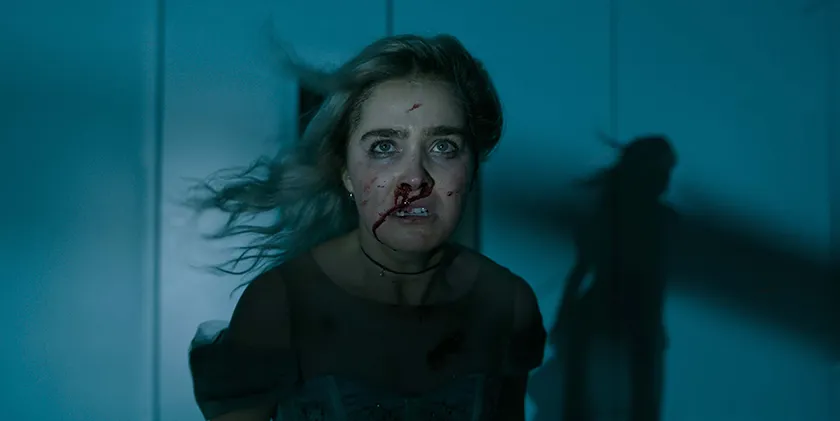
The women in this film are just incredible. I feel that Juno Temple and Haley Lu Richardson’s characters in particular are so important for the theme of motherhood in the movie, which also links to the theme of legacy: on one side, you’ve got the humans, and on the other side, there’s the AI with technology. And Juno and Haley both do such an amazing job with this material.
Gore Verbinski: Yeah. I don’t want to spoil anything for an audience, but I think you picked up on the motherhood thing. Ultimately, there’s this sense that we’re drawn towards the forbidden. As a child, you have to break away: you have to break rules; you have to climb up the counter and reach in the cookie jar, right? And I think, with Ingrid’s [Haley Lu Richardson] “illness”, for her, her disease is almost the “cure” in a way.
There’s a sense that maybe you’d think that she’s doing things for one reason, and the antagonist is trying to guilt her into that – as in, giving up her child – only to realize, that’s the mother’s job – to slap the hand away from the cookie jar. Nobody wants to do it, but you’ve got to slap the hand away from the cookie jar. There are temptations out there, and I think Ingrid finding that is pure. I’m glad [these themes] spoke to you: they’re definitely there.
As for Juno, in the same way, it’s very important that [her character Susan] is behaving honestly and as a human in an increasingly inhuman world. That’s the Franz Kafka of that, right? What makes it painful is that Juno’s playing her real. She’s playing [Susan as someone who’s] very bewildered by the possibility of getting her child back.
She’s fantastic.
G.V.: Yeah. It was very important to have three – with Zazie Beets [who plays Janet] – amazing actors in the movie, in terms of representing the women.
Our time is nearly up but I really want to ask you about these posters that appear in the movie from time to time, with some writing that reads “The New Reality,” in a way that feels intentional. What can you tell us about those?
G.V.: Oh yeah! You need to watch it many times. There’s that, with the triangle of the Martini glass [on the poster], and there are triangles and numerology [in the film as a whole]. There are a lot of numbers in the movie: a lot of gaming-coded messages. I don’t want to tell you where they all are, but there are many little clues to a larger mosaic. It’s nice to see you leaning into that.
Thank you so much for your time, and good luck with everything!
G.V.: Don’t die! Have fun!
[both laugh]
This interview was edited for length and clarity.
Good Luck, Have Fun, Don’t Die will be released in US theatres on February 13, 2026 and in UK & Irish cinemas on February 20. The film will also be screened at the Berlin Film Festival in February. Read our review of Good Luck, Have Fun, Don’t Die!