
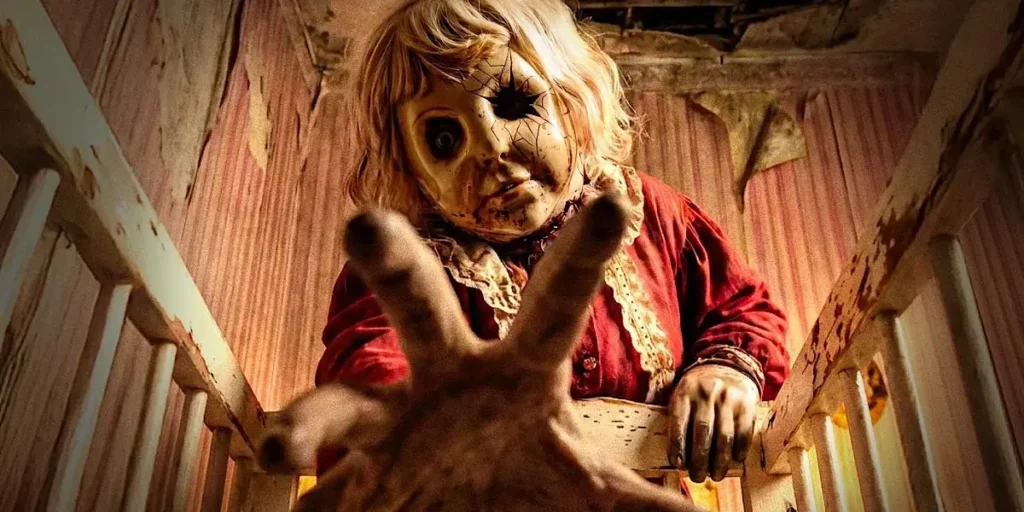
Dolly isn’t the most original slasher, but it features a memorable villain and pushes its graphic violence to nauseating extremes.
Director/Co-Writer/Producer: Rod Blackhurst
Genre: Horror, Slasher, Monster Horror
Run Time: 82′
Release Date: March 6, 2026
Where to Watch: In U.S. theaters, in U.K. and Irish cinemas, and globally in theatres
Already in the opening minutes of Dolly, we see a monstrous figure with a porcelain doll mask stroking a headless corpse in a room so rancid you can smell it through the screen. The scene gives us a good idea of the nauseating bloodbath that’s about to unfold. The movie officially begins with Chase (Sean William Scott, of The Righteous Gemstones) dropping off his daughter at her aunt’s house before heading out to a romantic getaway with his girlfriend, Macy (Fabianne Therese), whom he’s planning to propose to.
Unbeknownst to him, Macy suspects Chase’s true intentions and is having serious doubts about the prospects of becoming a stepmom.
These early scenes struck me as if director Rod Blackhurst felt obligated to add an interlude to contextualize the characters and add a human touch to the story. It could’ve worked if only there had been any chemistry between the lead couple, but the result is a bland compilation of unnatural affections. To make things worse, every line delivery made me squirm in my seat: I actually laughed out loud when Scott’s character stumbled upon a bunch of creepy dolls assembled in the woods and referred to it as “Someone’s art project, maybe?” with a serious look on his face.
Eventually, Macy and Chase clash with the monstrous doll-like figure of the beginning in the woods: the titular Dolly, a towering, mute woman dressed in a red outfit eerily reminiscent of Santa Claus. From here on, the movie shifts its focus to Macy, who wakes up dressed in doll clothes in a tiny cradle surrounded by the same creepy dolls she saw in the woods. Soon enough, Dolly shows up to care for her “baby.” It gets as weird as it can, complete with pacifiers, a disgusting baby bottle, and a breastfeeding scene that will take me a while to forget. Ironically, I had expected the film to handle the parallel between Dolly’s creepy maternal instincts and Macy’s hesitation to embrace her role as a stepmother with much greater care. Instead, the motif drifts shyly throughout the movie without ever landing with the force I had anticipated.
As soon as Dolly settles as a claustrophobic survival horror, the film’s main conflict essentially revolves around how far Macy is willing to “play along” with Dolly’s wicked maternity game. There’s a cruel sense of humor running through the ordeal, enhanced by Macy’s own incredulity: there she is dressed in children’s clothes with this possibly murderous woman caring for her as if she were two years old. What do you even do in a situation like that? The concept is something we saw not so long ago in Zach Cregger’s Barbarian, but where that film was fueled by sharp social commentary, Dolly is interested in pushing the concept to its goriest extreme with the confidence of a true low-budget film.
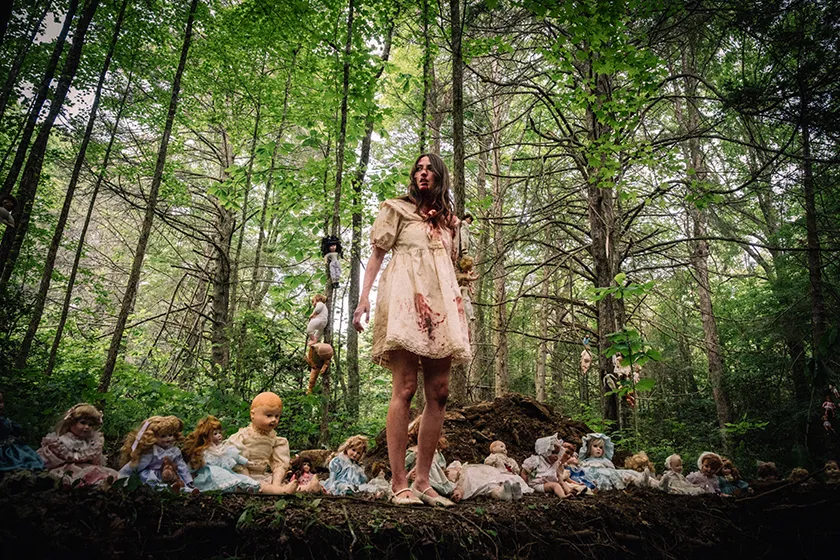
Dolly reminded me of Ti West’s The House of the Devil in the way it successfully emulates distinctive 16mm film textures from the 1970s. It’s the first of many (exhaustive) nods to The Texas Chainsaw Massacre, but it is one that goes easy on the eyes. The cinematography contributes to a grainy “video nasty” aesthetic that looks odd early on but eventually matches the sense of suspension of time evoked by porcelain dolls and the creepiness of Dolly herself, who appears to belong to a primitive past, like a villain who came out straight from a Grimm brothers’ tale.
There are many great things about our antagonist, starting with how little we know about her. The lack of context fuels an escalating sense of dread, punctuated by the creepy dolls scattered around the house and Dolly’s own unpredictable behavior. The fact that she is not a consistently terrifying presence aggravates her oppressiveness. Dolly can be unrelentingly violent in one moment and surprisingly tender towards Macy in another. The protagonist is at the mercy of these wavering moods, and so are we, the spectators.
The film carries a unique rhythm that sets it apart from most recent slashers. The sudden moments of silence and stillness are crucial to amplifying Dolly’s violent eruptions, and I’m not talking about that signature quietness that comes right before a predictable scare. The movie repeatedly lunges forward and then grinds to a halt, generating a creative disorienting effect.
Blackhurst has an eye for brutality that reaches unsettling extremes of graphic violence. It reminded me of Terrifier in how its practical effects aren’t necessarily realistic but completely attuned to the cruelty charged at the scene, reaching an optimal point of revulsion. Some of the gory scenes linger for way too long, forcing you to sit with the horror in shock, and it works in a weirdly amusing way.
Dolly achieves its full potential halfway through the movie, but as it heads towards the third act the cracks start to show. Some of the clichés feel very heavy-handed, such as the urgent, all-knowing voice that instructs Macy like an invisible mentor in a video game. In addition, it’s often painful how much Dolly wants to be the next Texas Chainsaw Massacre: it has the appetite for it, but no ambition.
A bigger problem, however, is how Dolly seems clearly designed to be a short film (the movie is inspired by a 4-minute short film that Blackhurst directed in 2022). The strongest short films concentrate their energy on a single explosive sequence that emphasizes their central idea. Here, that moment arrives midway through, as Macy desperately tries to find a way out of the house. I am glad Dolly doesn’t step into “origin story” territory, because the fact that we know so little about our villain amplifies her terrifying force in every way. However, this comes at the cost of revealing how thin the narrative is: there simply isn’t enough fuel to sustain its 82-minute runtime. To fill in the gaps, Dolly resorts to a succession of twists and turns that distract the viewer from the bold, entertaining direction it had seemed to embrace at the midpoint.
Suddenly, all that’s left are endless chase scenes and hollow character interactions that lack any real intensity or urgency. Even the violence seems uninspired in the third act, no longer carrying any weight. At the end of the day, Dolly will appeal to fans of gore and old-school practical effects, and Max Lindsey deserves immense praise for the oppressive screen presence she brings to the titular role. However, once the credits begin to roll, very little of the movie lingers with any lasting impact.
Dolly (2026): Movie Plot & Recap
Synopsis:
A young couple’s romantic getaway takes a sinister turn when a towering, doll-masked monstrous figure ambushes them in the woods.
Pros:
- Stomach churning practical effects
- A compelling and unpredictable villain
- A solid grasp of tension and suspense
Cons:
- Weak performances
- Inconsistent writing
- Wears out its welcome in the third act
Dolly will be released in U.S. theaters, in U.K. and Irish cinemas, and globally in theatres on March 6, 2026.