
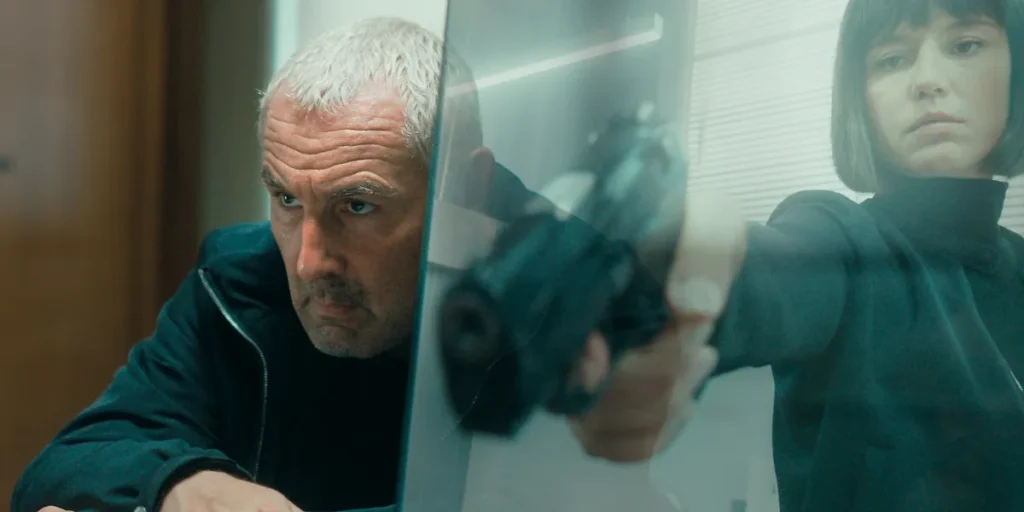
While Dog 51 contains stunning cinematography and solid performances, its grab-bag of underdeveloped ideas sinks its ambitious proposition.
Director: Cédric Jimenez
Original Title: Chien 51
Genre: Crime, Thriller, Sci-Fi, Dystopian
Run Time: 100′
Canadian Release: January 2, 2026 in theaters in Québec
U.S. Release: TBA
U.K. Release: TBA
The premise of Cédric Jimenez’s Dog 51, which was the closing film of last year’s Venice Film Festival and is now playing in Québec theatres, seems to be highly attuned to our AI-obsessed times, even more so than when Laurent Gaudé first wrote the novel on which the movie is based. With a society that’s desperately trying to convince us that AI is the future and isn’t “slop”, here’s another cautionary tale on the dangers of such a device, now employed to help police officers solve complicated crimes.
The device is named “ALMA,” and the crime at the center of the film involves the killing of its creator, Georges Kessel (Thomas Bangalter – yes, yes, of Daft Punk fame), set at a point in the future where Paris has become a totalitarian state and has divided its class system into three “zones”. All signs indicate, through the AI algorithm, that Jon Mafram (Louis Garrel, of Couture), the leader of Breakwalls, a rebel group which opposes the zone system Paris is under and has been vehemently anti-AI ever since the Ministry of Interior has adopted it with open arms.
But it seems more complicated than that, as police officers Zem Brecht (Gilles Lellouche, of Daaaaaali!) and Salia Malberg (Adèle Exarchopoulos, of The Animal Kingdom) will uncover once they are tasked to apprehend Mafram and realize that he might be innocent, and the AI software might be lying to them. A tale as old as time, though no one can fault Jimenez and co-writer Olivier Demangel forto treading in these waters, as Artificial Intelligence has become more prevalent in our everyday lives. Even people who do not want to use it in any way are likely confronted by it at work, as corporate companies are openly embracing softwares like ChatGPT with open arms. Any reminder that AI will suck the soul out of humanity and could be used for malevolent means is stark, but it still doesn’t help Dog 51 from feeling incredibly dated and, worse yet, extremely bloated.
So many ideas are thrown in this 100-minute feature, and none of them are actively explored. AI is, of course, the subject of the hour, but Jimenez and Demangel take far too many detours to discuss themes related to police brutality, fascistic oppression, political and institutional corruption, drug addiction, sexual abuse, the class system, and even more. It’s almost as if the Novembre filmmaker had taken everything he found interesting about Orwellian science-fiction and put it inside ChatGPT so that it could regurgitate this screenplay. And it’s a shame, because the ideas presented in Dog 51 are interesting enough, and the world, visualized through Laurent Tangy’s eyes, full of vivid, textured colors and a staggering use of depth of field, feels lived-in.
I immediately bought into what was shown to me on screen, from the AI telling Zem how much sleep he got (read: very little) to a society where clones can be fabricated, provided that someone has the money for them. You don’t need to spend much time in the world on screen to understand its machinations. The references are obvious (when the AI scans the environment, it immediately recalls the Odradek in Hideo Kojima’s Death Stranding), but never in a way that feels as if Jimenez was copying someone else.
Yet, what’s on screen is painfully dull, because none of what is said feels urgent. The dialogues are surprisingly basic and unengaging, while the film moves from one theme to the next, without ever focusing on one element of its screenplay, a grab-bag of great ideas that sadly go nowhere. It starts out as an effective police procedural, but it complicates itself further when it has no idea what it wants to be and fumbles the bag so hard in its concluding section that one even wonders whether there were any positive elements to be found in this dystopian sci-fi thriller.
Without spoiling anything, the twists thrown at the audience are both obvious and laughable, and the climax is manipulative to the point where it’s impossible to believe in the character relationships drawn on screen. At least Lellouche and Exarchopoulos have rock-solid chemistry together, which might have benefited from their time working on L’Amour Ouf (also shot by Tangy and produced by Hugo Sélignac, who collaborated with Jimenez on Dog 51). The supporting cast of French A-listers is also well-mounted, though one can’t help but feel that actors such as Garrel, Romain Duris, and Valeria Bruni Tedeschi are wasted in one-note attribute roles when their talents are much greater than the characters they portray in the film.
One leaves Dog 51 with the crushing disappointment that it could’ve been something much greater than what Jimenez ultimately puts on screen, though the final needle-drop (which must have been expensive, by the way) does give a bit of humanity in a film that’s otherwise shockingly devoid of it. And in an era when human creativity is in jeopardy, movies that feel as if an AI algorithm made them should not be part of our cultural ecosystem.
Dog 51 (Chien 51): Movie Plot & Recap
Synopsis:
In a totalitarian future where Paris is divided into three class systems, an AI known as ALMA, which helps the police in solving crimes, may no longer be trusted after the killing of its creator. Two police officers are tasked to find the perpetrator of the crime, but the case is more complicated than it seems.
Pros:
- The movie’s cinematography is striking and frequently gorgeous.
- Adèle Exarchopoulos and Gilles Lellouche have rock-solid chemistry as the two cops on the hunt for the murderer.
- The film’s well-mounted cast of French A-listers add some texture to this otherwise dull sci-fi actioner.
Cons:
- The action is haphazardly choreographed and incomprehensibly edited.
- While the movie contains numerous interesting themes, writer/director Cédric Jimenez and co-writer Olivier Demangel don’t develop any of them to their fullest extent.
- The multiple reveals near the end of the film are laughable, while the concluding section toys with emotions in cruelly manipulative ways.
Dog 51 (Chien 51) is now available to watch in theaters in Québec.