
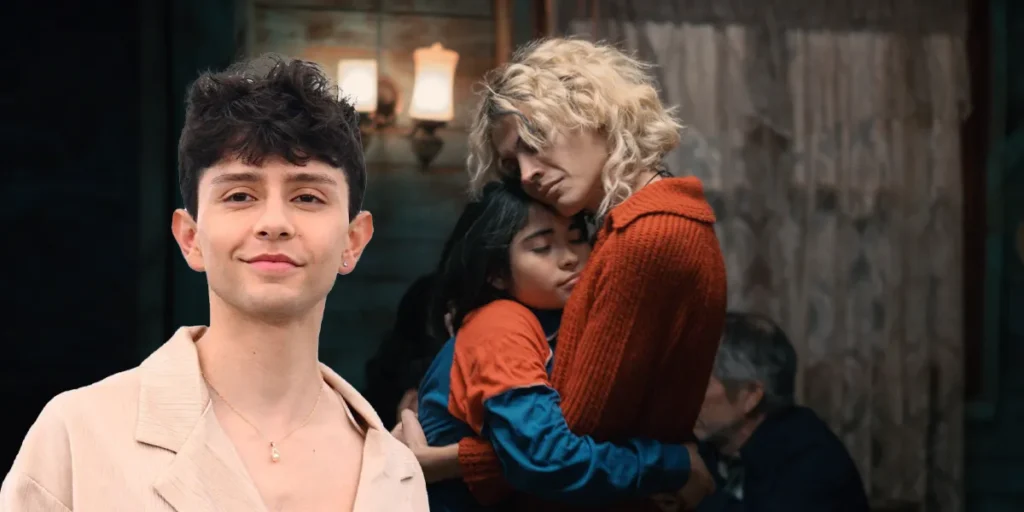
We interview Diego Céspedes, writer-director of The Mysterious Gaze of the Flamingo, about his debut film, Cannes and the importance of political filmmaking.
It’s not every day you come across a young filmmaker whose vision is so clear, it shocks you that they only have a handful of titles in their filmography. After watching Diego Céspedes’ The Mysterious Gaze of the Flamingo, you will be surprised to learn it’s his first full-length feature film. He effortlessly blends genre, tone and mise en scène in ways you’d never expect to turn in a truly captivating and wildly inventive directorial debut.
The Mysterious Gaze of the Flamingo takes place in a remote Chilean mining town in the year 1982. The story is told through the eyes of 11-year-old Lidia (Tamara Cortés), who is being raised in a queer, blended family that operates a rundown cabaret and serves as the only occupants of this small town outside of its miners. After being abandoned at birth, Lidia was taken in by Flamingo (Matías Catalá), who is the fiery heartbeat of the family, but is burdened by a mysterious illness known only as “the plague” to Lidia.
Lidia struggles to understand the miners’ hatred towards her family and why they blame the mysterious plague that is spreading through the town solely on them. Given her age, she has no real understanding of what the plague is, nor how it is transmitted. The most common answer she is given is that the plague passes through one sick person’s gaze when they stare at someone else long enough. When events take a tragic turn, Lidia sets out to find the answers to the questions that have left her mind racing and seek vengeance.
We sat down for an interview with writer and director Diego Céspedes after the U.S. debut of his movie, which took home the top prize in the Un Certain Regard section at Cannes 2025. Céspedes spoke about the process of building the film’s nuanced world, working with first-time actors, winning big at Cannes and how the struggles of filmmaking today only motivate him further to continue creating.
Creating the World of The Mysterious Gaze of the Flamingo
What inspired the story behind The Mysterious Gaze of the Flamingo?
Diego Céspedes: Writers or directors often say things like, “I was crossing the street, and then I had this amazing idea and thought, this is the movie”, but that wasn’t the case for me. There were a lot of sources of inspiration: it’s more like a painting that you work on for a long time, and from which you gather a lot of inspiration.
For example, talking about AIDS comes from a familiar story, because my family is from the suburbs in Santiago: they had a hair salon where they worked with gay men, and all of them died of AIDS. When I was growing up, I heard these terrible stories about this mysterious disease. I was very scared, because I am gay, and I thought there was a danger there, but I didn’t actually know what it was because there were, and still are now, a lot of prejudices. But that became my interest in this world.
Other things came from my own family too. A lot of characters and their relationships were inspired by my real family, whom I just put in a fictional context. So it was very fun and emotional to write them into the movie, and to see parts of them in the film.
When you’ve presented the film to your family, did they feel like they saw or recognized parts of themselves within it?
D.C.: Yes, totally. They watched it not too long ago, at one of the biggest festivals in Chile: there was a huge crowd, and they sat in the middle of it during the screening. Afterwards, they asked me if I got inspired by them for some parts of the story. It was very cool to have that experience, watching people react to the film with both the audience and my family.
I found it so impactful that you had the perspective of the film through Lidia’s eyes. As someone who witnessed and tried to understand the AIDS epidemic in their childhood, do you feel like that experience informed the film being told from her perspective in particular?
D.C.: It wasn’t a direct decision. For me, telling a story through the eyes of a child is to tell it with a certain kind of pureness. I thought it’d be good to present this story from someone who sees things differently from the rest of society. The world that we’re living in has built a lot of stigmas surrounding people in this community, but Lidia doesn’t see any of that. Lidia just sees people she loves, and she doesn’t have questions about their gender or identity.
As human beings, we aren’t born with prejudices; those horrible things are created. When you look through the eyes of a kid, you can just follow the emotions and follow something very natural in their hearts.
How The Mysterious Gaze of the Flamingo plays with genre
I think the film being told from a child’s perspective also allows you to include its more fantastical elements in a way that doesn’t completely uproot the story, but rather gives it a richer depth.
Diego Céspedes: The magical element was a natural thing when I decided to tell the story through Lidia. I think the magical part of the film shows the confusion she has about how this all works. I also think the world becomes a bit supernatural when you are a young girl trying to figure out what the world is really about, which I really liked exploring.
I’ve seen you call the film a coming-of-age story, but after watching the movie, it feels hard to pin down to one genre. You mix this coming-of-age story with Western elements and romantic exploration in such an interesting way. How were you able to blend all of these genres into one story in such a harmonious way?
D.C.: In my short films, I was more academic in following the rules of cinema. I realized with this movie that cinema doesn’t have such strict rules; you can play with your ideas and be free in exploring them. That was one of the most important things I learned from this movie. I felt like I was able to use different genres to show the different spectrum of emotions that I wanted portrayed. It was really natural to play with all of these genres because real life feels like that, too. In life, you can have a lot of humor, a lot of sadness, you can experience a lot of violence, and experience a lot of love. You can go through this journey, and you can change the genre of your life at any time. Because of that, it felt very natural to switch genres throughout the story because it’s the way I see life personally.

You have a wide spectrum of relationships in the film between Mama Boa and Clemente, Flamingo and Yovani, and Lidia and Julio. Can you speak about crafting those very different and very distinct relationships within the film and why you felt it was important to show these different forms of connection?
D.C.: There are three different relationships, but they all explore love, how we love each other, and also how it works when you love in a healthy way versus loving with a lot of fear.
The relationship between Boa and Clemente is one that changes, because they were able to look each other in the eye and see one another. He can see the truth of who she is in her heart, which is funny and protective and loving, versus the prejudices he initially believed about her.
Flamingo and Yovani’s relationship, on the other hand, is motivated by fear. I think Yovani loves Flamingo, but he’s so afraid of himself that he ends up doing a horrible thing because he cannot see a life beyond all his fear. He doesn’t know how to handle it. Then you have the relationship between Lidia and Julio, where they don’t even know what they are, but they just feel something very natural.
But the relationship I thought was the most important to show was the one in this chosen family at the center of the film. They are looking for love and a sense of community, like all of us are, and find it through each other. I think it’s the most beautiful relationship because Boa, Flamingo and Lidia are not related by blood, but they build a family as strong as any other. It’s maybe even more powerful because of the purpose they give each other; they love each other because their instincts tell them they need to protect one another.
Mythology and Religion in The Mysterious Gaze of the Flamingo
How did you craft the mythology of the film, specifically the symbolism of the gaze and how it was vilified in the story?
Diego Céspedes: As a person, I’m really interested in eye contact and the gaze because it’s such an important thing between human beings. We are losing too much humanity during these dark times we are going through. We’re always on our phones, and it distracts us all from realizing there are human beings right in front of us, having feelings we connect over.
To see each other is a basic thing, and with this concept, I wanted to question how powerful the gaze really is. Behind that concept really is the entire film; it’s questioning how important in dark times it really is to look each other in the eye. The real problem in the film is not the disease, it’s the fear of the disease and the prejudices we create out of fear.
We need to bring back that kind of connection between human beings; it’s the only way to eliminate that fear.
The film is really interesting in that it deals a lot with spirituality, but never directly addresses religion. Was that a conscious choice and, if so, how did you make it?
D.C.: It’s not too present because I think religion can be a problem, but it’s not the biggest problem here. Fear is the problem. Fear pushes the bad part of religion and can alter the way you make decisions. Fear is the real enemy.
How Diego Céspedes Found the Perfect Cast to Tell His Story
It was shocking to learn that your film predominantly comprises first-time actors. What was the casting process like, and how were you able to foster a sense of community among the cast that really enriched the fabric of your story?
Diego Céspedes: The cast is the thing that I love the most about my film, because I love them so much in their real life. The casting process was us trying to recreate a family, and we’ve been connected like one from the start of rehearsals. We had a lot of problems with the technical parts of production, but with the cast, it was always amazing because it felt just like working with family.
It was a very long process because we had a lot of characters, and I knew I wanted to work with brand new faces. I didn’t envision the film with any actors we had already seen on screen in Chile, so we went to girls in the community to discuss the film and did casting online too.
I think there’s also a lot of talent that is hidden in this industry. I had this amazing cast, but you have to work hard to put that together, and I think it’s not a job everyone wants to do. It’s easier to find famous people to put into your film, but what’s more difficult, more political and motivates me more is putting new faces in film. Seeing this cast in Cannes, seeing them on the red carpet was amazing; it was like a dream. To be able to give a platform on that scale to people who have a lot to say feels incredible.
I wanted to ask about Matías Catalán, who plays Flamingo. They give one of the most mesmerizing performances I’ve seen this year. At what point did you find them in the casting of the film?
D.C.: It was a very complicated character to find because we asked a lot of his character. In this family, they are not specifically all transgender women; these characters are all fluid. They created this family because they didn’t have any other place; it’s a place for people who feel different.
With Flamingo, it was important that we built this character that really read as gender fluid if we had to put a label on them. Matías has the same kind of fluidity and is able to go deep to play with his soul in his performance. I saw his ability to easily access this in his heart and soul in his eyes. He can work with a spectrum of emotions that is bigger than others because he can easily go between more masculine or feminine energy, depending on what the scene needs. He is really complex.
How did you find your Lidia?
D.C.: With Lidia, I wrote her thinking of my own sisters. I wanted someone who was shy but had a mature mind, but was also very sarcastic and funny. Most importantly for her, the girl we cast needed not to have any prejudices. With some children, you can see they have already been very exposed to the world or influenced by their parents, but there are also children who see the world and still keep their hearts open. Tamara (Cortes) was pure, like that. She never had any bad questions for the girls in the cast playing her family; she just saw people, which was a very important thing in the process of her casting.
How Céspedes’ Love for Filmmaking got his Debut Film to Cannes
This film was a huge success at Cannes. What was the process of getting your project there and what was your experience at the festival like?
Diego Céspedes: Cannes was amazing. I love this festival; I’ve shown all my shorts there. I began to love it even more because while there is a part of this industry that is really corrupt and moved by money, I think there’s a real soul at Cannes.
There are so many movies there that allow people to find new voices. I don’t have any connection with this industry, so when they selected me for my films, I felt very grateful to them. There’s something real still happening there and I saw it with my own eyes.

When I went there first with my shorts, the Un Certain Regard competition was always the one in particular I would want to watch, because it was the place where the new voices were. There, of course, were the bigger, buzzy films, but here is where they had new kinds of movies. When I was selected, I couldn’t believe it because it was my dream section to be in. When we won, I thought I was so happy I could die. I absolutely couldn’t believe that.
After hearing about the pure passion that drives your work and what an amazing journey you’ve had in your career, can you walk me back to what got you interested in filmmaking in the first place?
D.C.: My family is not connected to anything in the artistic world. When I found cinema, it was supernatural to me. I started to watch a lot of films because I was so fascinated by them. I first thought I would be a cinematographer because I loved the images on the screen, but then I started to write, and I discovered that I really loved that.
It felt like something very natural. It’s a tool I know how to put my emotions into and a very honest passion for me. Now, it’s getting more political, which is giving me more motivation because I’m not just talking about me in my writing and what I feel, but I’m talking about how I see society and what I think can help it.
If there’s one message you’d want audiences to take away from your film, what would you hope it’d be?
D.C.: I want people to recognize and remember that there were people before us who went through dark times, too, and we must learn about them. While this story is fiction, we used a lot of history to inform it. The history of the people who went through this will teach us a lot about what we’re going through today. We could also learn what parts of their history we should apply to our modern times to be political in a way that can bring about positive change. I think this is a time where we need to be political and feeling the connection and emotion in this film can help drive that.
This interview was edited for length and clarity.
The Mysterious Gaze of the Flamingo, Chile’s 2026 Oscar entry for Best International Feature, is currently being screened in select U.S. theaters. Click here for the full list of screenings.
Header credits: Diego Céspedes attends the photocall for the film at the 78th annual Cannes Film Festival on May 16, 2025 (Stephane Cardinale – Corbis via Getty Images) / A still from The Mysterious Gaze Of The Flamingo (Altered Innocence)