
Daniel J. Phillips’ Diabolic draws from real FLDS practices to craft a religious horror film that’s as disturbing for what it implies as for what it shows.
Director: Daniel J. Phillips
Genre: Horror
Run Time: 95′
U.S. Release: February 20, 2026
U.K. Release: TBA
Where to Watch: In select theaters and on demand
On paper, Diabolic is another vengeful-spirit-of-a-cursed-witch formula film. Only this time the witch wears prairie dresses. But hold onto that yawn, because Diabolic (seriously, stop yawning) is much better than you think, and has some surprisingly potent scares that had me wishing more than once I’d watched it in the daytime.
It’s simple enough that it doesn’t need much in the way of locations, and it’s well acted with a dandy mix of CGI and practical effects. There are several whopper scares, and director Daniel J. Phillips has a confident command of the mood, staging some of the best creeping dread sequences in recent memory.
Religious horror has been feeding the genre for over a century, mining the darkest corners of faith and ritual for something to keep you up at night. Filmmakers have long understood that the line between salvation and damnation can be terrifyingly thin. But as documentaries and investigative reports keep pulling back the curtain on what actually happens behind the closed doors of fundamentalist groups, it’s getting harder to dismiss these stories as fiction. Phillips’ Diabolic plants itself firmly in that uncomfortable territory, drawing from actual Fundamentalist Latter Day Saints practices to craft a supernatural chiller that disturbs as much for what it implies as for what it shows. For a good Lutheran boy like me, raised on coffee hour, hot dish, and church basement cookies, the rituals depicted here are shocking enough on their own.
When Phillips cranks those rituals to horror-movie extremes, the result is genuinely unnerving. Elise (Elizabeth Cullen, Elvis) has been suffering from mysterious blackouts and episodes of self-harm ever since a traumatic “baptism for the dead” ceremony went sideways a decade ago. Desperate for healing and answers, she returns to the remote, now-abandoned FLDS compound where she was raised, bringing along her supportive boyfriend Adam (John Kim, The Last Thing He Told Me) and her best friend Gwen (Mia Challis) for moral support.
They’re met by Hyrum (Robin Goldsworthy) and Alma (Genevieve Mooy), two former members who promise to help Elise confront her trauma through another ritual. What begins as an attempt at spiritual healing spirals into a waking nightmare when the ceremony unleashes the vengeful spirit of Larue, a cursed witch who’s been slowly crushing Elise for years. Now free and furious, Larue intends to claim Elise’s body as a vessel for her power and exact revenge on everyone who wronged her in life. Phillips, who co-wrote the script with Mike Harding and Ticia Madsen, clearly did his homework.
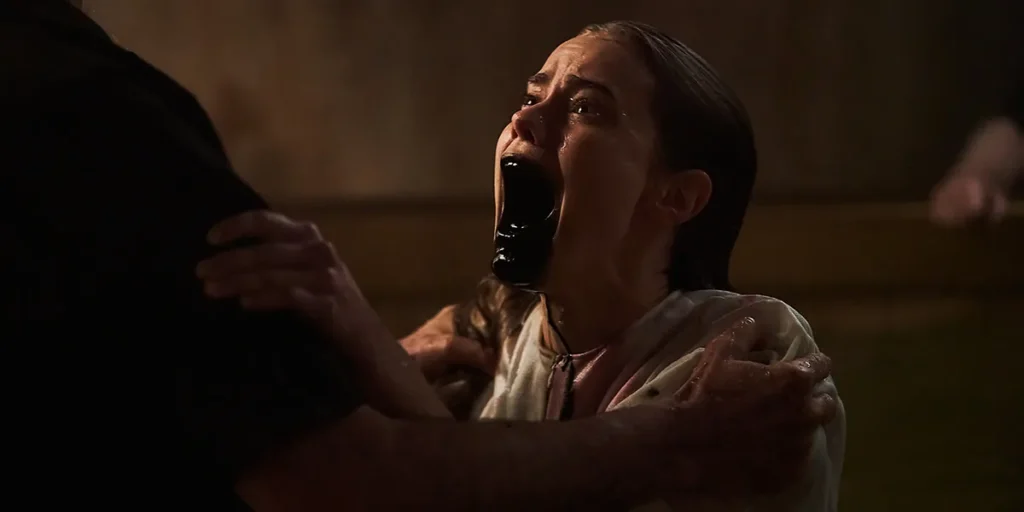
The “baptism for the dead” is a real FLDS practice, a ritual meant to grant salvation to the deceased by proxy, and the film mines that foundation for maximum dread. The sequence where something is extracted from Elise is skin-crawling in the best way: a tangled, hairball-like mass slowly regurgitated and yanked free while she convulses and gasps. It’s visceral, it’s uncomfortable, and it’s precisely the kind of image that refuses to leave your head after the credits roll. Phillips wisely holds back on the big supernatural showpieces until the final stretch, letting tension build through suggestion and shadow. When the horror finally erupts in the last fifteen minutes, it earns every bit of its impact.
For the first half hour, I’ll admit, Diabolic feels frustratingly familiar. Another story about a traumatized protagonist returning to the site of childhood pain to confront buried demons, a setup I’ve seen enough times I could probably write the dialogue in my sleep. But once that groundwork is laid, Phillips subverts expectations with a radical shift in tone and intensity that caught me off guard. The film becomes something altogether more ambitious, using horror as a lens to examine how upbringing within authoritarian religious structures can warp identity and inflict damage that doesn’t heal cleanly. It’s not subtle about this, but it doesn’t need to be. Phillips never loses sight of the human cost at the center of all the supernatural chaos.
Cullen delivers what I’d call a breakout performance, treating Elise as a puzzle she’s solving alongside the audience in real time. There’s no winking self-awareness here, no playing to the genre’s cheaper instincts. Cullen feels every fear, every revelation, every trauma as it happens, and by the third act, when all hell breaks loose, she unleashes a ferocity that cements her as a actress worth following closely. Kim and Challis provide decent support, and their chemistry as trio gives the film somewhat of an emotional anchor that makes the eventual terror hit harder. You actually have some investment in these people before the screaming starts, which is half the battle in horror.

Goldsworthy and Mooy bring a welcome air of mystery as Hyrum and Alma. It’s never quite clear how much they can be trusted, or whether Hyrum’s childhood affection for Elise is clouding his judgment. Mooy attempts a Midwestern “oooo yaaaa” dialect that doesn’t always convince, but it adds to her character’s vaguely ominous presence in a way that works for the film. Most of the cast is Australian, and not all of them hide it well. Mooy slips more often but uses her adopted dialect as a kind of mask to cover her tracks, and it works in a bizarre way, adding to the character’s untrustworthiness.
The real standout of the ensemble, though, is Seraphine Harley as Larue. Whether emerging slowly from the shadows or jolting into frame with violent speed, Harley and Phillips create some genuinely excellent scares. The kind that makes you grip the armrest and then feel silly about it afterward. Her physicality is unnerving in a way that’s hard to articulate, and the practical effects team at Formation Effects deserve real credit for making her appearances feel tangible and present rather than relying on cheap CGI shortcuts. You feel Larue in the room. That matters.
Cinematographer Michael Tessari and Phillips find the right balance between showing and concealing, which sounds simple but is something an alarming number of horror films get wrong. Unlike so many dark genre entries that become indecipherable murk, Diabolic is carefully lit to reveal what we need to see while leaving the scariest bits to our imaginations. As any good horror fan knows, what you picture will always be worse than what’s on screen. Editor Sean Lahiff understands pacing, knowing instinctively when to let shots breathe and when to cut for maximum punch. Anita Seiler’s costumes are mostly utilitarian for the leads, but the FLDS ensemble, with its prairie dresses and severe hairstyles, is pitch-perfect.
Will Spartalis’ score wraps the film in a soundscape that shifts seamlessly between mounting dread and the unresolved ache of trauma. It’s the kind of music that makes you realize you’ve been clenching your jaw. The third act, however, occasionally chugs along with a stop-and-start rhythm that disrupts the momentum Phillips worked so hard to build. There are moments where you can feel the film catching its breath when it should be sprinting.
Thankfully, it recovers for a flourish of a finale that’s as emotionally satisfying as it is terrifying, tying its themes of religious trauma and reclaimed agency together in a way that feels fully thought out rather than tacked on. Diabolic is considerably better than its generic title and bland poster art suggest. Once again, proof that you simply cannot judge a film by its marketing materials. In a cultural moment where religious division feels sharper than ever, and stories of abuse within fundamentalist communities continue to surface, Phillips has crafted a horror film that feels uncomfortably relevant. It’s a strong, confident piece of work, rich enough in its ideas to stick with you. It marks Phillips as a filmmaker worth watching closely, and whatever he does next, I’m in.
Diabolic (2026): Movie Plot & Recap
Synopsis:
A woman’s hope for a miracle cure turns into a nightmare when she confronts the vengeful spirit of a cursed witch, determined to claim her as a vessel for her evil power.
Pros:
- Elizabeth Cullen’s breakout performance
- Visceral practical effects and genuinely creepy scares
- Strong cinematography that balances light and shadow
- Thoughtful exploration of religious trauma
Cons:
- The first act feels overly familiar
- The third act’s pacing occasionally stutters
- Generic marketing doesn’t reflect the film’s quality
Diabolic will be released in select U.S. theaters and on demand on February 20, 2026.