
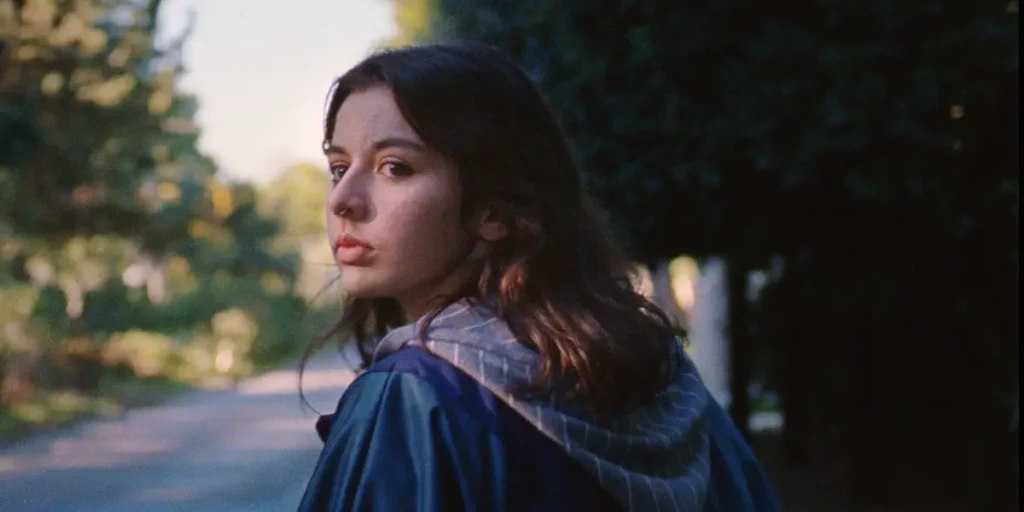
Jacqueline Lentzou’s A Day in the Life of Jo: Chapter Phaedra is a mesmerising, otherworldly film with a masterstroke of a climax.
Director: Jacqueline Lentzou
Original title: Mia mera sti zoi tis Tzo: Kefalaio Faidra
Genre: Drama
Run Time: 90′
BFI London Film Festival Screening: October 17, 2026
U.S. Release Date: TBA
U.K. Release Date: TBA
Winner of the Orizzonti Award for Best Director at this year’s Venice Film Festival, A Day in the Life of Jo: Chapter Phaedra is the sophomore feature from Greek director Jacqueline Lentzou. Her 2021 debut, Moon, 66 Questions, featured a woman confronting the ill health of her father. And with A Day in the Life of Jo, she delves into the unconscious – and the experimental – for a singular vision of life, death and an afterlife.
It can be quite abstract, particularly when it comes to an ending that won’t be on everyone’s wavelength. However, it is a mesmerising, otherworldly film full of mystery and visually spectacular filmmaking.
“Send her the dream.” That opening line, presented as an unspoken subtitle, kickstarts a silent conversation between different parts of the cosmos. These spirits are dictating the dreams of Jo (Evita Andriopoulou), a 15-year-old living in suburban Athens, subliminally showing her (and the audience) four objects that will become key to her day. They are a shell, chimes, a winged hat – and a bullet casing. Crucially, Jo will not remember these symbols, let alone grasp their significance once she wakes up. And so, the film goes about showing her day.
First, Jo is late for her school bus. Then she argues with her mother (Eleni Vergeti, of Killer Heat) about being driven to school. So far, so normal for a teenager. Later, though, during a music class at school, she meets Phaedra (Anastasia Gouliamou). She is a reserved student with a heavenly voice that brings Jo to tears. When the two meet again in the library, they connect over singing, music and absent fathers (Phaedra’s father has passed away; Jo’s divorced her mother, which is why she says he’s “symbolically” dead) before agreeing to meet after school. But Jo is unaware that other forces are at play and guiding her eventual fate.
Inspired by a real-life tragedy from 2008 (but crucially not about it in any obvious way), Lentzou’s film starts as this real, undramatic depiction of a teenager’s ordinary modern life. We see that Jo’s day is full of tentative makings of friendship, familial arguments and time spent in front of her computer. This seems to be setting up a character trying to find herself, like any normal coming-of-age story. Helping is an expressive, naturalistic performance from newcomer Andriopoulou, allowing us to sense feelings of melancholy and sensitivity in Jo. Vergeti’s turn as Jo’s mother is also worth noting. She is a dance teacher who doesn’t mince words with her daughter or her students, but she isn’t one-dimensional. She’s a fan of Roxy Music’s ‘Flesh and Blood,’ and she does seemingly want to find some connection with Jo.
Despite early impressions, any notions of conventionality here are as fleeting as the moon (and Jo’s father, played in one scene by Ektoras Lygizos), which we both see disappear in a flash. Lentzou is creating something more sensory, practically demanding you take in every aspect. Dialogue can be whispery or (in the case of the spirits) only conveyed in subtitles. The trancing score from Colin Stetson (Hereditary) is impactful. And on top of that, a load of visual ideas are thrown at you.
Shooting on 16mm, DP Grimm Vandekerckhove captures colour and sunlight to a blaring effect and uses a floating camera (as well as bird’s-eye and binoculars POV shots) to allow us to follow Jo’s perspective closely. Other tricks are extremely stylish, like a pan across a wooden floor that doubles as a seamless transition from dance studio to basketball court. At one point, the film even detaches the lens from the camera for a pivotal scene.
It all leads to the final part of A Day in the Life of Jo. Without wishing to spoil exactly what happens here (because most of the wonder is experiencing this with as clear a mind as possible), what Lentzou has conjured is unlike anything I’ve ever seen. A swirl of images, blues and frequency lines that amalgamate into a plane of inter-existence between life and death, this climax is simultaneously avant-garde, metatextual and poignant. It reminded me a lot of another film from this year’s London Film Festival, Sandra Wollner’s sublime Everytime. For one thing, both films are partially about death. Most importantly, Lentzou presents her third-act ideas so precisely yet so enigmatically and creatively that, like Everytime, it leaves you astounded.
A Day in the Life of Jo was already brilliant and heady before the ending. However, that final third is a fearless masterstroke that cements how enrapturing the film is. Hopefully, it signals that Lentzou will be a figure to watch in the years to come.
A Day in the Life of Jo: Chapter Phaedra: Movie Plot & Recap
Synopsis:
An ordinary day for 15-year-old Greek teen Jo is brightened when she meets and bonds with classmate Phaedra. But unbeknownst to Jo, otherworldly forces are at play guiding her fate.
Pros:
- It’s a mesmerising film – a realistic teen film that throws a lot of visual ideas at you.
- An expressive, naturalistic central turn from Evita Andriopoulou.
- The final third of the film is a heady, experimental masterstroke.
Cons:
- It’s quite abstract, particularly towards the end, which won’t be for everyone.
A Day in the Life of Jo: Chapter Phaedra was screened at the BFI London Film Festival on October 17, 2026.