
In D Is For Distance, Christopher Petit and Emma Matthews narrate their son’s struggle with epilepsy in a unique and not entirely effective way.
Directors: Christopher Petit and Emma Matthews
Genre: Documentary
Run Time: 88′
U.K. & Ireland Release: April 3, 2026 in cinemas; May 11, 2026 on the BFI Player
U.S. Release: TBA
With a heartbreaking portrayal of their son’s battle with severe memory-erasing epilepsy, Christopher Petit and Emma Matthew tackle a very personal and unique subject matter in their newest documentary, D is for Distance. Through the home videos and the third person narration, the film portrays Louis’ everyday struggles with his syndrome and the little help he and his family are given by the NHS in treating an illness that the audience does not often see portrayed on the big screen.
For most of the audience, this subject matter is rare and unheard of. Both Louis’ syndrome and the family struggle to get any help through the NHS are topics that we don’t usually hear or see portrayed in everyday media. Through its distinctive and unexpected style, D is for Distance attempts to shine a light on these matters and involve the audience emotionally in the filmmakers’ individual fight to give their son a relief and a better life. This is not only interesting, given how little we might have heard about it beforehand, but inevitably makes us care, especially when we see the effect that the seizures have on Louis through the home videos shot by his parents.
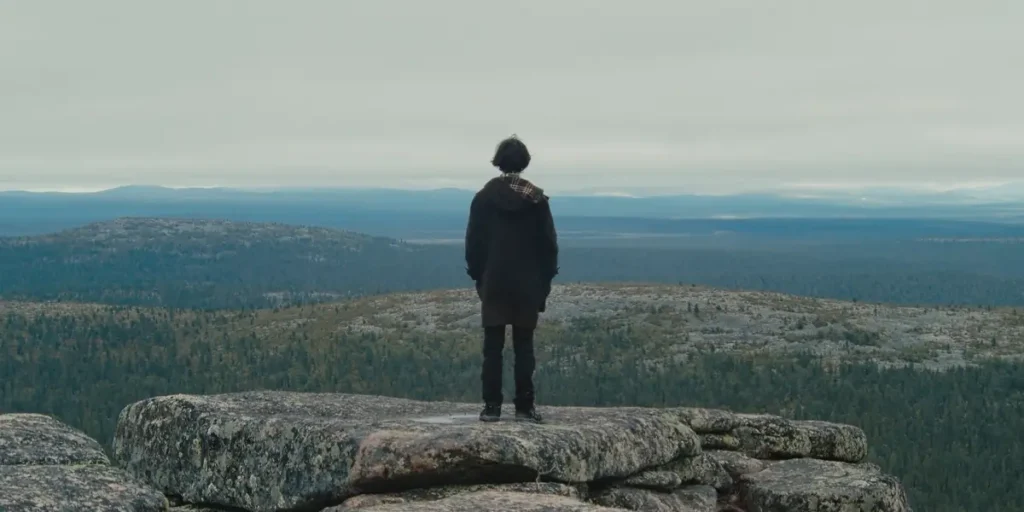
D is for Distance tells its story with a very individual style of filmmaking, mixing contemporary footage of the directors’ son epilepsy with archival footage of black and white and silent films, Louis’ art, the family’s trip to Finland, and third person narration. It sounds like a lot, and admittedly it is. At times, I wasn’t sure whether the film was trying to deliver a lesson in film history, desperately connect all these elements, educate the audience on Louis’ epilepsy, or simply function as a medium for Louis’ parents to come to terms with it all. Whatever the objective of this documentary was, it hardly succeeded. Its erratic style is hard to follow and can easily lose the audience after the opening scene. It also quickly becomes very repetitive in both its style and subject matter.
The documentary also hardly ever lets its subject speak at all. Louis is the one who suffers from these debilitating seizures, but we don’t hear his perspective or thoughts on the matter. While D is for Distance does feature his art in perhaps some of the most interesting sequences in the entire documentary, there seems to be no space for Louis to speak for himself. In many ways, this is not his story. Instead, it is the story of his parents’ struggles with his condition. This may be very close to the filmmakers but the latter point of view is sadly not as interesting as it could have been had it given space and voice to the main character of the documentary.
In many ways, D is for Distance feels too personal. On paper, there is nothing wrong with choosing a subject matter that is close to the filmmakers, if anything it would potentially help them make a poignant documentary given how involved they are with the main topic discussed. But in this case, the emotional connection seems to hinder the documentary more than anything else, as the directors lack the necessary distance that would have allowed them to narrate this story properly, without focusing on their own individual experience and pain caused by their son’s seizures.
Overall, the directors’ unique style of filmmaking and personal perspective over their son’s daily struggle is perhaps a little too involved and not effective. D is for Distance could have been a very interesting documentary had it focused on its actual subject matter rather than trying so hard to make everything work together. A little distance from its central topic could have also benefitted the story as the filmmakers are clearly very emotionally involved, perhaps too much to share this narrative effectively, without their own feelings clouding their judgement.
D Is For Distance: Movie Plot & Recap
Synopsis:
Through archival footage, cinema history, the subject’s own art, and documentary footage of his struggles, the film depicts Louis’s everyday battle with his memory-erasing epilepsy.
Pros:
- The film shines a light on a real-life struggle that is often not portrayed in the media.
Cons:
- The movie quickly becomes repetitive with its structure of voiceover, archival footage, and documentary scenes.
- It doesn’t really feature the subject matter’s voice at all and is too personal in its storytelling.
- The film tells us very little of its central topic and focuses, instead, on creating a unique style of filmmaking.
D Is For Distance will be released in UK and Irish cinemas on 3 April 2026 by BFI Distribution. A BFI Player release will follow on 11 May.