
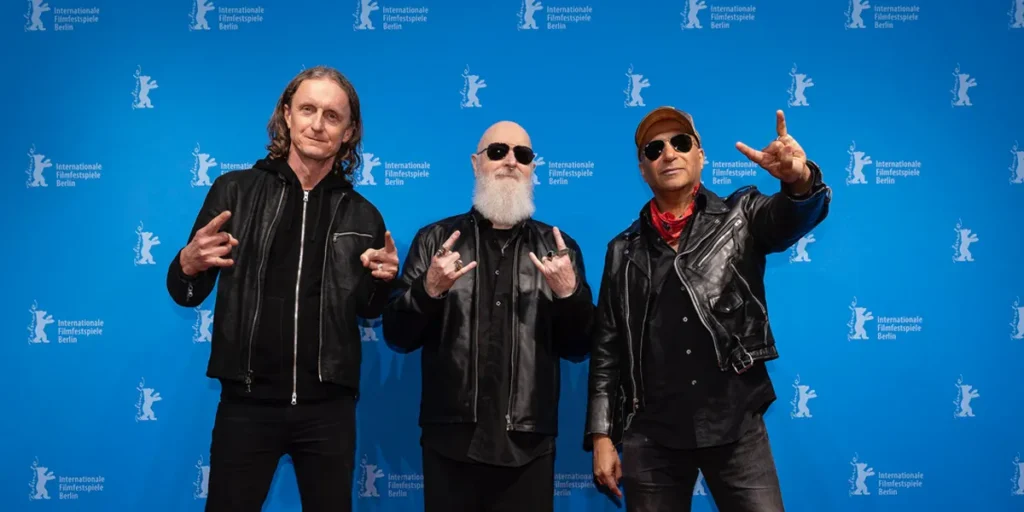
We interview directors Sam Dunn and Tom Morello about The Ballad of Judas Priest, which had its World Premiere at the 2026 Berlin Film Festival.
At the start of The Ballad of Judas Priest, Tom Morello explains that metal shows have always felt like a “musical home” to him, having played a huge part in shaping his identity. Those who have seen Sam Dunn‘s 2005 documentary Metal: A Headbanger’s Journey – where the then thirty-year-old filmmaker, a recent anthropology graduate, set off to explore the stereotypes associated with heavy metal – know that he shares similar feelings about a musical genre he’s loved since he was twelve. Together, Dunn and Morello feel like the perfect match to tell the story of Judas Priest, but the directors’ documentary is so much more than that.
The Ballad of Judas Priest chronicles the story of the band since its origin in England’s “Black Country”, but it also functions as an exploration of the genre as a whole. Looking at anything from vocalist Rob Halford’s struggle as a closeted gay man in heavy metal and the band’s trial during the 80s Satanic Panic to fan culture and the cultural impact of heavy metal, the movie works both as a Judas Priest doc and as a love song to the genre.
Featuring archival footage, live performances, and interviews with the band but also appearances from various well-known musicians and even a roundtable where Morello discusses the band with four very special ‘fans,’ The Ballad of Judas Priest is engaging from start to end. You’re guaranteed to leave the screening with a sense of attachment to both Judas Priest and the heavy metal family with whom you’ve just shared this beautiful journey.
After the World Premiere of the movie at the 2026 Berlin Film Festival, we sat down for an interview with directors Sam Dunn and Tom Morello. Read what they told us about Judas Priest, Rob Halford, the heavy metal community, the Rock & Roll Hall of Fame speech, the Berlinale screening, and more.
Sam Dunn and Tom Morello on Judas Priest Songs They Love
Thank you so much for this beautiful movie! You’ve both spoken a lot about how Judas Priest really influenced you both, not only musically but also in terms of your identity. Is there a specific song or moment that you remember fondly, from when you first discovered them?
Sam Dunn: To me, if we were to create an anthem for heavy metal music, it would be “The Hellion” [1982], which is the lead instrumental track on the album “Screaming for Vengeance,” because it’s just about the closest thing to a heavy metal symphony moment. This, to me, was always the ‘my hair is going up on my arms just talking about that song!’ track. I first heard it when I was about twelve years old, staring at the robot, futuristic bird dive-bombing on the cover of “Screaming for Vengeance”. Every time I hear that instrumental intro, and when I see it in the film on the stage of the US Festival… I just get the goosebumps. It’s the track that will be with me for forever.
Tom Morello: They’ve opened their show with that song since it came out in the ’80s. It’s a song which also resonates with my teenage boys: they love “The Hellion”, and they’ve learned to play it on guitar. For me, I would probably say the ‘back in the day’ song was “Breaking the Law“: that was really the one. It was that record, “British Steel”; that song appealed to my innate rebellious spirit. While a lot of heavy metal songs tended to be about either the devil or groupies, this was a song that felt like it was a protest anthem with a lot of great riffs.
Sam Dunn: It’s a great song to rob a bank too! [everyone laughs] Like in the video!
You’ve just released the first clip for the film, and the moment you chose to share was the “Breaking the Law” part. I think it’s so appropriate, as it’s such a key moment in the movie.
Is there a song that you’ve come to appreciate more now, after making the movie?
T.M.: For me, it would be “Sinner,” which I think is Jack Black’s favorite song: it’s a deeper catalog, and I was not as familiar with it. He made the pitch [for that song to be in the film] and it’s pretty great to have that. The movie finishes with it: it’s such a great song.
‘It’s So Much Deeper than That.’ – On the Community Judas Priest Formed, and Preconceived Notions of Metal
To me, this is a film of contrasts: between Rob Halford’s “angst and loneliness” as a closeted gay man – which he talks about in the film – and his stage persona; between how heavy metal is perceived and what it actually stands for; and I think, there’s a similar contrast within the fans too, as heavy metal is such a huge part of their identity.
When did you realise that the film was going to be as much about identity and community as it was about the band itself?
Sam Dunn: Well, right at the beginning. Judas Priest was the band that really created the idea of there being a heavy metal identity, a heavy metal look, a heavy metal attitude, a heavy metal tribe. They were the first ones to write songs about the music, and about the community. You wouldn’t have a song like “Hit the Lights” by Metallica, which is about the experience of being in a metal show with your fellow metal heads, without Judas Priest. They created that idea. We knew very early on that that was a really important part of that story because that’s been their main contribution to all music, I think.
Tom Morello: Yeah. Think of Judas Priest songs like “Defenders of the Faith“, which is explicitly about that idea. And then, the way that Rob would always talk to the fans in the show… A lot of bands would have self-aggrandizing things to say, but with Rob, it was always about this community that they forged, and then went beyond that band to the other metal bands that also followed in their wake, of ‘self-identifying’ as metal. That’s a thing that didn’t happen before. You had favorite bands before, but now it’s like, ‘This is the lane that I am in’. It was the lane that I was certainly in as a youth. Heavy metal is the music that made me love music. That’s why I owe that band a great debt.
S.D.: I think punk rock has always been the music that’s been associated with shattering the divide between the performers and the audience. But I actually think that with Judas Priest, they do have tremendous theatricality, tremendous bombast, and it’s a show, but what Rob Halford did was, he broke down that separation as well. ‘I am one of you. You are one of me, of us. We are here together because we love this music’. He created much more of an equal playing field concept, especially in the ’70s, when most bands were producing prog rock and wearing robes [both laugh], and writing songs that were fourteen minutes long, which were creating a lot of distance between the person in the audience and the band on stage. [Judas Priest] were like, ‘No, f*ck that. We’re all here together’. And that’s really a big contribution.
I love that you mentioned Metallica just now, because one of my favorite scenes in the movie is when Metallica’s Kirk Hammett says, when thinking of the Judas Priest trial, “Heavy metal is an easy target because of what it looks and feels like superficially,” and then starts to cry. You can feel how much this music means to so many people.
T.M.: Yes. And that’s something that people don’t know. There’s a preconceived notion about what metal is, what Judas Priest is, and what fans are. What this movie reveals, hopefully, to a new audience and to a new generation, is that it’s so much deeper than that. It’s so much more important than that.
S.D.: I love his line [Kirk Hammet] says: “It’s medicine”. And this is the guitar player of the biggest and most successful heavy metal band of all time. Kirk Hammet is a tremendously successful individual. And here he is, crying, talking about how the music of Judas Priest, and the music of heavy metal, is medicine.
T.M.: Yes! And to him today, not just historically. He’s like, ‘I need it’.
I was almost crying myself.
S.D.: It’s this level playing field that gets created through this music: even the most successful guitar player in the most successful rock band of all time, he needs it.
The Roundtable in The Ballad of Judas Priest
I really love the format of The Ballad of Judas Priest, from that genius opening scene with Jack Black to all the familiar people we see, and especially that roundtable. Tom, I heard it was your decision to include the roundtable and put yourself in it too?
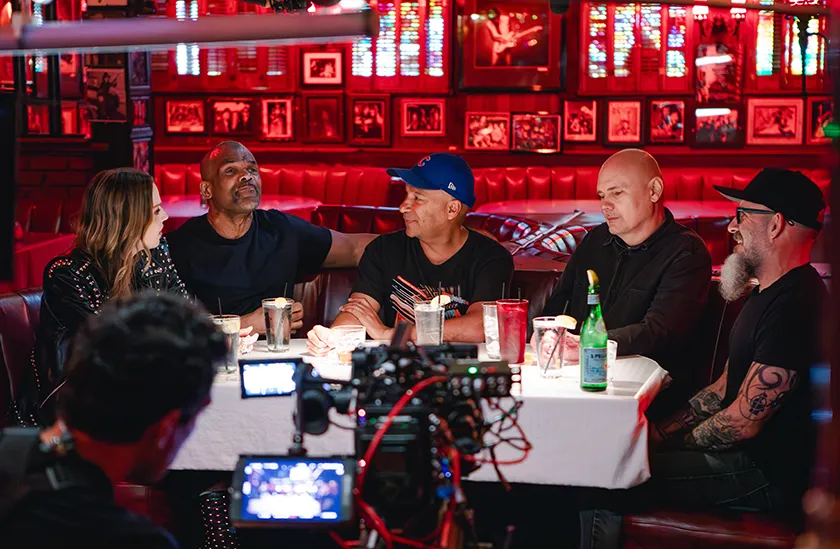
Tom Morello: Yeah, because the roundtable is something that happens when the cameras are off. You know what I mean? I regularly gather at the Rainbow – the historic rock and roll site on the Sunset Strip [in LA] – with friends to talk about our favorite bands, or some of our less favorite bands. We thought it would be an ideal way to demonstrate something that fans could very much relate to, because that’s what people do. You sit around, you talk about your favorite music with your friends. We just let people into these particular individuals, having that conversation in a totally unscripted way, as you would on any night at any bar talking with your friends about music. We let the cameras in to reveal the ‘tectonic plates’ that move beneath the surface of each of us with regards to Judas Priest.
Sam Dunn: From a filmmaking perspective, any documentary has a number of ingredients, and you have to decide what ingredients go in, what ingredients don’t go in, and what’s the balance between the ingredients. Documentary can often typically fall into an ‘archival clip, talking head, archival clip, talking head’ formula. I love the roundtable because it breaks that up a bit: it feels like you’re a fly on a wall of a conversation of a bunch of fairly successful musicians, just really being fans of the music. It has a humanizing element.
It really does feel like we, as an audience, are part of that conversation too. How did you decide who was going to take part in these roundtables?
T.M.: That’s a good question! We had a bit of a wish list, and we got most of them. [both laugh]
S.D.: We wanted a combination of people of different generations, different backgrounds, and coming from different music styles. You’ve got Darryl McDaniels from Run DMC, who is my favorite character in that roundtable, because he’s exactly who you wouldn’t expect to be talking passionately about heavy metal. But then you’ve got Scott Ian from Anthrax, who is directly cut from the cloth, as a young guy worshiping Judas Priest.
T.M.: I think in some ways, Scott Ian is the only person you might expect to be at that table. It’s a table of all Judas Priest fans, from Billy Corgan’s ‘Lollapalooza era intellectualism’ to Darryl McDaniels’ passion [about the band] – he’s ready to convert his sexuality based on the awesomeness of Rob Halford! [laughs] – to Lzzy [Hale, of Halestorm], who is speaking her truth as a LGBTQ person, and how important Rob Halford was to both the metal and her life.
Sam Dunn and Tom Morello on the Rock & Roll Hall of Fame Speech, and the Berlinale Screening of The Ballad of Judas Priest
It was such a great choice for you to feature Judas Priest’s 2022 induction at the Rock & Roll Hall of Fame; after the journey you’ve taken us on, it’s so beautiful to watch Rob’s acceptance speech. It comes across as such a big, moving moment.
When did you know you were going to feature this clip at the end?
Sam Dunn: When we wrote the pitch deck for this film, more years ago than I care to say out loud [smiles], that was the first thing: Rob Halford’s speech at the Rock & Roll Hall of Fame. It was one of about four or five pieces of the story that I knew needed to be in. It was the trial, it was Rob’s story of being a gay man in heavy metal, it was the “Breaking the Law” video and the political messaging, and it was also the ‘culture building’ – that this is a band that built the metal culture.
We knew the Rock & Roll Hall of Fame was going to be in there because the speech was so powerful: everyone talked about that speech after it happened. It was either going to be at the beginning or the end, because it was so good, but we realized it worked better at the end: as you were saying, it kind of became the summary statement for everything that you had just seen. It couldn’t have been anywhere else.
The Ballad of Judas Priest has just had its World Premiere here at the Berlinale. What was that screening like? Did anything surprise you about people’s reaction to the film?
Tom Morello: All the reactions to the screening. It was great to watch it in a room of a thousand fans! I guess, many of them Judas Priest fans, and some strangers to the band as well. We’ve only seen it in screening rooms, or on an iPad, before, and… It’s a much funnier movie [than I though it was, by watching it without an audience]! I was laughing out loud at Jack [Black] and at Rob, and…
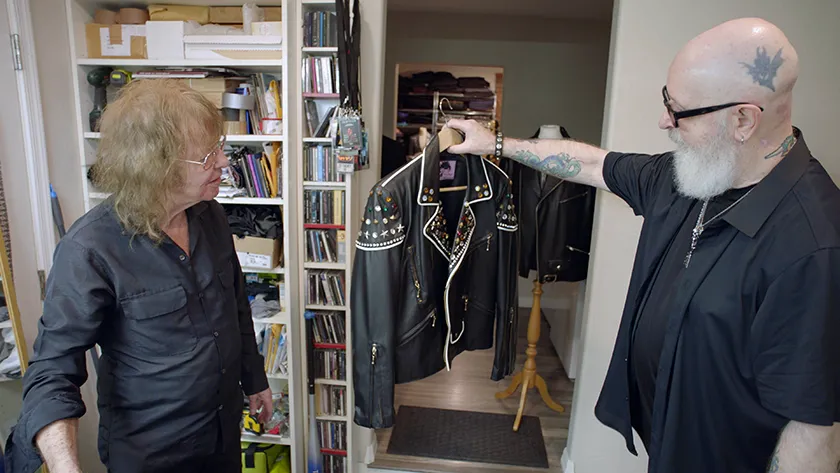
S.D.: … The Spinal Tap jacket!
T.M.: Also, it delivers the goods, as a fan of Judas Priest; to see it with other fans, almost in a concert-like setting, with the music cranked like that, it felt like a powerful rock concert as well as this exploration of a band’s history and meaning.
S.D.: Yeah, we kept turning it up!
As you should!
T.M.: During the screening, we kept going like…
S.D.: “It’s not loud enough”.
T.M.: We were like, “Crank that!” [everyone laughs]
I love this! Thank you so much for speaking with us!
This interview was edited for length and clarity.
The Ballad of Judas Priest is currently being screened at the Berlin Film Festival, where it premiered on February 15, 2026. Read our Berlin Film Festival reviews!
Header credits: Sam Dunn, Rob Halford and Tom Morello at the Berlin Film Festival photocall for The Ballad of Judas Priest on February 15, 2026 (Richard Hübner, Courtesy of the Berlinale)