
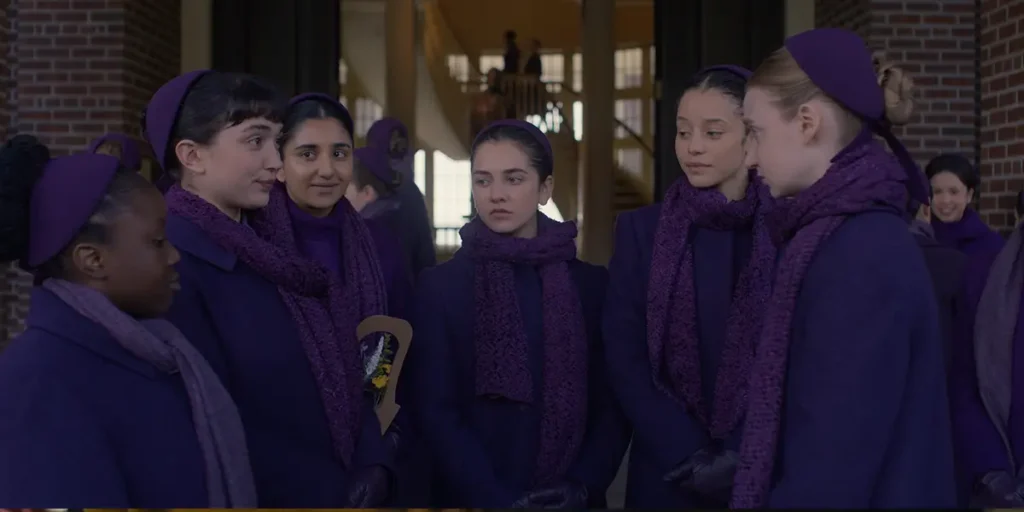
Bruce Miller returns to Gilead in The Testaments, in a series that examines what life is like for the girls who have grown up in this dystopia.
Creator: Bruce Miller
Genre: Drama, Thriller
Number of Episodes: 10, released weekly
Rated: TV-MA
Release Date: April 8, 2026
Where to Watch: Hulu (U.S.) and Disney+ (U.K. and globally)
I had conflicted feelings about The Testaments when I read Margaret Atwood’s novel in 2019, and they continue with the Bruce Miller follow-up to The Handmaid’s Tale coming to Hulu. This return to Gilead, 15 years after the events of the previous series, feels like it has learned some lessons from its predecessor, but balancing the tone of a dystopian story, especially one involving younger characters, still feels out of reach, making this a mixed bag.
Gilead was hurt by the rebellion, but was not toppled. The school for girls that Aunt Lydia (Ann Dowd, of Mass) founded is still going strong. The older girls in the school are Plums, young women being trained to become wives and mothers as they await their periods. Among this group is Agnes (Chase Infiniti, of One Battle After Another), the daughter of a prominent Commander. Her stepmother, Paula (Amy Seimetz), seems anxious to get her married off, so the wait for the onset of menses, signaling fertility, is a very urgent concern.
One of the things that The Testaments nails is both the friendship between these girls and the rivalries that also happen. In addition to the Plums, there are the Pearl Girls – young women who have been recruited from difficult situations to join Gilead. The Pearl Girl that we follow most closely is Daisy (Lucy Halliday, of California Schemin’), a girl who came from Toronto. She is tasked with following Agnes, who is a few years older than her, and who is a model Plum. The Pearl Girls are “lesser” than the Plums, so there can be a desire to advance, adding tension where none would necessarily exist. But throughout the season, we see the girls help one another as well.
Because the characters in The Testaments are younger than they were in The Handmaid’s Tale, the emotional whiplash sometimes feels more pronounced. The way that the girls are celebrated when they get their period is genuinely lovely, because there is something special about that moment that is often ignored in modern society. But there is a darkness along with that, because it is also a sign of fertility, meaning that the girls are now headed into marriage. And because the Plums are from the most prestigious families, they are married to the most prestigious Commanders, which often means men far too old for them.
Because of the fertility crisis in the world of The Testaments, these aren’t children (we’re never given their exact ages, but they seem to be primarily in their late teens/early twenties), but they are significantly younger than their potential marriage partners. Still, these are girls who have grown up in Gilead, so they have almost no education and are shielded from nearly all knowledge. In one episode, we see a sex education class, which includes no information beyond a crudely drawn picture of a uterus, explaining that they are now able to reproduce.
While we seldom see things that are quite as violent as they were in The Handmaid’s Tale, they almost feel worse here, because of the age and naivete of the girls. This is amplified by the score, which moves quickly between a bubbly, bouncy vibe into dark and mysterious sound. It can feel jarring at times, sometimes to the detriment of the show. The Testaments is a tough watch, not because it is more violent than what came before, but because that violence is enacted on girls. As the world grapples with the Epstein files, this series feels even darker.
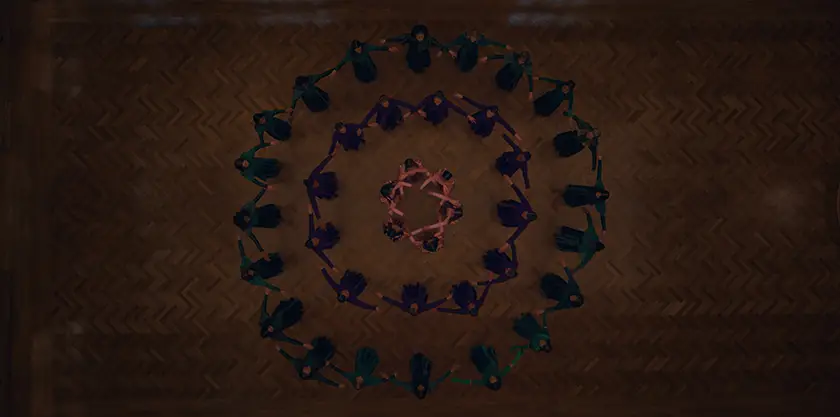
The costumes and choreography are once again exceptional. There are numerous truly beautiful scenes. At one point, the girls who are moving from Plums to Greens (what happens after you get your period) have a tea party to impress the Aunts and gain favor for better matches. The filming is absolutely gorgeous, but the pageantry shows the underlying darkness brilliantly.
The performances in The Testaments likewise show this uneasy balance between girlhood and womanhood. Infiniti, in particular, has to perform both a very adult role and a very childish one, and she does a fantastic job pulling that off. There is a bit more nuance in Halliday’s role that I can’t speak to due to spoilers, but the way the cast works within the story is genuinely impressive.
Still, a series based on a novel that was based on a series that was based on a novel starts to feel a bit thin. It has more than a whiff of cash grab to it that feels like it undercuts the message that it’s trying to send about the nature of Christian nationalism and the worst-case scenarios presented. Nevertheless, if you are a fan of Atwood’s novels and of The Handmaid’s Tale series, there is likely enough good here in The Testaments to keep your attention.
The Testaments (Hulu) Series Plot & Recap
Synopsis:
The story takes place 15 years after the events of The Handmaid’s Tale, as we follow the girls of Gilead as they become women and must get married off, as well as the resistance to the regime.
Pros:
- Excellent, nuanced performances
- Beautiful set and costume design, as well as fantastic choreography
- Timely insights into Christian nationalism
Cons:
- The tonal shifts can sometimes feel too jarring
- The entire story feels a little like a cash grab, undermining the messaging
- Because the victims are younger, the abuses can feel more intense
The three-episode series premiere of The Testaments will be available to stream on Hulu (U.S.) and on Disney+ (U.K. and globally) from April 8, 2026. The remaining episodes will be released weekly, with the finale airing on May 27.